
 English
 Español
 Français
 Deutsch
 Polski
 Nederlands
Volumetric Concrete for Bridge Decks: A Practical Guide for DOT and Infrastructure Work

Volumetric concrete mixers are the standard equipment for many bridge deck overlay and repair projects because they produce fresh concrete on-site, ondemand, mixed to exact specification, and stop when the work stops. Bridge deck work involves tight lane closure windows, strict DOT specifications, demanding curing requirements, and the need to coordinate concrete production with rebar placement, deck preparation, and traffic management. Volumetric mixers fit this work because they eliminate the timing risk and waste of ready-mix delivery while meeting the accuracy and documentation requirements that DOT and federal projects demand.
Why Volumetric Mixers Fit Bridge Deck Work
Bridge deck overlay and repair work is a specific category of concrete project with constraints that ready-mix delivery struggles to meet. Volumetric mixers are not just an alternative to ready-mix on this work; for many bridge projects they are the preferred or even required equipment.
Lane closure windows are short and unforgiving
Most bridge deck overlay work happens during scheduled lane closures, often overnight or during weekend windows. These windows are tight, and the project schedule depends on concrete arriving when needed and stopping when needed. A ready-mix delivery that arrives 30 minutes late or 10 cubic yards short can blow a closure window. A volumetric mixer on-site produces concrete continuously as the deck work progresses, eliminating delivery timing risk.
Mix specifications are exacting
DOT bridge deck specifications often require precise water-to-cement ratios, specific admixture dosages, and tight control over the concrete’s rheology for proper placement on the deck surface. Volumetric mixers allow adjustment of the mix on the truck, in real time, as conditions change throughout the pour. A ready-mix delivery brings a fixed batch; if the mix is wrong for the conditions on arrival, options are limited.
Wasted concrete is expensive and environmentally problematic
Bridge deck projects often involve smaller pours that do not match ready-mix truck capacity well. A 7-yard pour from a 10-yard ready-mix truck leaves 3 yards of returned-load concrete, with the disposal cost and environmental impact that entails. Volumetric mixers produce only what is needed, with no returned-load fees or disposal waste.
Documentation and DOT acceptance
Volumetric mixers calibrated per ASTM C685 / C685M produce concrete with documented accuracy that meets DOT acceptance criteria for most federal and state bridge work. The calibration certificate, the on-truck batching records, and the digital ticketing that modern volumetric units produce all support the documentation requirements that bridge projects demand.
Materials Used in Bridge Deck Overlays
Bridge deck overlays use several specialized concrete materials, each designed for specific durability, bonding, and traffic-restoration characteristics. Understanding the material options helps in spec interpretation and equipment selection.
Latex modified concrete (LMC)
Latex modified concrete is one of the most common materials specified for bridge deck overlays. The latex polymer additive improves bond strength to the existing deck substrate, increases tensile and flexural strength, and reduces permeability to chlorides and water. LMC is widely specified by state DOTs and the FHWA for deck rehabilitation work. Our complete guide to latex modified concrete covers the material in depth.
Silica fume and high-performance concrete
Silica fume concrete (often abbreviated as SFC) and other high-performance mixes use supplementary cementitious materials to achieve higher strength, lower permeability, and improved durability. These mixes are often specified for bridges in aggressive environments (de-icing salt exposure, marine conditions, freeze-thaw cycling). Volumetric mixers handle these specialty mixes well because the materials can be metered precisely on-truck.
Polymer-modified concrete (beyond latex)
ACI 548 provides guidelines for polymer-modified concretes used in repair and overlay applications. Beyond LMC, other polymer modifiers (epoxy-modified, styrene-butadiene latex variants, and others) are used in specific bridge applications. The choice depends on the project specification, the substrate condition, and the expected traffic and exposure environment.
Rapid-set and accelerated mixes
When traffic restoration windows are extremely short (some interstate bridge work demands lane reopening within 6 to 12 hours of pour completion), rapid-set concrete mixes are specified. Calcium sulfoaluminate cements and accelerated portland-based mixes achieve early strength gain that allows traffic to return faster. Volumetric mixers are particularly well-suited to these mixes because the materials must be combined just before placement to avoid premature setting.
Planning a Bridge Deck Overlay Project
Successful bridge deck overlay work depends as much on planning as on execution. The pour itself is often the simplest part; the preparation, sequencing, and traffic management are where projects succeed or fail.
Project specifications and DOT requirements
Before any equipment shows up to the site, the contractor needs a clear read on the project specification: the required concrete mix design, the strength requirements (28-day and any early-strength criteria), the curing requirements, the documentation expected for DOT acceptance, and any specific equipment certifications required. Different state DOTs have different requirements, and FHWA-funded projects often layer federal requirements on top of state specs.
Lane closure planning
The lane closure window dictates everything else about the project. The window has to accommodate deck preparation (milling, hydrodemolition, or other removal), rebar inspection and tie-down, formwork or edge preparation, the concrete pour itself, initial curing or evaporation control, and the strength gain required before traffic restoration. Tight windows leave no margin for delivery delays, which is one of the main reasons volumetric mixers are specified for time-sensitive bridge work.
Deck preparation and substrate condition
The bond between the new overlay and the existing deck depends on the substrate being properly prepared. Hydrodemolition (high-pressure water removal) is commonly used to remove deteriorated concrete down to sound substrate without damaging the underlying structure. Scarifying and shot-blasting are also used. The deck must be clean, sound, and properly conditioned before the overlay material is placed.
Curing and traffic restoration
Bridge deck overlays require careful curing to achieve their specified strength and bond performance. Wet curing with burlap and continuous moisture is common for LMC and many silica fume mixes. Curing duration varies by material and specification but often runs 24 to 72 hours minimum before traffic can be restored. Rapid-set mixes shorten this window significantly but at higher material cost and tighter execution requirements.
Equipment Considerations for Bridge Deck Work
Not every volumetric mixer is equally suited to bridge deck work. The specific application has equipment considerations worth understanding before bidding or buying for this work. Calibration documentation. For DOT acceptance, the mixer needs a current calibration certificate per ASTM C685. Some projects require recalibration at specific intervals. Confirm the calibration requirements before mobilization.
Mix flexibility. Bridge deck specifications can require non-standard mix designs including polymer additives, specialty cements, fiber reinforcement, or admixture combinations that need precise metering. The mixer’s ability to accommodate these specifications matters.
Continuous production capacity. Larger bridge deck pours benefit from mixers with sustained production capacity rather than batch-style equipment. The ability to maintain a continuous pour without stoppages matters for deck surface finish and bond performance.
Documentation and ticketing systems. Modern volumetric mixers can generate detailed batching records and digital tickets that satisfy DOT documentation requirements. For federal projects, the documentation can be as important as the concrete itself.
Operator training and certification. Some bridge projects require certified operators or specific training on the mixer being used. Confirm any operator certification requirements as part of project bidding.
Common Challenges on Bridge Deck Projects
Even with proper planning, bridge deck overlay projects come with recurring challenges. Knowing what to expect lets contractors and project managers prepare for these scenarios.
Weather and ambient conditions
Concrete placement and curing performance depend on ambient temperature, humidity, and wind. Bridge decks are particularly exposed to wind and direct sun, which accelerate moisture loss from the fresh concrete surface. Evaporation rate calculators (ACI 305 covers hot-weather concreting practices) help contractors decide when to pour and when conditions are too aggressive for quality work.
Substrate variability
Bridge decks often have variable substrate condition. Some areas have sound concrete; others have delamination, corrosion, or contamination from chloride exposure. The pour plan needs to accommodate substrate variability, and the contractor needs to be prepared to communicate substrate issues to the project engineer if they exceed what was assumed in the design.
Traffic management coordination
Bridge deck work depends on coordinated traffic management with state or local DOT traffic operations. Schedule changes, weather delays, and unexpected substrate issues can require last-minute traffic plan adjustments. Strong communication with traffic operations is part of running a successful bridge project, not just an administrative formality.
Documentation under pressure
When work is moving fast under a tight closure window, the documentation required for DOT acceptance can feel like a burden. But missing or incomplete records can result in rejected work, retesting requirements, or payment disputes. Building a documentation discipline into the work flow, not handling it as an afterthought, is what separates contractors who do bridge work routinely from those who try it occasionally.

Why use volumetric concrete for bridge decks?
Bridge deck work involves tight lane closure windows, exact mix specifications, and demanding
DOT documentation requirements. Volumetric mixers produce fresh concrete on-site to exact
specifications, eliminate returned-load waste, and meet ASTM C685 calibration standards required for
DOT acceptance. The combination of timing flexibility, mix precision, and documentation makes
volumetric the standard for many bridge deck overlay projects.
What concrete is used for bridge deck overlays?
Common materials include latex modified concrete (LMC), silica fume concrete, polymer-modified
concrete per ACI 548 guidelines, and rapid-set mixes for short traffic restoration windows. The choice
depends on the project specification, the substrate condition, and the expected traffic and exposure
environment. Latex modified concrete is the most widely specified material for bridge deck
rehabilitation.
Do bridge deck projects require DOT certification?
Most state and federal bridge projects require DOT-certified equipment and ASTM C685
calibration documentation for volumetric mixers. The specific requirements vary by state DOT and
project type. For FHWA-funded work, federal documentation requirements layer on top of state specs.
Confirm certification requirements as part of project bidding to avoid mobilization problems.
How long does a bridge deck overlay take to cure?
Curing duration depends on the concrete material and the specification. Latex modified concrete
and silica fume mixes typically require 24 to 72 hours of moist curing before traffic restoration.
Rapid-set mixes designed for short closure windows can allow traffic restoration in 6 to 12 hours, but
require tighter execution and higher material cost.
What ASTM standards apply to volumetric mixers for bridge work?
ASTM C685 / C685M is the standard specification for concrete made by volumetric batching and
continuous mixing. It governs the accuracy requirements that volumetric mixers must meet for most
public-works applications including bridge deck work. DOT acceptance typically requires calibration
certificates verifying compliance with this standard.
Next Steps
- Learn about DOT certification: Cemen Tech’s DOT certification information covers the certification process and documentation for state and federal bridge work.
- See the equipment lineup: Cemen Tech’s volumetric mixer lineup includes units sized and configured for DOT and infrastructure work.
- Talk to a representative: For specific calibration questions or service scheduling, contact a Cemen Tech rep for a no-pressure conversation.
Volumetric Mixer Parts: What Wears, What Lasts, and What to Stock

Volumetric mixer parts fall into three categories: high-wear items that replace regularly (belt and chain drive components, auger flighting, hose fittings), consumables that get replaced on schedule (filters, fluids, gaskets, seals), and structural components that rarely fail but are expensive when they do (hydraulic cylinders, mixing system components, electronic controls). Experienced owners stock the high-wear items, schedule the consumables, and rely on dealer support for the rare structural failures. The right parts strategy balances inventory cost against the downtime risk of waiting for parts when something breaks.
The Three Categories of Volumetric Mixer Parts
Understanding parts by category helps owner-operators think about stocking strategy, vendor relationships, and budget. Each category has different replacement patterns and different consequences when the part is needed but not available.
High-wear items
High-wear items are the parts that contact the materials being moved or that experience constant friction during normal operation. These include belt and chain drive components on the materials handling system, auger flighting that contacts cement and aggregate, discharge chute liners and wear plates, hose fittings and connections, water meter components in regular use, and bearings on rotating equipment.
These parts have predictable failure patterns based on operating hours and the abrasiveness of the materials being mixed. Operators running coarser aggregates or higher production volumes see faster wear than operators running fine-aggregate, lower-volume work. Tracking actual wear in your operation lets you predict replacement intervals and stock accordingly
Consumables
Consumables are parts replaced on schedule rather than at failure. Engine oil and filters, hydraulic fluid and filters, air filters, fuel filters, gaskets at routine service points, and seals that get replaced during teardowns all fall in this category. The manufacturer’s service manual specifies the schedule for each consumable, and following the schedule is one of the cheapest ways to extend equipment life.
Consumables are predictable in cost and timing, which makes them easy to budget. Most operators handle consumables through a service relationship that includes the consumable cost in periodic service visits, rather than ordering each item separately.
Structural and electronic components
Structural and electronic components rarely fail in normal operation but are expensive when they do. Hydraulic cylinders, hydraulic pumps and motors, mixing system gearboxes, electronic control modules, displays, and major electrical harnesses fall in this category. Many of these parts have replacement intervals measured in years or full equipment overhauls rather than ongoing operating cycles.
When a structural or electronic component does fail, the repair is typically dealer-level work using OEM parts. Owner-operators rarely stock these items because the inventory cost is high, the failure rate is low, and the diagnosis and replacement require dealer expertise anyway.
What Drives Parts Wear
Two mixers in the same fleet running the same hours can have very different parts wear patterns. Knowing the wear drivers helps you predict what your operation will actually need.
Aggregate hardness and gradation
Harder aggregates and aggregates with higher fines content accelerate wear on materials handling components. Operators running quartzite, granite, or other hard aggregates see faster wear than operators running softer limestone or natural river gravel. Gradations heavy in fines wear differently than coarser gradations because of how the materials flow through the handling system.
Production volume and operating intensity
Mixers running high daily production wear faster per calendar month than mixers running lower volume. Hour-based wear tracking is more useful than calendar-based tracking for high-utilization equipment. A mixer running 2,000 hours per year will need parts attention more frequently than one running 600 hours per year, even though both are “the same age.”
Material handling practices
How materials are loaded into the mixer affects wear. Materials that arrive consistent in moisture, gradation, and cleanliness produce predictable wear. Materials that arrive variable (wet aggregates, contamination, off-spec gradations) produce uneven wear and sometimes accelerated failures. Material handling discipline on the supply side reduces parts costs on the equipment side.
Operator practices
Operator skill affects wear. Operators who start and stop the system gradually, run at appropriate setpoints, and follow proper warmup and shutdown procedures see less wear than operators who run equipment harder. Training and experience pay back in extended parts life, which is one of the often-overlooked benefits of investing in operator development.
OEM vs Aftermarket Parts
Most volumetric mixer parts are available from the original equipment manufacturer (OEM) and from aftermarket suppliers. The decision between OEM and aftermarket has trade-offs worth understanding before you build your parts strategy.
OEM parts
OEM parts are the components the equipment manufacturer specifies and supplies, either directly or through authorized dealers. For Cemen Tech equipment, OEM parts through the Cemen Tech parts network are the safest path for ensuring fit, performance, and warranty coverage.
OEM advantages: guaranteed fit and performance, warranty coverage that may be voided by aftermarket use, supplier accountability if there is a parts problem, integration with manufacturer service procedures, and proper documentation for any project work that requires OEM-only specifications.
OEM trade-offs: typically, higher cost than aftermarket equivalents, sometimes longer lead times for less common parts, dependent on the manufacturer’s parts inventory and supply chain.
Aftermarket parts
Aftermarket parts are components made by third-party suppliers that fit the equipment but are not manufactured or specified by the original equipment manufacturer. They cover the full range from high-quality alternatives to low-quality knockoffs.
Aftermarket advantages: often lower cost than OEM, sometimes faster availability through general parts distributors, sometimes the only option for older equipment where OEM parts are no longer manufactured.
Aftermarket trade-offs: fit and performance not guaranteed, may void manufacturer warranty, no supplier accountability if parts fail, may not be acceptable for project work requiring OEM-only specs, quality varies wildly between aftermarket suppliers.
When OEM is the clear choice
For high-value structural components, electronic controls, calibration-affecting parts, anything still under warranty, project work requiring documented OEM parts, and any situation where a parts failure could trigger expensive secondary damage, OEM is almost always the right choice. The premium pays back through reliability and accountability.
When aftermarket can make sense
For routine consumables (filters, fluids) where the aftermarket is a mature commodity market, generic wear items where multiple quality suppliers compete, and emergency replacements when OEM is unavailable in the time required, aftermarket can be a reasonable choice. The key is sourcing from reputable suppliers, not the cheapest option.
Building Your Parts Stocking Strategy
Most owner-operators settle into a parts strategy over time by trial and error. Thinking through the strategy deliberately saves money on inventory and reduces downtime when something breaks.
Stock high-wear items based on your actual wear data
Track which high-wear items you actually replace and how often. After a year or two of operation, you have meaningful wear data specific to your operation. Stock enough of the most-frequently-replaced items to avoid downtime, but don’t stock years’ worth of items that may sit on the shelf. The right inventory level is enough to bridge typical replacement intervals plus reasonable lead time from your supplier.
Schedule consumables through your service relationship
Consumables are usually best handled through a scheduled service relationship rather than self-inventory. Service Plus and similar service programs include consumables in periodic service visits, which spreads the cost evenly across the year and ensures the right parts are used at the right intervals. Self-inventorying consumables saves a small amount of cost but creates inventory management work that often is not worth it for small operations.
Do not stock structural and electronic components
The inventory cost of structural and electronic components is too high relative to their failure rate for self-stocking to make sense. When these parts fail, the response is to call dealer service, who can typically expedite the parts from the manufacturer or regional inventory. Stocking these parts ties up substantial capital in items that may sit for years.
Build relationships with your parts suppliers
A good relationship with your parts supplier matters more than which specific supplier you use. Suppliers who know your equipment, your operation, and your typical needs respond faster when something is urgent, may stock items just for you, and can advise on substitutes when the standard part is unavailable. For most owner-operators, the parts supplier is the manufacturer parts network or an authorized dealer.
Getting Parts Fast When You Need Them
Equipment downtime is expensive. Beyond stocking strategy, the speed of getting parts when you need them affects your operation’s real cost of any failure. A few practical considerations.
Know your supplier’s typical lead time. Different parts have different lead times. Routine wear items may ship same-day or next-day from a well-stocked dealer. Specialty components may take a week or longer. Understanding the typical lead times for your operation helps you size your stocked inventory appropriately.
Establish account terms before you need them. Opening a parts account, establishing credit terms, and being a known customer to your supplier all speed up the response when something is urgent. Calling for parts as a brand-new customer slows things down.
Understand expedited shipping options. Many parts can be air-shipped or expedited for an additional fee. For high-value downtime situations, the expedited shipping cost is far less than the lost productivity of waiting on standard delivery. Know what is possible before you need it.
Keep records of part numbers and specifications. When you need a part fast, having the exact part number and specifications saves the time of looking them up under pressure. Build a parts reference file for your equipment as part of your records.
What parts wear out fastest on a volumetric concrete mixer?
High-wear items include belt and chain drive components, auger flighting that contacts cement
and aggregate, discharge chute liners, hose fittings, water meter components, and bearings on
rotating equipment. Wear rate depends on operating hours, aggregate hardness, production intensity,
and operator practices. Tracking actual wear in your operation helps predict replacement intervals.
Should I use OEM or aftermarket parts for my volumetric mixer?
OEM parts are the safer choice for structural components, electronic controls, calibration-affecting
parts, equipment under warranty, and project work requiring documented OEM specs. Aftermarket can
make sense for routine consumables and generic wear items from reputable suppliers. The premium
for OEM usually pays back through reliability, warranty coverage, and accountability.
What volumetric mixer parts should I stock?
Stock high-wear items based on your actual replacement data (typically belt and chain
components, auger flighting wear sections, common hose fittings, and bearings). Skip stocking
consumables (handle through scheduled service) and structural/electronic components (call dealer
service when needed). Stock enough to bridge typical replacement intervals plus reasonable lead
time.
How long do volumetric mixer parts last?
Lifespan depends on the part category and operating conditions. High-wear items may need
replacement several times per year in heavy-use operations. Consumables follow scheduled intervals
(typically every few hundred operating hours). Structural and electronic components often last the
equipment’s full useful life. Tracking your specific operation’s wear patterns is the only way to predict
accurately.
Where can I buy volumetric mixer parts?
Manufacturer parts networks and authorized dealers are the safest source for OEM parts that
match your equipment. Cemen Tech’s parts network supports Cemen Tech equipment owners with
documented OEM parts, dealer-level expertise, and integration with the broader service support
network. Independent suppliers can serve as alternatives for routine consumables.
Next Steps
- Order parts for Cemen Tech equipment: Cemen Tech parts assistance provides documented OEM parts delivered fast through the parts network.
- Combine parts with service: Service Plus includes consumables as part of scheduled service visits, simplifying parts management.
- Find a local dealer: The dealer support network includes certified parts and service support in your region.
- Talk to a representative: For specific calibration questions or service scheduling, contact a Cemen Tech rep for a no-pressure conversation.
The True Cost of Returned-Load Concrete (And What to Do About It)

Returned-load concrete costs contractors far more than the obvious return fees ready-mix suppliers charge. The true cost includes five categories: the return and disposal fees themselves, the lost margin on concrete you paid for but did not use, the crew time wasted waiting for or managing the returned load, the environmental and regulatory compliance costs, and the indirect impact on customer relationships and project schedules. Most contractors significantly underestimate their actual returned-load cost because they only count the visible fees. Modeling the full cost reveals why eliminating returned-load waste is one of the highest-return operational changes available to concrete contractors.
Why Returned-Load Cost Is Almost Always Underestimated
Most contractors think of returned-load cost as the disposal fee they pay the ready-mix supplier. The number on the invoice is real, but it represents only a portion of the actual cost. When you map all the cost categories that returned-load waste actually creates, the total is typically several times the visible fees.
The visible cost is just the surface
Return fees from the ready-mix supplier are the obvious cost. The supplier charges for the unused concrete, the disposal, and sometimes a per-yard handling fee. These charges appear on the invoice and get tracked. But they are only one of five cost categories that returned loads create.
Most cost categories never appear on an invoice
Crew time waiting for or managing the return, the lost margin on concrete you paid for but did not place, environmental compliance burdens, and customer relationship impacts all create real costs that never show up as a line item on a bill. The contractor pays them through reduced productivity, lost opportunity, and operational friction, but the costs are diffuse rather than concentrated. This is why they get missed in cost analysis.
The mismatch problem is structural
Ready-mix trucks deliver in fixed batch sizes (typically 8-10 yards). Many pours are smaller than the batch size or larger than a single batch but smaller than two. Either situation produces returned-load waste: oversized batches leave excess; undersized batches require extra trucks. The structural mismatch between fixed delivery sizes and variable pour requirements is the root cause of returned-load waste.
Volumetric mixers eliminate the mismatch
Volumetric concrete mixers produce concrete on-site in exactly the amount needed for each pour. There is no fixed batch size, so there is no mismatch between delivery and demand, so there is no returned-load waste. This is one of the largest single operational advantages of volumetric mixing over ready-mix, and one of the easiest to model in financial terms.
The Five Cost Categories of Returned-Load Concrete
Each cost category has its own drivers and its own measurement approach. Mapping all five for your operation reveals the true cost.
-
Return and disposal fees
- The most visible cost. Ready-mix suppliers charge for unused concrete that returns to the plant, often combining a per-yard charge with a flat disposal fee. The specific rates vary by supplier and region, and some suppliers waive fees for small returns while charging heavily for larger returns. Track your actual invoice charges over a representative period to know your baseline.
-
Lost margin on unused concrete
- When you order 10 yards and use 8, you paid for 2 yards of concrete plus delivery that produced no revenue. This lost margin is often larger than the return fee itself, especially for contractors who pour at higher margins. If your concrete margin is 20 percent and you waste 2 yards on a pour, the lost margin is 20 percent of 2 yards of revenue you could have earned if the concrete had been used productively.
-
Crew time and productivity impact
- Returned-load situations consume crew time in several ways: waiting for the second ready-mix truck on undersized deliveries, coordinating the return on oversized deliveries, managing the placement schedule around delivery timing, and the productivity drag of crew sitting idle while the concrete situation gets resolved. Loaded crew labor rates (including taxes, insurance, benefits) make this category larger than most contractors realize. Multiply your loaded labor rate by the actual hours lost to returned-load situations to estimate this cost.
-
Environmental compliance and disposal burden
- Returned concrete that does not get reused in another pour or returned to the supplier becomes a disposal problem. Environmental regulations vary by jurisdiction but generally require concrete waste to be disposed of properly, which has both direct cost (disposal fees) and indirect cost (regulatory compliance work, environmental impact assessments for larger operations). EPA and state environmental rules treat concrete waste as a regulated material, and noncompliance creates real exposure for the contractor.
-
Customer relationship and project schedule impact
- When returned-load issues delay pours, customers notice. Project schedules slip, follow-on work gets pushed back, and the contractor’s reputation for reliability takes small hits with each incident. Over time, this affects repeat business and referrals. The cost is hard to quantify in any single incident but real over a year of operation. Contractors who track their customer satisfaction and repeat business rates see the impact even when individual events are too small to measure.
Calculating Your Actual Returned-Load Cost
Most contractors do not know their actual returned-load cost because they have not modeled it. Working through the math for your operation reveals whether returned-load waste is a minor inefficiency or a major cost center.
Step 1: Establish your returned-load rate
Look at your last 6 to 12 months of concrete invoices. Calculate the percentage of total yards delivered that were returned-load yards. Some contractors have very low rates (under 2 percent) because their work mix matches truck sizes well. Others have substantially higher rates (5 percent or more) because their work involves many small pours or irregular sizing. Knowing your actual rate is the foundation of the math.
Step 2: Sum the direct fees
Pull the returned-load fees from your invoices for the same period. This is the visible cost. Divide by total yards delivered to get a per-yard returned-load fee equivalent. Now you know what category 1 (return and disposal fees) costs you per yard of concrete delivered.
Step 3: Estimate the indirect costs
Category 2 (lost margin) equals your typical concrete margin multiplied by returned yards. Category 3 (crew time) equals loaded labor rate multiplied by typical lost hours per returned-load incident, multiplied by number of incidents. Categories 4 and 5 are harder to estimate precisely but can be approximated through disposal fees and a reasonable assumption about customer impact. Sum all five to get your true cost.
Step 4: Compare against the volumetric alternative
The savings from eliminating returned-load waste is one of the major financial drivers for switching from ready-mix to volumetric. Cemen Tech’s concrete savings calculator models this comparison specifically. Feed in your actual operation data and see what the financial impact of eliminating returned-load waste would be. The calculator handles the math; you provide the operational reality.
Strategies for Reducing Returned-Load Waste (Without Switching to
Volumetric)
Not every contractor is ready to switch to volumetric mixing immediately. For contractors continuing with ready-mix supply, several strategies can reduce returned-load waste even within the structural mismatch problem.
Better order sizing
Many returned-load situations come from contractors ordering more than they need to avoid running short. The mindset is rational (running short costs more than over-ordering), but the over-ordering compounds over many pours. Order sizing closer to actual needs requires accepting some risk of running short, which is uncomfortable but financially better for many operations. Tracking your actual versus ordered yards over time reveals how much over-ordering you are doing.
Better pour planning
Pour plans that combine multiple work areas into a single delivery, schedule deliveries closer to placement readiness, and account for actual pour volume rather than form capacity can all reduce returned-load incidents. Pour planning discipline takes time but pays back through reduced waste.
Supplier relationship and pricing structure
Some ready-mix suppliers offer better returned-load terms (lower fees, waived charges for small returns, partial credits for unused concrete). Negotiating these terms can reduce the visible category 1 cost even when the underlying waste continues. Suppliers compete for contractor business; better terms are available to operations that ask for them.
Communication with the placement crew
Communication between dispatch, the truck driver, and the placement crew can catch over-ordering situations before they become returned loads. If the placement crew realizes mid-pour that less concrete is needed than ordered, communicating quickly to dispatch can sometimes redirect the remaining concrete to another job before it becomes returned-load waste.
Volumetric Mixing: The Structural Solution
The strategies in the previous section help reduce returned-load waste but cannot eliminate it because they do not solve the structural mismatch problem. Volumetric mixing solves the problem structurally by producing concrete on-site in the exact amount needed.
How volumetric eliminates the mismatch
A volumetric mixer carries raw materials (cement, aggregate, water, admixtures) separately and produces concrete on demand at the placement site. The production rate matches the placement rate. The total volume produced matches the actual placement need, not a pre-determined batch size. When the placement is finished, production stops. There is no batch left over, no return trip to a plant, no disposal fee.
What this means for the cost model
All five returned-load cost categories drop to zero for the work performed with the volumetric mixer. No return fees because nothing returns. No lost margin because nothing was paid for that was not used. Minimal crew waiting time because production matches placement. No environmental disposal burden because no waste is created. No customer schedule impact from delivery timing problems. The structural elimination of returned-load waste is one of the major drivers of the financial case for volumetric.
Honest caveat: volumetric has its own cost structure
Volumetric mixing is not free. The equipment has higher upfront cost than a typical ready-mix truck. Operating costs are real (fuel, labor, maintenance, materials handling). The financial comparison is not “ready-mix cost minus returned-load cost vs zero” – it is “ready-mix all-in cost vs volumetric all-in cost.” Volumetric usually wins for contractors with significant returned-load waste, but the comparison should be done honestly with full cost data on both sides.
Where volumetric wins biggest on returned-load economics
Contractors who serve many small pours (residential, repair work, scattered job sites) see the biggest returned-load economics from switching to volumetric because the mismatch problem is largest for their work. Contractors with large, predictable pours that match ready-mix truck sizes well see smaller returned-load economics because their existing waste is lower to begin with. Knowing your work mix helps predict where you fall on this spectrum.
Environmental Considerations
Returned-load concrete has environmental impact beyond the contractor’s direct cost. Awareness of this dimension is growing among customers, regulators, and the industry generally.
Concrete waste is a significant industry-wide issue. The concrete industry produces substantial waste annually through returned loads and over-ordering. This waste consumes water, cement (which has a substantial carbon footprint), aggregate, and energy that produced no productive use. Industry-wide initiatives are working to reduce this waste through better practices and technology adoption.
Customer awareness of environmental impact is growing. More construction customers, especially institutional and government buyers, are evaluating contractors on sustainability practices. Contractors who can document low returned-load waste have a marketing story that increasingly matters in competitive bidding.
Regulatory framework is tightening. EPA guidelines and state environmental rules around concrete waste have generally trended toward stricter compliance over time. Contractors with high returned-load waste face increasing administrative burden and potential cost increases as regulatory frameworks evolve.
Volumetric mixing supports sustainability claims. Operations that eliminate returned-load waste through volumetric mixing can document the environmental benefit credibly. For bids, marketing, and customer relationships where sustainability matters, this is a real competitive advantage beyond the direct financial impact.
What is the true cost of returned-load concrete?
The true cost includes five categories: return and disposal fees, lost margin on unused concrete,
crew time and productivity impact, environmental compliance burden, and customer relationship
impact. Most contractors only count the visible return fees, which understates the actual cost
significantly. Modeling all five categories typically reveals a total cost several times higher than the
visible fees.
How do I calculate my returned-load cost?
Start with your actual returned-load rate as a percentage of total yards delivered. Sum your visible
return fees from invoices. Estimate lost margin (concrete margin times returned yards), crew time
impact (loaded labor rate times lost hours), environmental disposal costs, and customer impact. The
total across all five categories is your true cost. Cemen Tech’s savings calculator can model this for
your specific operation.
Can returned-load waste be eliminated without volumetric mixing?
Not entirely. Returned-load waste comes from the structural mismatch between fixed ready-mix
batch sizes and variable pour requirements. Better order sizing, pour planning, and supplier
relationships can reduce waste, but the structural problem remains as long as concrete arrives in fixed
batches. Volumetric mixing eliminates the mismatch by producing concrete on-site in exactly the
amount needed.
How much can contractors save by eliminating returned-load waste?
Savings vary widely based on returned-load rate, concrete margin, labor rates, and operation size.
Contractors with high returned-load rates and significant small-pour work see the largest savings.
Contractors with low returned-load rates see smaller savings. Cemen Tech’s savings calculator helps
model the specific impact for your operation based on your actual data.
What are the environmental impacts of returned-load concrete?
Returned-load concrete represents wasted cement (which has substantial carbon footprint),
aggregate, water, and energy that produced no productive use. EPA and state environmental rules
treat concrete waste as regulated material. As sustainability becomes more important to customers
and regulators, contractors with low returned-load waste have both compliance advantages and
marketing differentiators.
Next Steps
- Calculate your savings: Use Cemen Tech’s concrete savings calculator to model the actual financial impact of eliminating returned-load waste for your specific operation.
- Explore equipment options: Cemen Tech’s volumetric mixer lineup covers compact, mid-range, and large mixers for different operation types.
- Talk to a representative: For specific calibration questions or service scheduling, contact a Cemen Tech rep for a no-pressure conversation.
Fleet Management for Volumetric Concrete Mixer Operations

Volumetric concrete mixer fleet management combines software for tracking equipment, jobs, and performance with the operational practices that turn data into better decisions. Effective fleet management covers four areas: dispatch and scheduling (matching mixers to jobs efficiently), utilization tracking (knowing what each unit produces), and performance analysis (identifying what works and what does not). The right tool stack for your operation depends on fleet size, but the underlying practices apply whether you run one mixer or 20.
Whether You Run One Mixer or 20…
Some may think a single-mixer operation can be managed in someone’s head. Sure, the owner may know where the mixer is, what it is producing, when it was serviced, and what the next job needs. But Accu-Pour can provide essential data tracking to business owners, whether they have one mixer, or many. Not only can business owners schedule and have easy access to data reports, but Accu-Pour also allows access to things like quotes, digital batch tickets, invoices, and payments. As an operation grows and more mixers enter the operation, Accu-Pour allows business owners to easily track their volumetric fleet and the supporting data.
setting up for growth
Even with one mixer, being able to learn and establish data in Accu-Pour will make it easier when adding to your fleet in the future. With multiple mixers, and no software, scheduling can become a coordination problem: which mixer goes where, why, and what happens if a job runs long? The decisions still need to be made, but they cannot be made on the fly the same way. Multi-mixer operations need systems that support coordination, not just rely on memory.
Information has to flow between the field and the office
Single-mixer operators live in the field most of the time. Multi-mixer operations have to coordinate field operations from a central point, which means information has to flow back and forth: dispatch instructions out, completion confirmations in, materials needs reported, problems escalated. Without good information flow, the fleet operates in fragments rather than as a coordinated unit.
Standardization matters more than personal preference
Single operators do things their own way and it works. Multi-mixer operations need standardized procedures because the work has to be consistent across operators, equipment, and jobs. Standardization is not about removing operator judgment; it is about creating a common foundation so the team can work effectively.
Maintenance becomes a fleet-level discipline
With one mixer, maintenance is a calendar task. With multiple mixers, maintenance has to be coordinated across the fleet to avoid having multiple units down simultaneously. The fleet-level coordination needs systems that track maintenance status across all units and schedule service to balance availability with maintenance discipline.
The Four Areas of Fleet Management
Effective fleet management addresses four interconnected areas. Each area has practices that work and tools that support them. The right approach for your operation depends on fleet size, but the four areas apply universally.
Area 1: Dispatch and scheduling
Dispatch is the daily decision of which mixer goes to which job and when. Effective dispatch matches the right equipment to the right job (size, capability, distance), coordinates start times with customer requirements and adjusts in real time when schedules shift.
Software tools track unit availability, job requirements, and the assignment that ties them together. Without software, dispatchers rely on whiteboards, spreadsheets, and phone calls, which work until they do not. The point where manual dispatch breaks down varies by operation, but it usually arrives somewhere between 3 and 5 active mixers.
Area 2: Utilization tracking
Utilization tracking answers a simple question: what does each mixer produce, and what does it cost to produce it? Per-mixer profitability is often very different across units in the same fleet, and the reasons may be operator skill, equipment age, job mix, or geographic territory. Without tracking, the differences hide. With tracking, the fleet can focus on what works and fix what does not.
Useful utilization data includes hours operated, cubic yards produced, revenue earned, and direct costs incurred, all per-mixer and per-time-period. Comparing the units against each other reveals patterns. Comparing the fleet against itself over time reveals trends.
Area 3: Maintenance coordination
Fleet maintenance has to keep equipment running while spreading the work so the fleet stays productive. Sequencing maintenance across the fleet, tracking service history per unit, coordinating with service providers, and managing parts inventory across multiple units all require fleet-level discipline. The maintenance system for one mixer (a log book and the manufacturer’s schedule) does not scale.
Area 4: Performance analysis
Performance analysis turns raw data into decisions. Which jobs are most profitable? Which operators produce the best results? Which equipment configurations work best in your operation? Where is the fleet underperforming and why? Good performance analysis identifies the questions worth asking and provides the data to answer them.
Most operations underuse the performance data they already have. The discipline is asking better questions, not just collecting more data. A weekly review of fleet performance against a few key metrics is more useful than a daily flood of detail that no one reads.
Accu-Pour™: Fleet Management Software for Volumetric Operations
Software that fits your operation makes fleet management practical. Generic fleet software designed for trucks does not fit volumetric mixing operations well because it does not understand concrete production, mix designs, materials handling, or the specific reporting that DOT and project work requires. Software designed specifically for volumetric mixing fits the work natively. Cemen Tech’s Accu-Pour™ fleet management software is built for volumetric concrete operations.
What volumetric-specific software handles that generic software does not
Mix design tracking and accountability across the fleet, production volume reporting per unit, materials consumption and batch-level documentation that supports DOT and project work, and integration with the metering systems that select volumetric mixers (C-series and MS2), actually use. Generic fleet software may track location and hours but misses the volumetric-specific data that matters to the work.
How software fits with operational practices
Software is a tool, not a substitute for management. The best software in an operation without disciplined practices produces dashboards no one acts on. Disciplined practices without software produce coordination that fails as the fleet grows. The combination of fit-for-purpose software with disciplined operational practices is what produces effective fleet management.
When aftermarket can make sense
For routine consumables (filters, fluids) where the aftermarket is a mature commodity market, generic wear items where multiple quality suppliers compete, and emergency replacements when OEM is unavailable in the time required, aftermarket can be a reasonable choice. The key is sourcing from reputable suppliers, not the cheapest option.
When to invest in fleet software
Operations with 2-3 mixers can often manage on spreadsheets and whiteboards if the team is disciplined. Operations with 4+ mixers usually benefit from purpose-built software. Operations with 8+ mixers find that software has stopped being optional and become essential. The break point varies by complexity, geographic spread, and the diversity of the work being done.
Building a Fleet from One Mixer
For owner-operators considering a second mixer, the decision is part business case and part operational readiness. Understanding both dimensions before the second unit arrives prevents the most common transition problems.
The business case for a second mixer
A second mixer makes business sense when the existing mixer is consistently at capacity, when there is demonstrable demand the existing mixer cannot meet, and when the operation has the financial capacity to absorb the additional fixed costs (financing, insurance, the operator). Adding capacity ahead of demand usually creates carrying costs without revenue. Adding capacity behind demand misses opportunities but is less financially risky.
Operational readiness for multi-mixer operation
Before adding the second mixer, the operation needs to be ready to coordinate two units: standardized procedures, basic tracking systems for dispatch and utilization, a maintenance log that scales to multiple units, and ideally an experienced operator who can teach the new operator. Going from 1 to 2 mixers is a much bigger operational change than going from 5 to 6, because it is the first time the informal management approach has to evolve.
The first operator is critical
The second operator is the single most important hire in the transition to multi-mixer operations. They need to be technically competent, work well with the owner, and ideally be capable of becoming a future supervisor or trainer. Hiring the wrong second operator can stall the operation’s growth for years.
Avoiding the “two single-mixer operations” trap
A common failure mode is running the second mixer as a separate single-mixer operation rather than integrating it into a coordinated fleet. The two mixers compete for the same jobs, share no information, and the owner ends up running two operations rather than one larger one. Building the coordination infrastructure from the start prevents this trap, even when the second mixer is just one additional unit.
Real-World Example: Bauman Landscape Construction
Some operations have built substantial volumetric mixer fleets to serve specific market opportunities. Bauman Landscape Construction is an example: they built a large volumetric mixer fleet specifically for public works and parks projects, leveraging the fleet to serve high-volume government contracts that would be difficult to handle with single-mixer operations. The Bauman case study covers how they thought about the fleet build, the coordination challenges they faced, and the market opportunities the fleet opened up.
Lessons that transfer to smaller fleets
Even operations that will never reach Bauman’s scale can apply the principles their case demonstrates: specializing the fleet around specific high-value markets, building coordination systems before they are desperately needed, investing in operator development across the fleet, and using fleet capability as a competitive advantage rather than just adding capacity. These principles apply at 5 mixers as much as at 25.
Common Fleet Management Mistakes
Several recurring mistakes show up in multi-mixer operations. Knowing them in advance helps you avoid them as you scale.
Growing the fleet faster than the systems can support
Some operations add mixers based on demand without building the coordination infrastructure to support them. Each new mixer adds revenue but also adds complexity, and the complexity grows non-linearly. Operations that grow without investing in systems eventually hit a wall where the additional mixers create more chaos than revenue.
Treating mixers as interchangeable
Different mixers have different capabilities, different operators, and different track records. Treating them as interchangeable units misses the actual variation across the fleet. Effective fleet management tracks the per-unit reality, including the strengths and weaknesses of each mixer-operator combination, and makes dispatch decisions accordingly.
Underinvesting in fleet supervision
Multi-mixer operations need someone whose job is to manage the fleet, even if it is not full-time. The owner who tries to run their own mixer AND coordinate the fleet usually ends up doing both jobs badly. At some point the operation needs a dispatcher, operations manager, or fleet coordinator. The right time to make this hire is usually 1-2 mixers before it feels necessary.
Ignoring per-unit profitability
Operations that track fleet-level profitability without breaking it down per unit may miss the fact that one or two mixers are dragging down the average. Per-unit profitability analysis reveals which units, operators, or job types are pulling their weight and which are not. Without this analysis, underperforming units hide in the average.
What is concrete mixer fleet management?
Fleet management for volumetric concrete mixer operations combines software (for dispatch,
utilization tracking, and reporting) with operational practices (standardized procedures, coordination
systems, and per-unit performance analysis). It covers four areas: dispatch and scheduling, utilization
tracking, maintenance coordination, and performance analysis. The discipline scales from small
multi-mixer operations to large fleets.
When do I need fleet management software?
Operations with 2-3 mixers can often manage on spreadsheets and whiteboards. Operations with
4+ mixers usually benefit from purpose-built software like Accu-Pour™. Operations with 8+ mixers find
software essential rather than optional. The right time to invest depends on fleet size, complexity,
geographic spread, and how much your team is spending on coordination work that software could
handle.
How is volumetric mixer fleet software different from generic fleet software?
Generic fleet software tracks location, hours, and basic vehicle data. Volumetric-specific software
like Accu-Pour™ also handles mix design tracking, production volume per unit, materials consumption,
batch-level documentation for DOT and project work, calibration tracking, and integration with the
metering systems volumetric mixers actually use. The volumetric-specific data is what matters to the
work.
How do I decide whether to add a second mixer?
A second mixer makes business sense when your existing mixer is consistently at capacity,
demand exceeds what the existing unit can serve, and your operation has financial capacity to absorb
the fixed costs. Operational readiness matters too: standardized procedures, basic tracking systems,
and ideally a qualified second operator should be in place before the second mixer arrives.
What is the biggest fleet management mistake?
Growing the fleet faster than the coordination systems can support is the most common mistake.
Each additional mixer adds non-linear complexity, and operations that scale revenue without scaling
systems eventually hit a wall. Investing in coordination infrastructure (software, supervision,
standardized procedures) before it feels desperately necessary is the right discipline for sustainable
growth.
Next Steps
- Explore fleet management software: Accu-Pour™ is purpose-built for volumetric concrete mixer fleet operations.
- Read the Bauman Landscape story: See how Bauman Landscape Construction built a volumetric mixer fleet for public works and parks projects.
- See the equipment lineup: For operations scaling to multiple mixers, the full equipment lineup includes mobile and stationary units across different capacity ranges
- Talk to a representative: For specific calibration questions or service scheduling, contact a Cemen Tech rep for a no-pressure conversation.
Gunite, Shotcrete, and Conventional Concrete: How They Compare

Gunite, shotcrete, and conventional concrete are three different approaches to placing concrete, each suited to specific applications. Gunite is dry-mix shotcrete, where dry materials are conveyed pneumatically and water is added at the nozzle just before placement. Shotcrete (wet-mix) is concrete that has already been mixed with water and is then pneumatically sprayed onto the surface. Conventional concrete is mixed and placed by traditional methods (chute, pump, bucket) for structural elements. The right choice depends on the application: ground stabilization and rock support favor gunite, swimming pools and structural lining favor wet-mix shotcrete, and most structural concrete work favors conventional placement.
What Is Gunite?
Gunite is the older of the two pneumatic concrete placement methods, developed in the early 1900s. The term has stuck in the industry even as the technology evolved. In modern usage, gunite specifically refers to the dry-mix process: dry cement, sand, and aggregate are conveyed through a hose under air pressure, water is added at the nozzle, and the wet mixture is sprayed onto the surface at high velocity.
How the dry-mix process works
A gunite machine (sometimes called a gun) feeds the dry mix into a pressurized hose. Compressed air carries the dry materials through the hose to the nozzle, where a separate water line meets the dry stream just before the nozzle tip. The nozzleman controls the water flow rate to achieve the right consistency for placement. The mixture is then sprayed onto the target surface.
Where gunite fits best
Gunite works well for swimming pool shells (where it has been the traditional choice for decades), rock face stabilization and tunnel support, slope stabilization, repair of damaged structures, and any application where the placement surface is vertical or overhead and the concrete has to bond to the substrate. The nozzleman has significant control over consistency, allowing real-time adjustment for
site conditions.
The Cemen Tech G30X for gunite work
Cemen Tech’s G30X gunite mixer is built specifically for gunite operations, supplying the dry-mix material that gunite work requires. For contractors running pool installations, rock support, or slope stabilization, dedicated gunite equipment matters because the production has to keep pace with the gunite gun’s throughput.
What Is Shotcrete?
Shotcrete is the wet-mix counterpart to gunite. The term technically covers both dry and wet pneumatic concrete placement under modern ACI definitions, but in practice “shotcrete” usually refers to the wet-mix process specifically. ACI 506 provides the comprehensive standards for shotcrete placement.
How the wet-mix process works
In wet-mix shotcrete, concrete is mixed conventionally (in a transit mixer, central batch plant, or volumetric mixer) and then pumped through a hose to the nozzle. At the nozzle, compressed air accelerates the wet concrete and sprays it onto the placement surface at high velocity. The result is similar in appearance to gunite but with different mix design and operational characteristics.
Where shotcrete fits best
Wet-mix shotcrete works well for larger volume applications where consistent mix design matters more than nozzle-level water control: large-scale tunnel lining (final structural lining rather than initial ground support), structural shell construction for tanks and silos, pool work where the pool size justifies wet-mix production, and overhead slab work where a pneumatic application is preferred over conventional formwork and pour.
Where volumetric mixers supply wet-mix shotcrete
Wet-mix shotcrete needs concrete supply, and volumetric mixers fit that role well. For shotcrete contractors who need concrete produced on-site (where ready-mix is not practical or where the mix has to be adjusted in real time), a volumetric mixer feeding the shotcrete pump provides flexible, on-demand supply. This is one of the ways volumetric mixing supports shotcrete operations.
What Is Conventional Concrete Placement?
Conventional concrete placement covers everything that is not pneumatically sprayed: pouring concrete by chute from a mixer truck, pumping concrete through a hose to the placement point, placing concrete by bucket (for areas a truck cannot reach), and screeding or troweling the placed concrete to final finish.
Where conventional placement fits
The vast majority of structural concrete work uses conventional placement. Foundations, slabs, walls, columns, beams, and most building construction relies on conventional methods. Conventional placement allows higher slump concrete to flow into forms, accommodates traditional finishing methods, and integrates with standard construction sequences.
How volumetric mixers fit conventional placement
Volumetric concrete mixers are well suited to conventional placement applications. The mixer produces fresh concrete on-site to exact specifications, and the concrete is then placed by the usual methods (chute, pump, bucket, screed). Cemen Tech’s lineup of volumetric mixers, including the CD2 computerized mixer and other models, serves this work across residential, commercial, and infrastructure applications.
Side-by-Side: When to Use Each Method
The choice between gunite, shotcrete, and conventional placement depends on the specific application, not on which method is “best” in the abstract. Each fits different work.
Surface orientation matters
Horizontal placement (slabs, foundations, pavement) almost always uses conventional methods. Concrete flows and self-levels into the form or onto the surface, then finishers shape it. Vertical or overhead placement (walls, tunnel linings, pool shells, slope faces, rock stabilization) often uses gunite or shotcrete. The pneumatic placement bonds to vertical surfaces in ways that conventional placement cannot match.
Production volume affects the choice
Small-volume vertical work (pool shells, repair patches, ground support) often favors gunite because the dry-mix process can start and stop easily and the nozzleman controls consistency in real time. Larger vertical projects (large tunnel lining sections, big pool projects, structural shells) often favor wet-mix shotcrete because the consistent mix design and higher production rate matter more than nozzle-level control.
Substrate and bond requirements
Pneumatic placement (both gunite and shotcrete) achieves better bond to existing substrates than conventional placement. The high-velocity application drives the material into the surface, creating mechanical interlock that conventional placement cannot match. For repair work, structural overlays on vertical surfaces, and any application where bond performance is critical, pneumatic placement is often specified.
Crew skill and equipment availability
Gunite and shotcrete require specialized crews and equipment. A skilled nozzleman is essential for either pneumatic method, and that skill is harder to find than general concrete labor. Conventional placement uses widely available skills and equipment. For contractors weighing the methods, crew availability and equipment investment are real factors alongside the technical fit.
Mix Design Differences
The three methods use different mix designs because the placement process imposes different constraints on the concrete.
Gunite mix design
Gunite uses a dry blend of cement, sand, and small aggregate (usually 3/8 inch or smaller). The mix has to flow through the dry hose without segregating, then accept water at the nozzle and bond cleanly to the placement surface. The water-cement ratio is controlled by the nozzleman in real time, not specified in a batched mix. ACI 506 provides specifications for the dry components.
Wet-mix shotcrete design
Wet-mix shotcrete uses a flowable concrete mix designed to pump through the placement hose and spray cleanly at the nozzle. Aggregate is typically smaller than conventional concrete (commonly 3/8 inch maximum) to avoid clogging. Admixtures often include accelerators (to control set time once placed) and air entrainment (for freeze-thaw resistance where applicable). ACI 506 covers the mix design requirements.
Conventional concrete design
Conventional concrete uses the full range of mix designs from low-slump structural concrete to high-slump self-consolidating concrete. Aggregate can be larger (3/4 inch or larger), the water-cement ratio is fixed at the mix stage, and the placement method does not impose pneumatic-specific constraints. ACI 318 governs the structural concrete design framework.
What is the difference between gunite and shotcrete?
Gunite is the dry-mix pneumatic process: dry materials conveyed through a hose, water added at
the nozzle. Shotcrete (in common usage) refers to the wet-mix process: concrete mixed first, then
pumped and pneumatically sprayed. Both are sometimes called shotcrete under modern ACI
definitions, but the dry-mix and wet-mix processes are operationally distinct.
When should I use gunite vs conventional concrete?
Use gunite for vertical or overhead placement where bond to the substrate matters: swimming
pool shells, rock face stabilization, slope work, and similar applications. Use conventional concrete for
horizontal placement (slabs, foundations, pavement) and most structural elements. The choice is
about placement geometry and bond requirements, not which is “better” in general.
Can a volumetric mixer be used for shotcrete?
Yes. Volumetric mixers can supply wet-mix shotcrete operations by producing concrete on-site
that feeds a shotcrete pump. The mixer’s ability to adjust the mix design in real time fits the on-site
nature of shotcrete work. For shotcrete contractors who need flexible, on-demand concrete supply,
volumetric mixing is a strong fit.
Which ACI standards apply to gunite and shotcrete?
ACI 506 is the comprehensive standard for shotcrete placement, covering both dry-mix (gunite)
and wet-mix processes. It addresses mix design, equipment, application techniques, and quality
control. ACI 318 covers structural concrete design including elements that may be placed via
shotcrete. The two standards work together for shotcrete structural applications.
Is a dedicated gunite mixer different from a regular volumetric mixer?
Yes. Dedicated gunite mixers like the Cemen Tech G30X are configured specifically for dry-mix
gunite supply, with the production rate, material handling, and dispensing optimized for gunite
operations. Conventional volumetric mixers supply wet concrete (for conventional placement or
wet-mix shotcrete). Contractors running significant gunite work benefit from dedicated equipment.
Next Steps
- For gunite work: See Cemen Tech’s G30X gunite mixer built specifically for dry-mix gunite operations.
- For conventional concrete and wet-mix shotcrete: See the CD2 computerized mixer and the full equipment lineup.
- Talk to a representative: For specific calibration questions or service scheduling, contact a Cemen Tech rep for a no-pressure conversation.
Volumetric Mixer Calibration Explained: What It Is, When You Need It, and Who Performs It

Volumetric mixer calibration is the process of verifying that the mixer produces concrete at the rate, proportion, and accuracy specified by ASTM C685 / C685M, the industry standard for volumetric batching and continuous mixing. Calibration matters because out-of-calibration mixers produce concrete that may not meet design specifications, which can fail DOT acceptance, project quality control, and structural performance requirements. Calibration is performed by qualified service technicians using yield tests, material verification, and metering system checks. Most operators have their mixers calibrated annually, after major repairs, or when project specifications require recent calibration documentation.
What Calibration Means for a Volumetric Mixer
Volumetric mixers produce concrete by metering individual materials (cement, aggregate, water, admixtures) into a continuous mixing process. Calibration is the verification that each metering system delivers materials at the rate and proportion the mixer claims. When a mixer is in calibration, the concrete coming out matches the mix design dialed in at the control panel. When a mixer is out of calibration, the actual mix can differ from the intended mix in ways that affect strength, durability, workability, and yield.
WHAT ASTM C685 specifies
ASTM C685 / C685M is the comprehensive standard for concrete made by volumetric batching and continuous mixing. It establishes the accuracy requirements for the metering systems, the procedures for verifying accuracy, and the documentation that supports calibrated operation. For most public-works and DOT applications, ASTM C685 calibration is required and the calibration certificate is part of the documentation submitted with the work.
The components calibration verifies
Calibration verification typically covers cement metering rate and accuracy, aggregate metering for each aggregate bin, water metering accuracy and the water-cement ratio control, admixture dispenser accuracy across the range of admixtures used, and the production rate of the complete system. Each component has tolerance specifications that the calibration test verifies. If any component falls outside tolerance, that component is adjusted and re-verified until it meets the standard.
Yield tests as the foundation of calibration
A yield test measures the actual volume of concrete produced relative to the input materials and the mix design specification. The test is performed by producing a known batch, collecting and measuring the concrete output, and comparing the measured yield to the calculated yield. Yield within the ASTM C685 tolerance confirms the metering systems are performing as expected. Yield outside tolerance triggers adjustment and re-verification.
When Calibration Is Required
Calibration is not a one-time event. Mixers drift out of calibration over time due to component wear, material handling variations, environmental conditions, and component replacements. Knowing when calibration is required prevents both regulatory problems and unexpected mix quality issues.
Annual or periodic recalibration
Most manufacturers and service organizations recommend annual calibration verification for mixers in regular service. Some operations recalibrate every 6 months for high-utilization equipment or operations producing concrete for sensitive applications. The exact interval depends on the equipment’s age, operating hours, and the criticality of the work being produced.
After major repairs or component replacements
Any service that affects the metering systems requires recalibration of those systems before returning to production. Cement metering belt replacements, aggregate gate repairs, water meter replacements, and admixture pump replacements all change the system’s metering characteristics. Even when the replacement matches the original specification exactly, the new component’s actual performance has to be verified.
When project specifications require it
Many DOT contracts, federal projects, and large commercial projects require calibration documentation dated within a specific recent period (often 6 to 12 months). When you bid such work, the calibration documentation is part of the qualification package. Mixers that have not been calibrated within the required window cannot be used on the project until current calibration is performed and documented.
When mix design issues appear
Unexplained mix quality problems (cylinders testing low for strength, segregation, workability issues) sometimes trace back to calibration drift. When troubleshooting mix problems, calibration verification is one of the first checks. If the mixer is producing concrete that does not match the specified mix design, the metering systems are a likely culprit.
Who Performs Calibration
Volumetric mixer calibration is performed by qualified service technicians at startup, and recalibration is offered as a service by Cemen Tech. The procedures, equipment, and judgment required to verify calibration accurately go beyond what most owner-operators typically have on hand. However, some owner-operators may have the knowledge and expertise needed to perform calibration successfully on their own. Understanding who performs calibration can help you plan for service appropriately.
Manufacturer service technicians
Manufacturer service technicians are typically the most qualified to calibrate the specific equipment they support. They have access to manufacturer-specific procedures, calibration data for the model, and any model-specific tolerances or adjustments. For Cemen Tech equipment, Service Plus and the broader service support network include calibration services as part of the support offering.
Authorized dealer technicians
Dealer service networks often include certified technicians trained on the specific equipment they sell. For owner-operators, the nearest authorized dealer is often the practical first call for calibration service, especially for equipment under warranty or with active service agreements.
Independent qualified technicians
Some equipment owners use independent service technicians for calibration, particularly for older equipment or where dealer support is limited. The technician should be qualified per ASTM C685 procedures and able to produce documentation acceptable to the relevant DOT or project authority. Not all “independent” calibrators meet this standard, so vetting matters.
Self-calibration by the operator (limited scope)
Some routine checks (water meter verification using known volumes, basic yield tests against expected output) can be performed by operators as part of regular pre-operation checks. These are not substitutes for formal ASTM C685 calibration, but they serve as early warning indicators of drift. When self-checks suggest a problem, calling a qualified technician is the right next step rather than attempting full calibration in the field.
What Happens During a Calibration Check
Understanding what calibration involves helps owner-operators plan around service visits and budget appropriately. The specifics vary by equipment and technician, but the general workflow follows a consistent pattern.
Pre-calibration inspection
Before any calibration verification, the technician inspects the equipment’s general condition: belt and chain drive condition, hydraulic system health, electrical and control system function, and any wear or damage that might affect the metering systems. Calibration of equipment with underlying mechanical problems is wasted effort because the calibration will drift quickly.
Material verification
Calibration uses the specific materials the operator runs in normal production: the cement, aggregate, and admixtures from the operator’s suppliers. The materials are characterized (bulk density, gradation, moisture content, admixture concentration) so the calibration tests reflect actual operating conditions, not generic assumptions.
Metering system testing
Each metering system is tested individually. The technician operates the system at a known setpoint, collects and measures the actual delivery, and compares it to the expected delivery per the ASTM C685 tolerance. Components outside tolerance are adjusted (mechanical adjustment of gates, calibration adjustment of digital controls, replacement of worn components) and re-tested until within tolerance.
Yield test verification
After individual metering systems are verified, the complete system is tested with a yield test. A known batch is produced, the concrete output is measured, and the yield is compared to the calculated yield from the mix design. Yield within tolerance confirms the system as a whole is producing concrete to specification.
Documentation and certification
The technician produces a calibration certificate documenting the equipment identity, the date and location of the calibration, the materials used in testing, the test results across all metering systems, the yield test results, and any adjustments made. This certificate is the document submitted with DOT and project work to verify calibrated operation.
Calibration Documentation for Project Work
For most public-works applications, the calibration certificate is just as important as the concrete itself. Understanding what the certificate should contain and how to use it prevents project documentation problems.
What the certificate should include: equipment identification (make, model, serial number), calibration date and location, technician identification and credentials, materials used during calibration, test results for each metering system with tolerance compliance noted, yield test results, any adjustments performed, and the certifying technician’s signature.
How long the certificate remains valid: project requirements vary. Many DOT contracts accept calibration documentation up to 12 months old, some require 6-month-current documentation, and some require calibration performed specifically for the project. Confirm requirements during project bidding to avoid mobilization-day surprises.
What changes invalidate the certificate: significant repairs to metering systems, replacement of major metering components, changes in materials suppliers that affect the calibration assumptions, and physical damage to the equipment can all invalidate prior calibration. Plan for recalibration after any of these events.
Keeping calibration records: maintain calibration certificates with your equipment records and your project documentation. Many operators keep a binder per mixer with all calibration history, plus copies submitted with project documentation. Lost or missing certificates can require recalibration even when the equipment is still in tolerance.
What is volumetric concrete mixer calibration?
Volumetric mixer calibration verifies that the mixer produces concrete at the rate, proportion, and
accuracy specified by ASTM C685 / C685M, the industry standard for volumetric batching. Calibration
covers cement, aggregate, water, and admixture metering systems, plus a yield test of the complete
production system. It is performed by qualified service technicians, not by operators in the field.
How often does a volumetric mixer need calibration?
Most manufacturers and service organizations recommend annual calibration for mixers in regular
service. High-utilization equipment or operations producing concrete for sensitive applications may
calibrate every 6 months. Recalibration is also required after major repairs affecting the metering
systems and when project specifications require recent calibration documentation.
Who can calibrate a volumetric concrete mixer?
Qualified service technicians perform calibration: manufacturer service technicians, authorized
dealer technicians, or independent technicians qualified per ASTM C685 procedures. Cemen Tech
Service Plus and the dealer support network include calibration services. Operators can perform some
routine self-checks as early-warning indicators, but full ASTM C685 calibration requires a qualified
technician.
What is ASTM C685 calibration?
ASTM C685 / C685M is the standard specification for concrete made by volumetric batching and
continuous mixing. It establishes the accuracy requirements for metering systems, the procedures for
verifying accuracy through yield tests and component verification, and the documentation
requirements. Most DOT and public-works applications require ASTM C685 calibration documentation
as part of the project submission.
How long is a volumetric mixer calibration certificate valid?
Most DOT contracts accept calibration documentation up to 12 months old, though some require
6-month-current documentation or calibration performed specifically for the project. Significant repairs
to metering systems, replacement of major components, or material supplier changes can invalidate
prior calibration even within the document’s nominal validity window.
Next Steps
- For calibration service on Cemen Tech equipment: Service Plus covers calibration as part of the service offering, with documentation that meets DOT and project requirements.
- Find a local service technician: The dealer support network includes certified technicians trained on Cemen Tech equipment.
- Operator training and certification: Cemen Tech’s volumetric mixer training helps operators understand calibration well enough to recognize when service is needed.
- Talk to a representative: For specific calibration questions or service scheduling, contact a Cemen Tech rep for a no-pressure conversation.
Mix-on-Site Concrete Trucks: How to Run a Continuous Pour
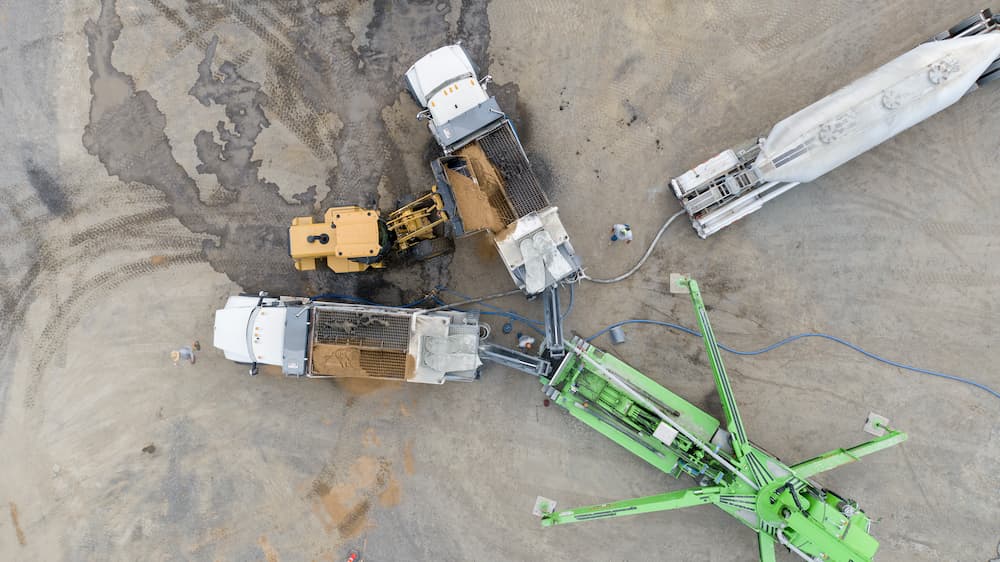
A mix-on-site concrete truck, or volumetric mixer, produces concrete continuously at your job site instead of delivering it pre-mixed from a plant. That makes it well suited to continuous pours, where fresh concrete has to keep flowing without the stop-start of waiting on successive ready-mix trucks. Volumetric mixers deliver top-quality concrete with less equipment and fewer trucks on the road, and crews stay productive because they are never waiting on the next delivery.
What a Mix-On-Site Concrete Truck Does
A mix-on-site concrete truck carries sand, stone, cement and water separately and combines them through a continuous auger at the moment of placement. Because the concrete is made on demand, you get a steady stream of fresh material at the correct slump, with no returned loads and no setting clock. For a continuous pour, that on-demand control is the whole advantage: the operator can stop and restart production to match the crew’s pace without compromising the mix.
McQuay Construction is an industry leader in using volumetric trucks for continuous pours. Through trial and error the company helped perfect the process, and its five-step approach is a practical blueprint for running one.
1. Take control of the equipment
“It is much easier when you own all of the equipment,” says Zach McQuay. McQuay Construction owns everything used to produce concrete on site: the concrete pump, the volumetric concrete mixers, water trucks when needed, pneumatic cement powder trailers, and wheel loaders. Owning the full chain simplifies scheduling, because you are not working around the owner of the pump truck or the cement supplier.
2. Stage the Equipment
To run a continuous pour you discharge into a concrete pump, so staging matters. Choose where the pump truck sits, then position each volumetric concrete mixer truck in a Y-pattern off the corner of the pump, leaving room for a loader to work between them and feed materials. Position the pneumatic cement trailers so they can reach the mixers but be swapped out without stopping production, and place any water truck in front of or beside the pump.
3. Source the water
Water is a critical ingredient, and a continuous pour needs an ample, uninterrupted supply. In the best case, water comes from a nearby hydrant with hoses run to the volumetric concrete mixers. If no hydrant is available on site, a water truck shuttles water to the mixers.
4. Stage the material stockpiles
“The material placement is very important,” says McQuay. Stockpile enough material to complete the job on site, spaced so the loader can feed the mixers with minimal movement. McQuay keeps rock on the right side and sand on the left of the volumetric mixer trucks. Placing the piles on concrete where possible eliminates material loss.
5. Ensure cement powder availability
McQuay consistently pours a 3,500 psi mix design at 120 cubic yards an hour with two volumetric trucks, which takes careful planning. Rock and sand are easy to stockpile; cement powder is the limiting resource and must be secured from a vendor in advance. McQuay stores powder in silos and hauls it to the site in pneumatic cement trailers that hold enough for just over 90 cubic yards. “We constantly make sure there is enough powder for today and tomorrow,” he says.
Perfecting Continuous Concrete Pours

Learn how McQuay Construction uses volumetric mixers to set up and run continuous pours for quality, consistent concrete. Discover their five-step process for top results and easy operation.
What a Continuous Pour Needs
Pulling those five steps together, a successful continuous pour comes down to three things, and a mix-on-site concrete truck delivers each: steady output matched to the crew’s placement speed, the ability to adjust the mix without stopping, and no dependence on drum-truck delivery timing. When set up properly, one operator can run two trucks by remote, and once production starts it does not stop.
Proper Setup Yields Quality Results
Producing a continual flow of fresh concrete eliminates the common problem of cold joints and seams. “If the ready-mix truck needs to stop for 20 minutes while the crew catches up, you have to add another 10 gallons of water to get the mix back to the right consistency,” McQuay says. “With the volumetric truck, we can simply hit stop. There is fresh concrete available as soon as you are ready to go again.” Adding water to a ready-mix load compromises strength; mixing on demand holds the concrete at the ideal slump with no added water, so the result keeps its maximum psi strength with no variation.
FREQUENTLY ASKED QUESTIONS
What is a mix-on-site concrete truck?
A mix-on-site concrete truck, or volumetric mixer, carries sand, stone, cement and water separately and combines them through a continuous auger at the job site. It produces fresh concrete on demand rather than delivering a pre-mixed load, which makes it ideal for continuous pours.
Why are volumetric trucks good for continuous pours?
They produce a steady stream of fresh concrete at the correct slump with no setting clock. The operator can stop and restart production to match the crew’s pace, which eliminates the cold joints and water-added strength loss that happen when ready-mix trucks have to wait.
How many volumetric trucks does a continuous pour need?
With proper staging, two volumetric trucks run by a single operator can sustain a continuous pour, pouring on the order of 120 cubic yards per hour at a set mix design. The operator monitors the water-to-cement ratio throughout.
What limits a continuous pour?
Material supply, especially cement powder. Rock and sand are easy to stockpile on site, but cement powder must be secured in advance and kept flowing from silos and pneumatic trailers, since running out stops the entire operation.
Does mixing on site improve concrete quality?
Yes. Because the concrete is made fresh and never waits, there is no need to add water to restore workability, so it holds its design slump and maximum psi strength with no consistency variation and no cold joints.
If the ready-mix truck needs to stop for 20 minutes while the crew catches up, you have to add another 10 gallons of water to get the concrete mix back to the right consistency. There is nothing you can do about it. With the volumetric truck, we can simply hit stop. There is fresh concrete available as soon as you are ready to go again.


One Operator, Two Trucks, Continuous Concrete
With a proper setup, a single operator can control two volumetric trucks via remote, ensuring a nonstop, continuous pour for your projects.
"*" indicates required fields
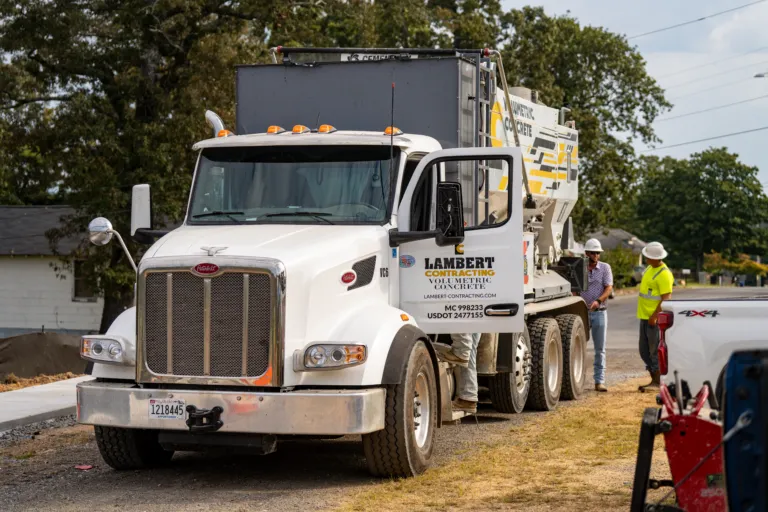
Thinking Beyond The Barrel: The Lambert Contracting Story
Cold Weather Operations: Running a Volumetric Concrete Mixer in Winter
Section 179 and Bonus Depreciation for Volumetric Concrete Mixers: A Buyer’s Guide
Joe & Sons Finds a Better Way to Deliver and Control Concrete
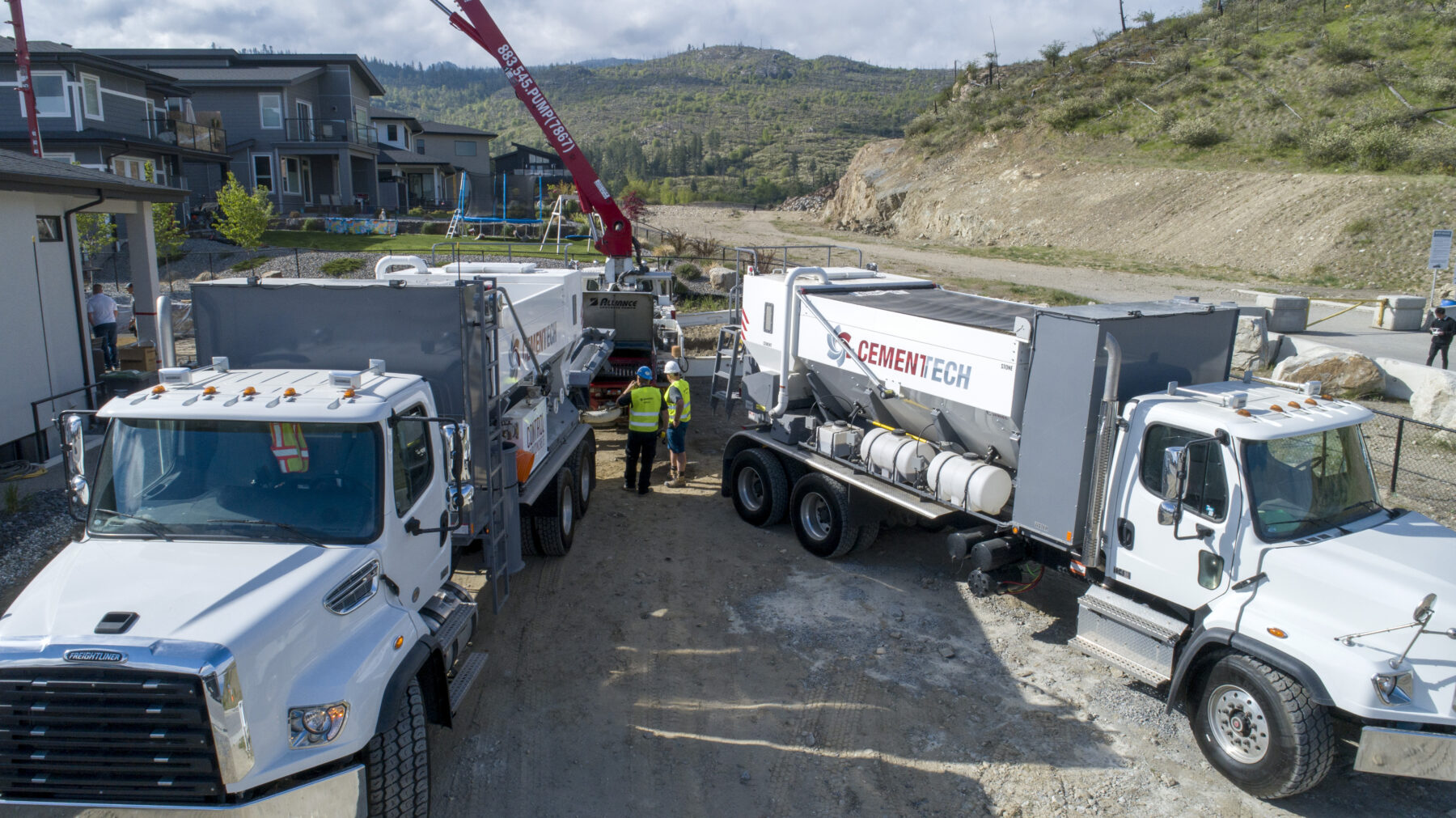
Kris Courtoreille, the owner and operator of Joe & Sons Concrete, prides himself on delivering exceptional service to his customers in the Okanagan region of British Columbia. With a booming local economy and increasing demand for high-quality concrete work, Kris wanted a solution that would improve his team’s efficiency, quality, and flexibility. When he learned about Cemen Tech volumetric mixers, he saw an opportunity to fully integrate his concrete business and take it to the next level.
First Impressions: Skepticism Meets Curiosity
Kris had heard of volumetric mixers before but didn’t have much experience with them. “It was maybe 10 or 15 years ago, and I didn’t know enough about them at the time. We were inexperienced, and so was the operator.” Despite this, Kris’s curiosity won out, and he decided to learn more.
When Jay, a Cemen Tech representative, approached Kris on-site in Kelowna, he caught his attention right away. “I usually dismiss most sales guys because I’m a busy guy. But for whatever reason, I kind of gravitated toward talking to him.,” Kris admitted. Jay’s personable approach and deep knowledge about volumetric mixers made the conversation stand out, sparking Kris’s interest and curiosity.
Choosing Cemen Tech: No Contest
After his conversations with Jay, Kris was convinced. “I was sold. I know enough about concrete
and he explained enough about Cemen Tech’s product and the competitors and that’s all I needed to know.” The decision was clear: Kris trusted the quality of Cemen Tech’s mixers and the support offered by their team.
Overcoming the Learning Curve
Integrating volumetric mixers into the business came with a learning curve, especially for a team used to traditional drum mixers. “It’s understanding concrete a lot more than we thought we knew,” Kris explained.
He highlighted how the hydration process differs with volumetric mixers. “When you see the slump change on the ground, it’s not the concrete setting up—it’s hydrating.” Adjusting to this and dialing in the right mix designs required some trial and error, but Kris and his team embraced the challenge.
The mixers also came equipped with advanced features like a color add-on, fiber chopper, and admixture capabilities. “Knowing your mix and knowing concrete is important,” Kris emphasized. Despite the complexities, the team quickly adapted, finding the mixers user-friendly and intuitive.
Streamlining Operations with ACCU-POUR™
One of the standout benefits for Kris was the ACCU-POUR™ software, which simplified scheduling, dispatching, and invoicing. “It’s punch in your concrete, the address, and you’re off to the races,” he said.
The software allowed Kris to manage his two volumetric mixers independently from his other construction operations. This separation gave him better control and streamlined his workflow, making it easier to deliver on time and meet customer demands.
Exceptional Support from the Start
Kris praised the start-up training and support provided by Cemen Tech and their partners. “Tyler was great. He came down and showed us the ropes,” Kris said. When issues arose, the team quickly resolved them.
“The support was awesome,” he continued. “If there was an issue, it was fixed on the fly.” The hands-on approach and quick follow-ups reassured Kris that he had made the right choice.
Controlling Concrete, Delivering Quality
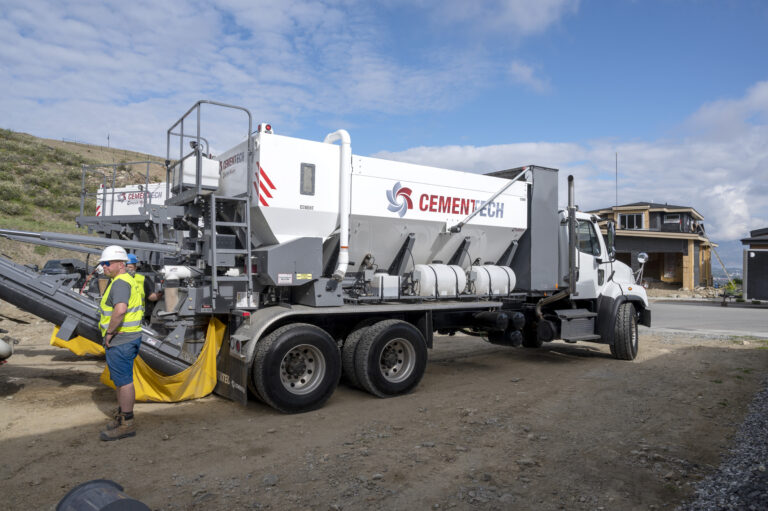
Joe & Sons Concrete is leading the Okanagan area with innovative, efficient concrete delivery solutions using Cemen Tech mixers.
Company Profile: Joe & Sons Concrete
Location: Okanagan, British Columbia, Canada
Customer Segments: Concrete Forming, Finishing, Repair & Coating Services
Website: joeandsons.ca/
The saying “control your concrete” that’s what we’re doing. We’re controlling it and we are able to offer our clients a really well-rounded service now on top of what we already do.
Improved Quality and Cost Savings
With the volumetric mixers, Joe & Sons Concrete has seen significant improvements in both quality and saving money.
“The quality is better,” Kris explained. “We’re not sending back hot loads or wasting concrete that’s been sitting too long.” The ability to batch on demand has reduced waste and allowed for greater flexibility.
Kris also highlighted the financial benefits. “We can switch mix designs on the fly,” he said. This adaptability has enabled the team to handle diverse projects, from exposed aggregate finishes to custom designs, without downtime or extra costs.
Delivering a Complete Service
One of the biggest advantages for Joe & Sons Concrete is the ability to offer a fully integrated service. “We form, place, finish, and supply concrete,” Kris said. This end-to-end approach gives them complete control over quality and eliminates the finger-pointing that can occur when multiple contractors are involved.
Kris summed it up perfectly: “The saying ‘control your concrete’—that’s what we’re doing. We’re controlling it and offering our clients a really well-rounded service.”
Embracing Innovation
The introduction of Cemen Tech volumetric mixers has generated excitement in the Okanagan community. “People are taking pictures and asking, ‘What is this thing?’” Kris said with a smile.
As the only company in the area with these trucks, Joe & Sons Concrete has positioned itself as a leader in innovation. “We haven’t even scratched the surface of what we’re going to be able to help people with,” Kris said.
A Smarter Way to Deliver Concrete
For Kris Courtoreille and his team, adding Cemen Tech volumetric mixers has been a significant advancement. From improving quality and reducing waste to streamlining operations and delivering exceptional service, the mixers have helped Joe & Sons Concrete stand out in a competitive market.
Kris’s advice to other contractors considering the switch? “Why wouldn’t you go with a company that offers all these services? There’s no finger-pointing, just quality work from start to finish.”
The future looks bright for Joe & Sons Concrete, and with the support of Cemen Tech, they’re ready to continue breaking new ground in the Okanagan concrete industry.
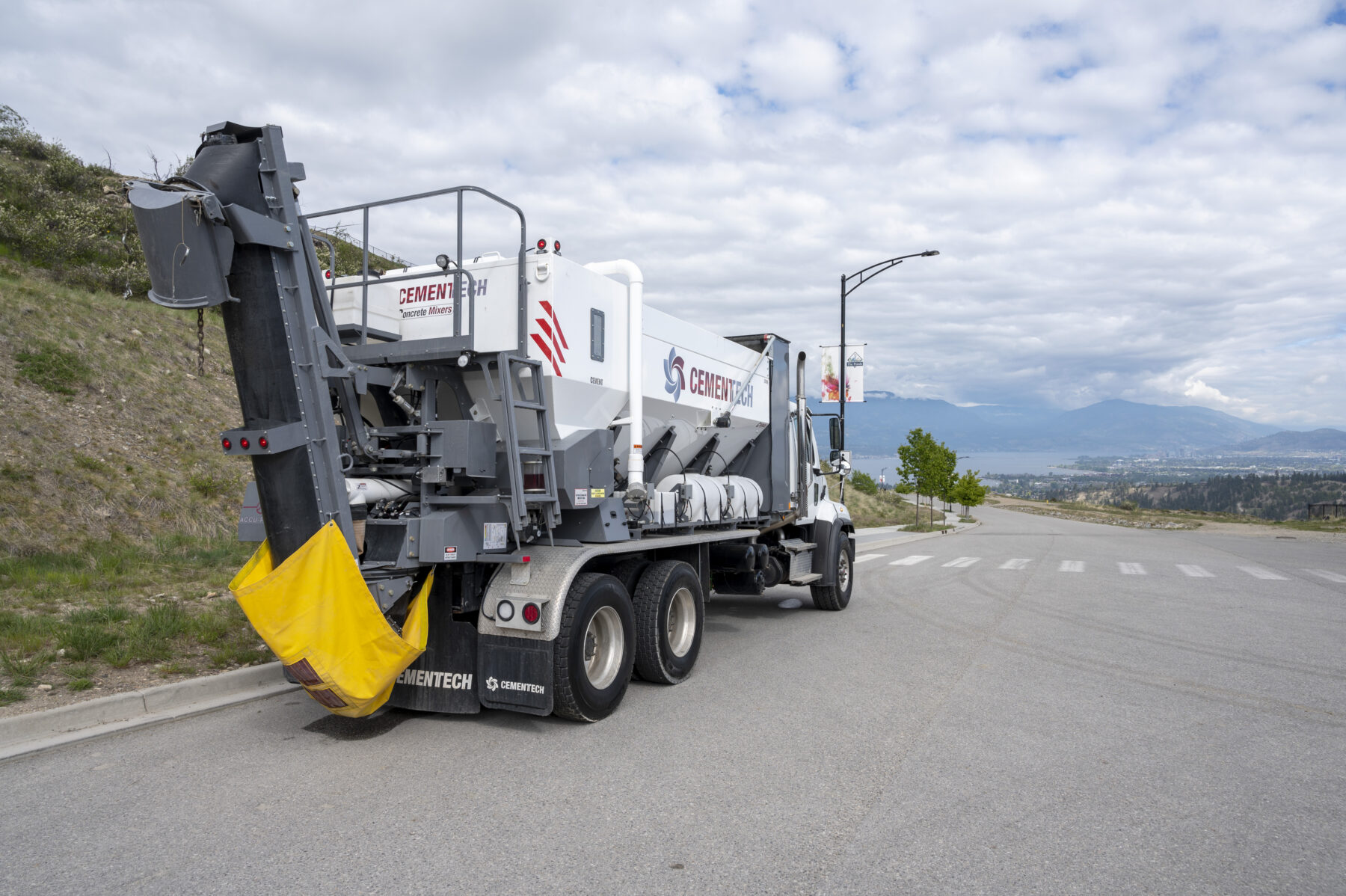


"*" indicates required fields
Thinking Beyond The Barrel: The Lambert Contracting Story
Cold Weather Operations: Running a Volumetric Concrete Mixer in Winter