
 English
 Español
 Français
 Deutsch
 Polski
 Nederlands
Thinking Beyond The Barrel: The Lambert Contracting Story
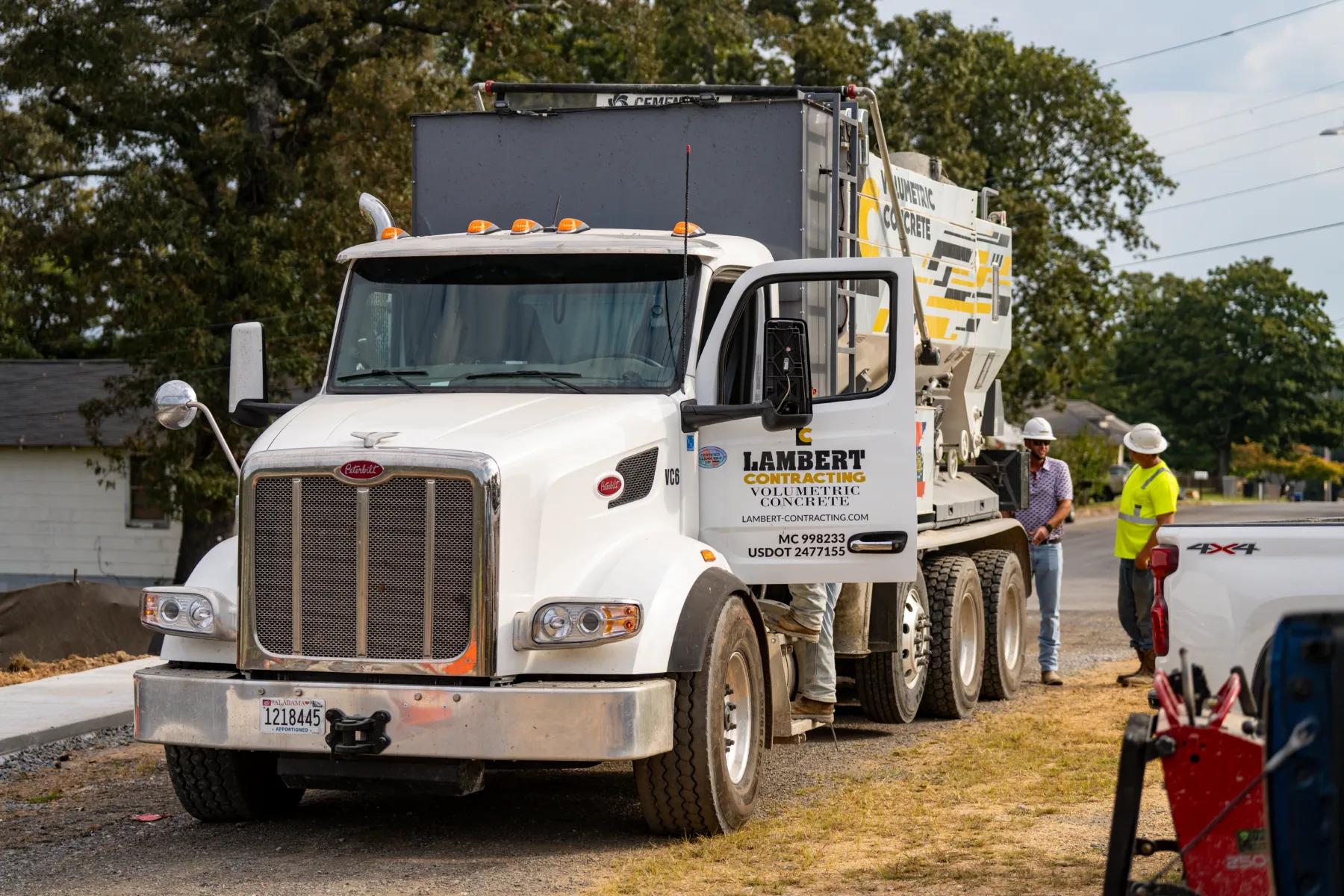
“Once you make the leap, you’re in it, and you’re glad you’re in it. The only thing anybody ever regrets is not buying enough trucks the first time.”
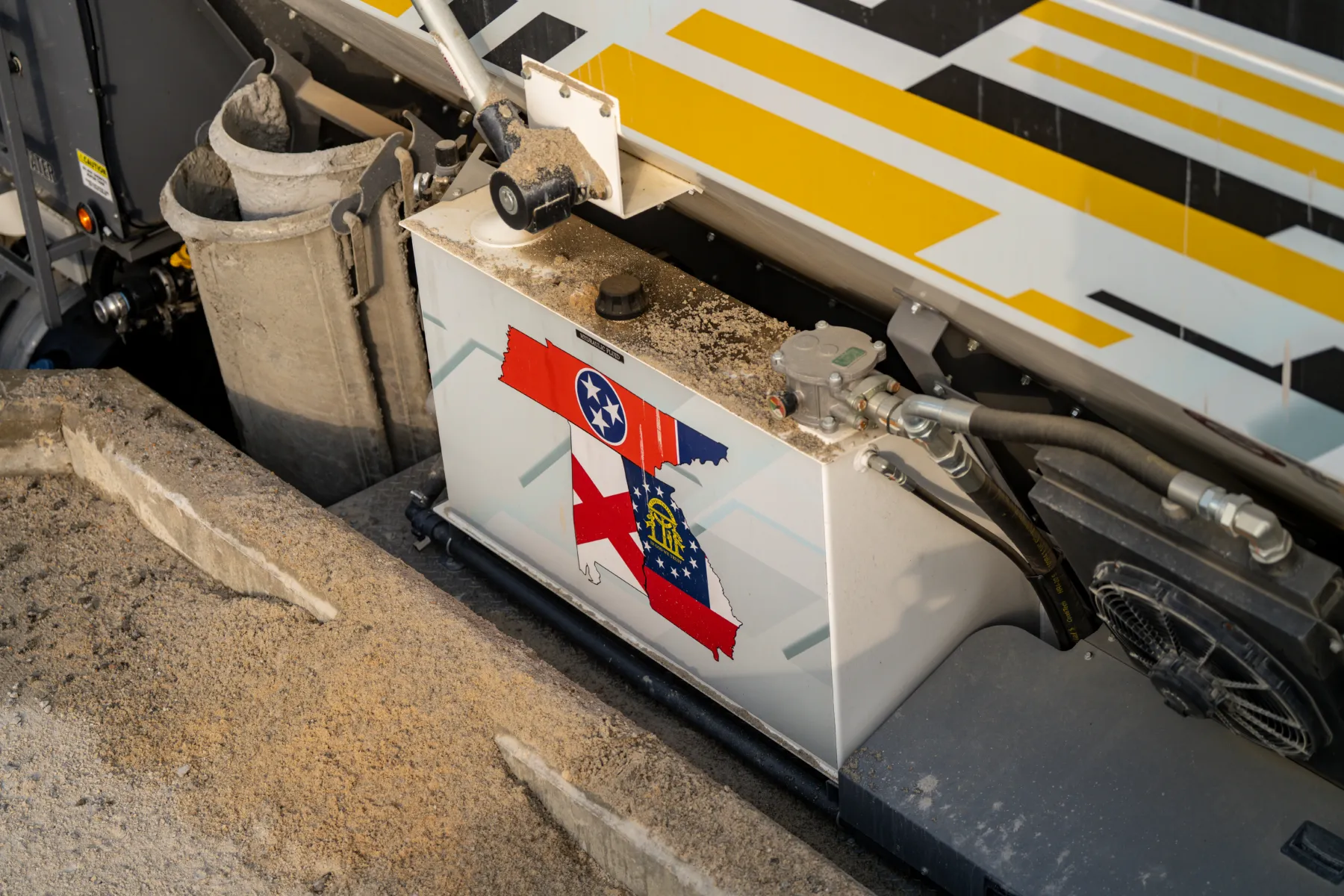
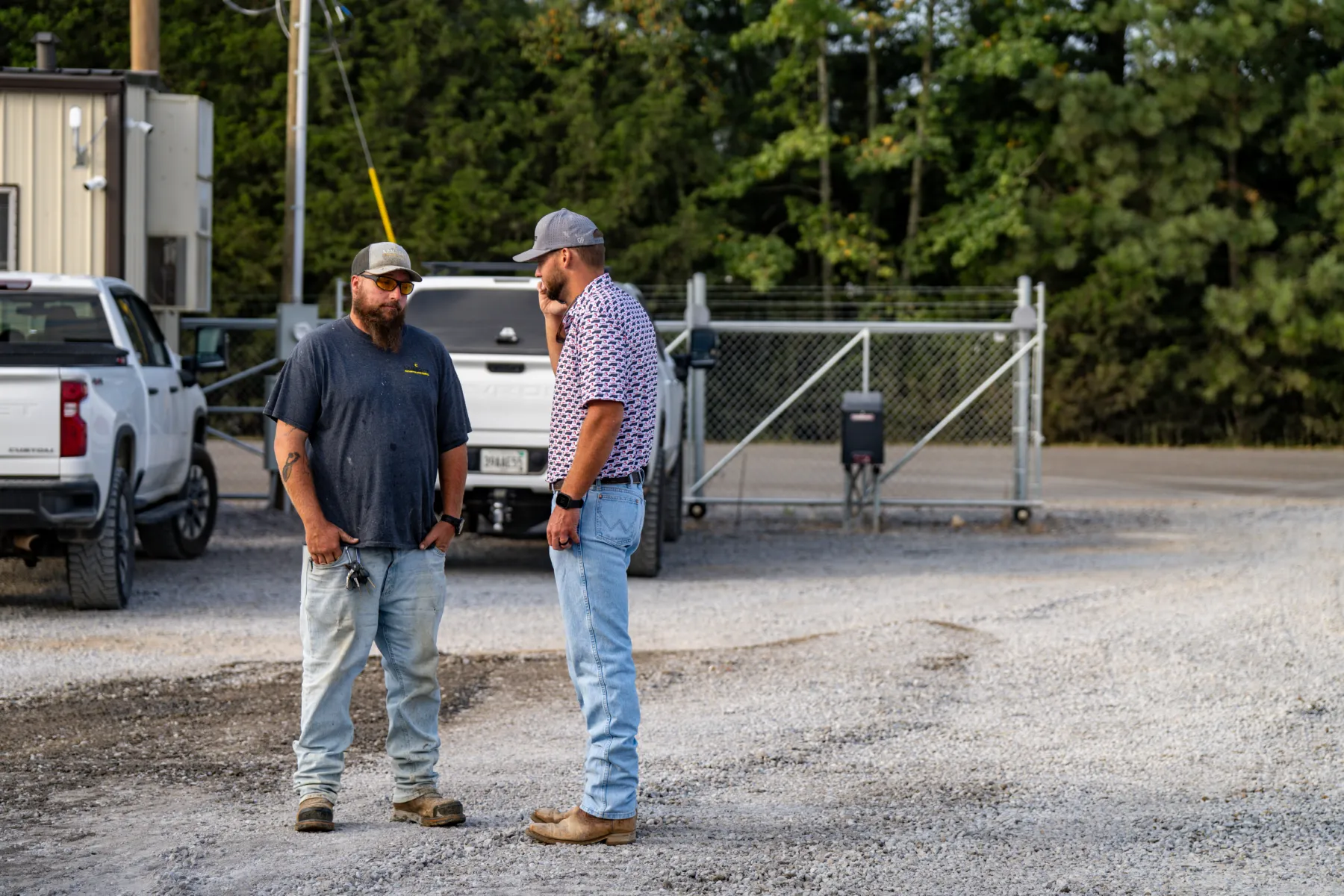
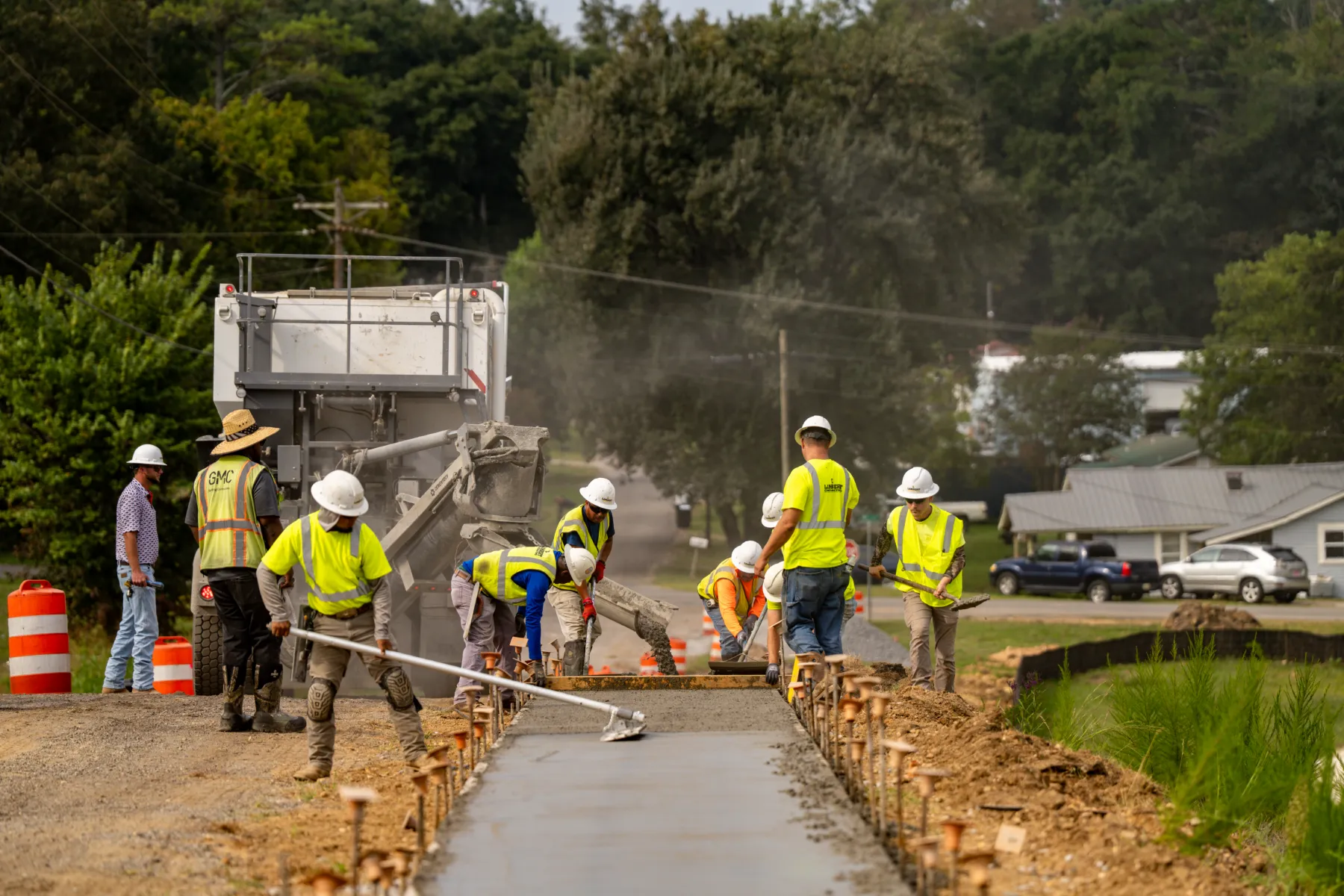
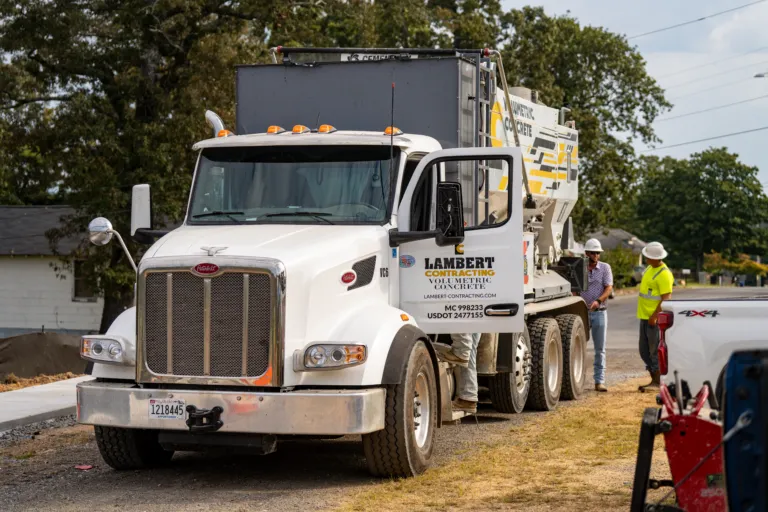
HOLLYWOOD, Ala. — Cody Lambert, the owner of Lambert Contracting (est. 2015), was looking into ways to grow his company and offer more diverse services to his clientele. Lambert was already doing concrete work, but wanted to expand into the volumetric space, and also be able to supply concrete to the public in the areas of North Alabama, Southern Tennessee, Western North Georgia.
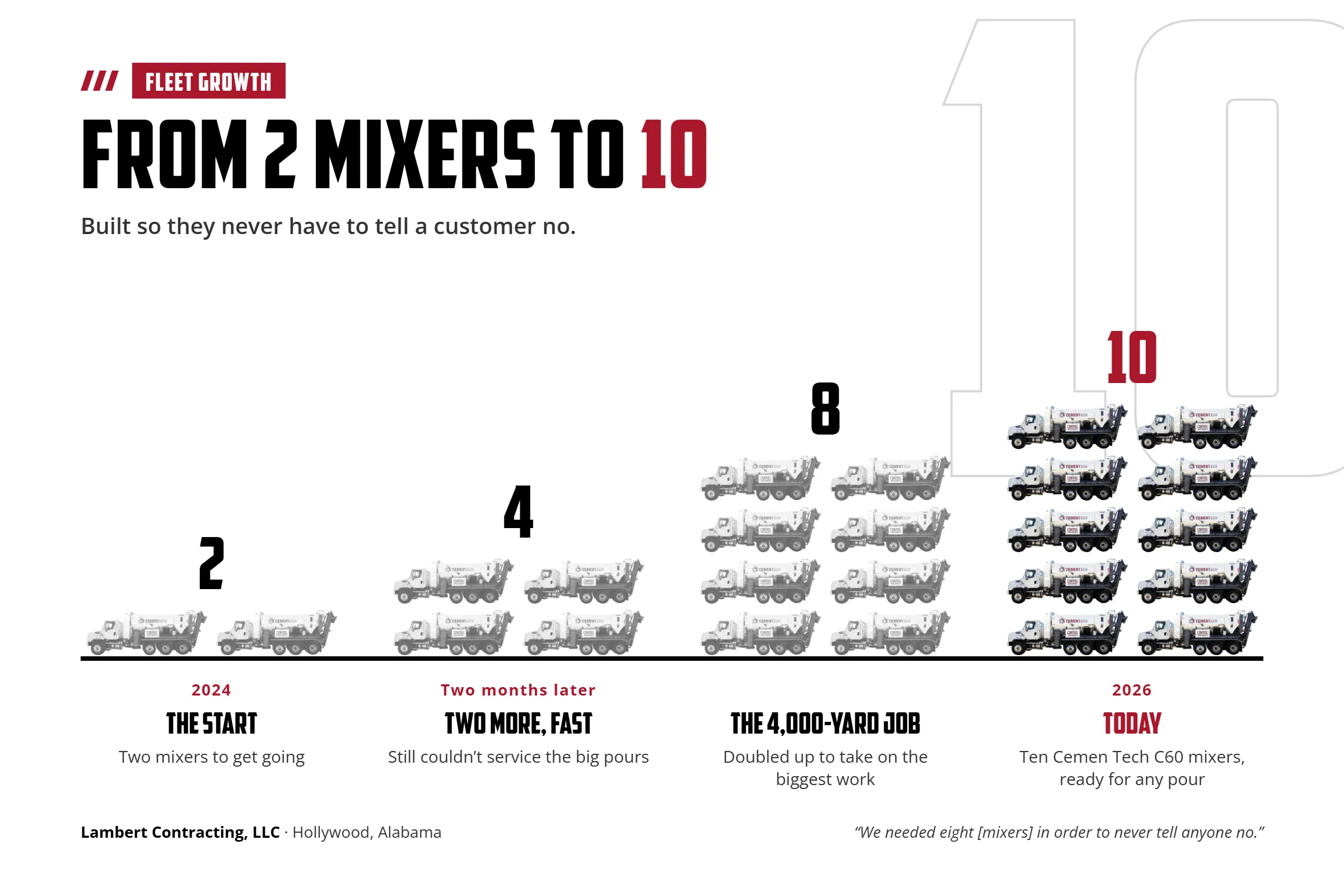
“You hate to tell anybody no,” says Lambert, “as you’re growing a business, you’re trying to never tell anyone no. You only get one opportunity to tell people no in life typically.”
“So, when we got two (trucks), we decided we wanted two more really quick. Then we realized with four trucks, we couldn’t really service the big pours. We received an opportunity to pour 4,000 yards, and we realized we needed eight trucks in order to never tell anyone no.”
Overcoming Hesitation
When it comes to the hesitation most people have about entering the volumetric space, Lambert cites what he thinks are the two main reasons. First, will the demand be there? And second, will my protentional customers adapt and accept a method of concrete many are unfamiliar with? Lambert says he has never met anyone who has regretted going the volumetric concrete route with Cemen Tech.
What You Need, When You Need It
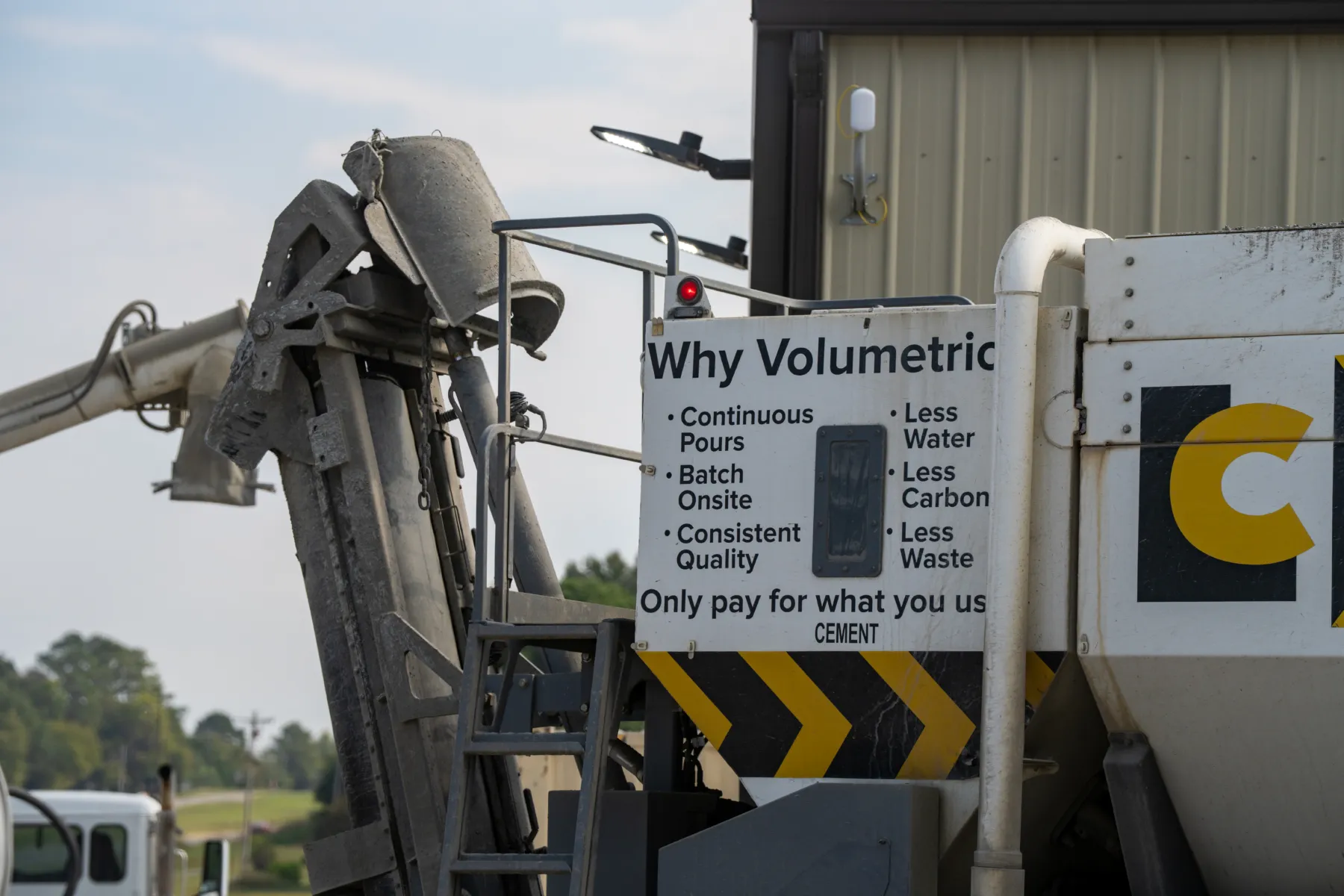
Lambert Contracting prides themselves on being able to offer benefits to their concrete services that are exclusive to volumetric concrete mixers. Key reasons they reference are;
- Fresh concrete mixed on-site with volumetric trucks.
- Pay only for what you use.
- No waste, no over-ordering.
- Continuous pours for efficient, uninterrupted work.
- Ideal for contractors, municipalities, and commercial projects.
The Best of the Best
In 2025, Lambert Contracting was honored as Jackson County’s Best of the Best in Concrete Services, a reflection of the dedication, precision, and innovation their team brings to every job.
This recognition highlights the impact of Volumetric Concrete services, which allows for the delivery consistent, on-demand concrete tailored to each project. From commercial builds to municipal infrastructure, our mobile batching trucks help reduce waste, improve efficiency, and ensure every pour meets the highest standards.
Lambert proudly to serves North Alabama, Southern Tennessee, and Western North Georgia with concrete solutions that prioritize quality, sustainability, and client satisfaction.
Offering Convinient, Customized Total Concrete Solutions

Lambert Contracting, LLC offers unique concrete solutions and services to with innovative, efficient concrete delivery solutions using Cemen Tech mixers.
Company Profile: Lambert Contracting, LLC
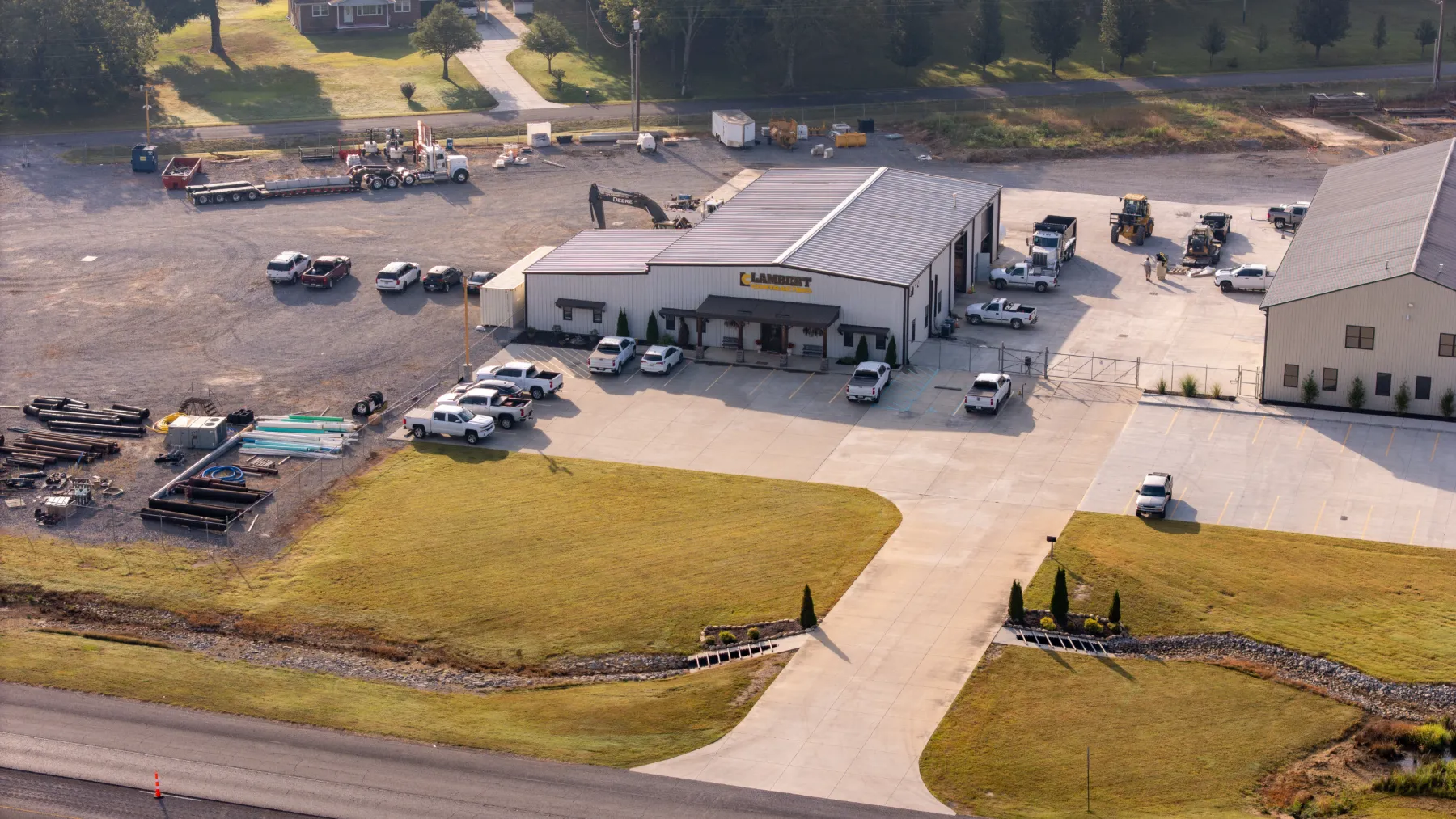
Location: 31303 Lee Hwy, US-72 Hollywood, AL 35752
Customer Segments: Concrete Forming, Finishing, Repair & Coating Services
Products: C60
Website: lambert-contracting.com

Cody Lambert of Lambert Contracting LLC

Thinking Beyond The Barrel: The Lambert Contracting Story
Cold Weather Operations: Running a Volumetric Concrete Mixer in Winter
Section 179 and Bonus Depreciation for Volumetric Concrete Mixers: A Buyer’s Guide
"*" indicates required fields
Cold Weather Operations: Running a Volumetric Concrete Mixer in Winter

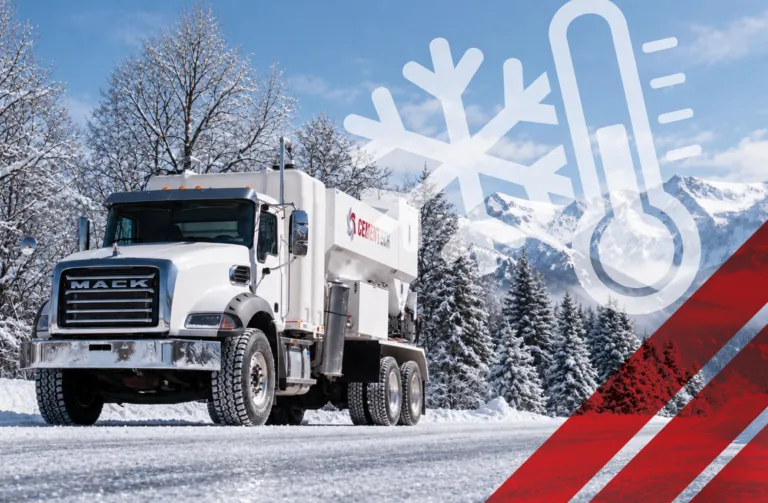
Running a volumetric concrete mixer in cold weather involves three categories of consideration: the equipment itself (engine warmup, hydraulic systems, materials handling under freezing conditions), the concrete chemistry (cement hydration slows below 50 degrees Fahrenheit and stops near freezing), and the placement environment (substrate temperature, curing protection, ambient conditions). ACI 306 governs cold-weather concreting practices in U.S. construction. Most volumetric mixers can operate effectively in winter conditions with proper preparation and crew discipline, but there are temperature thresholds below which work should stop. For end-of-season storage and winterization (rather than active cold-weather operation), see our companion guide on winterizing your concrete mixer.
This Piece Covers Operations, Not Winterization
Two distinct topics get conflated when buyers search for “winter” volumetric mixer content. This piece covers operations: how to run the mixer effectively during cold weather work. For end-of-season storage and winterization procedures, see Cemen Tech’s winterizing guide. The two topics serve different operational needs.
Cold weather operations
This piece addresses contractors who pour year-round in cold climates. The question is how to operate effectively below 50 degrees Fahrenheit while still meeting concrete specifications, protecting equipment from cold-related issues, and maintaining crew safety. The audience is northern US contractors and infrastructure crews who need to work through winter months.
End-of-season winterization (covered elsewhere)
Winterizing is the process of preparing equipment for prolonged shutdown when winter conditions exceed your operational threshold. Fluids drained or treated, water systems blown out, batteries maintained, storage protection applied. Different audience, different procedures, different concerns. Operators who shut down for winter need that guidance; operators who run through winter need this piece.
Cold Weather Concrete Chemistry
Concrete behavior changes substantially in cold weather. Understanding the chemistry helps explain why certain practices matter and why temperature thresholds exist.
Hydration slows as temperature drops
Cement hydration (the chemical reaction that gives concrete strength) slows significantly as temperature decreases. Below 50 degrees Fahrenheit, hydration proceeds at a substantially reduced rate. Below 40 degrees, the slowdown is dramatic. Near freezing, hydration essentially stops. This means concrete poured in cold weather takes much longer to reach specified strength than concrete poured in mild weather.
The freeze risk window
Concrete that freezes before reaching approximately 500 psi compressive strength suffers permanent damage. Ice crystals forming in the fresh concrete disrupt the matrix as it hardens, leaving voids and weakened areas that the concrete cannot recover from once thawed. This is why curing protection during the first 24-72 hours after placement is critical in cold weather.
Temperature thresholds that matter
Ambient temperature: ACI 306 defines cold weather concreting as the period when three consecutive days have mean daily temperatures below 40 degrees Fahrenheit, or when the temperature is expected to fall below 50 degrees Fahrenheit for more than half of any 24-hour period during placement. Concrete temperature at placement: minimum recommended concrete temperature at placement varies by ambient conditions and section thickness, typically 50-65 degrees Fahrenheit. Substrate temperature: must be above freezing at placement; placing fresh concrete on frozen
substrate creates immediate bond and strength problems.
Cement type and supplementary cementitious materials
Type III high-early-strength cement gains strength faster than Type I in cold weather, which reduces the time the concrete is vulnerable to freeze damage. Supplementary cementitious materials (fly ash, slag cement) typically slow strength gain and should be used with caution in cold weather work. Mix design adjustments specifically for cold weather are common and supported by ACI 306 guidance.
Equipment Considerations for Cold Weather Operation
Volumetric mixers are designed to operate in a range of weather conditions, but cold weather places specific demands on the equipment. Proper preparation and crew discipline keep the equipment running effectively through winter.
Engine warmup and operation
Diesel engines need adequate warmup in cold weather before being put under load. Cold-soaked engines should run at low idle for sufficient time to circulate oil and warm critical components before mixing operations begin. Block heaters (for overnight cold) and ether starting aids (for very cold starts) are common in northern operations. Manufacturer guidance on cold-weather starting and warmup applies.
Hydraulic system performance
Hydraulic fluid viscosity increases dramatically in cold temperatures. A hydraulic system that operates smoothly at 60 degrees may struggle at 10 degrees with thick, sluggish fluid. Cold-weather hydraulic fluids (lower viscosity grades) help, as does adequate warmup of the hydraulic system before full-load operation. Hydraulic component failures in cold weather often trace back to inadequate warmup or wrong fluid selection.
Materials handling under freezing conditions
Water systems are the most vulnerable component in cold operations. Water lines that freeze burst or block flow, water meters can be damaged by freezing, and water that arrives at the mixer too cold reduces concrete temperature below acceptable thresholds. Heated water (or warm water from a heated tank) is common in cold-weather operations. Aggregate handling is affected because frozen aggregates contain ice that contributes to the water content of the mix and chills the concrete. Aggregate storage that protects from freezing or pre-warmed aggregate handling addresses this. Cement and admixtures are less temperature-sensitive but still benefit from indoor or sheltered storage during extreme cold.
Electrical and control systems
Modern volumetric mixers have substantial electronic control systems. Extreme cold can affect display readability, sensor accuracy, and battery performance. Batteries lose capacity significantly in cold weather; cold-weather operations benefit from new or recently tested batteries and from charging systems verified before winter work begins.
Daily start-up routine in cold weather
Cold-weather operations benefit from a more extensive daily start-up routine than mild-weather work: longer engine warmup, hydraulic system warmup at low load, verification of water system function before production begins, and verification of control system function in cold conditions. Skipping cold-weather warmup procedures to save time creates equipment problems that cost far more than the saved minutes.
Operator Practices in Cold Weather
Beyond equipment considerations, cold weather affects how operators do the work. Several practices distinguish effective cold-weather operators from those who struggle.
Mix design awareness
Cold-weather mix designs often include accelerators, heated materials, or Type III high-early-strength cement. Operators need to understand which adjustments are in their current mix and why, because the operational implications differ. Accelerated mixes have shorter workability windows; heated materials require careful temperature monitoring; Type III cement requires different placement timing.
Concrete temperature monitoring
Operators should measure and record concrete temperature at production and at placement. ASTM C1064 covers the procedure. Concrete temperature that drops below specification during transport (which can happen quickly in cold weather with longer travel distances) signals a problem before the concrete is placed. Recording temperatures protects the operator and creates the documentation projects require.
Communication with the placement crew
Cold-weather work has tighter tolerances and shorter workability windows than mild-weather work. Communication between the mixer operator and the placement crew matters more in cold conditions. Coordinating placement rate to mixer production rate, signaling early when conditions are deteriorating, and stopping work proactively when conditions exceed thresholds all depend on good crew communication.
Crew safety and exposure
Cold-weather work creates safety risks beyond the concrete: hypothermia, frostbite, slip hazards from ice, reduced visibility from snow or fog, equipment surfaces that can stick to bare skin in extreme cold. Proper cold-weather PPE, work-rest cycles to prevent fatigue, and crew awareness of cold-injury symptoms protect the workers doing the actual production.
Pour Planning for Cold Weather
Cold-weather pours need more planning than mild-weather pours. Building the planning steps into the work flow prevents the rushed last-minute decisions that produce poor outcomes.
Pre-pour temperature assessment
Check the forecast for the pour day and the following 48-72 hours (the critical curing window). If temperatures are expected to drop below the freeze-risk threshold during the curing period without adequate protection, the pour should be rescheduled or additional protection planned. Pouring into a falling-temperature forecast without protection is one of the most common cold-weather mistakes.
Substrate preparation
Substrate temperature has to be above freezing at placement. Frozen ground, frozen forms, or frozen existing concrete that the new pour will bond to all create problems. Substrate heating (insulated blankets the night before, heated ground covers, indoor staging where possible) brings the substrate into acceptable range. ACI 306 covers acceptable substrate conditions.
Curing protection
Fresh concrete in cold weather needs protection until it reaches the freeze-resistance threshold (approximately 500 psi). Common protection methods include insulating blankets, heated enclosures, curing compounds (for surface protection in moderate cold), and combinations of these. The protection has to maintain concrete temperature above freezing while allowing proper hydration. The duration of protection depends on temperature, mix design, and section thickness – typically 24-72 hours, sometimes longer in extreme conditions.
Placement timing
Cold-weather pours often work best earlier in the day when ambient temperature is rising rather than falling, and when the curing window has the longest possible daylight period for monitoring. Late afternoon or evening pours in cold weather face falling temperatures during the most vulnerable hours of cure. Planning placement timing around temperature trends, not just convenience, improves outcomes.
When NOT to Pour
Cold-weather operations have temperature thresholds below which work should stop. Knowing when not to pour prevents projects from producing defective concrete that the contractor has to remove and replace.
Absolute thresholds
Ambient temperature far below freezing (typically below 10-20 degrees Fahrenheit depending on protection capabilities), forecasts showing temperatures will fall below freezing without adequate protection capacity, frozen substrate that cannot be brought above freezing before placement, and ongoing precipitation that compromises pour or cure conditions all constitute reasons to postpone work.
Conditional thresholds
Some conditions allow work to proceed with additional measures: heated water and aggregates, accelerated mix designs, comprehensive curing protection, and shorter pour cycles. Whether to proceed under marginal conditions requires judgment about whether the additional measures will actually deliver the required concrete performance.
Customer expectation management
Stopping work in cold weather affects customers who have schedules to maintain. Setting expectations early in the season about cold-weather thresholds, communicating proactively when conditions are approaching the threshold, and offering alternative scheduling when work has to be deferred all reduce customer friction. Customers who are surprised by cold-weather shutdowns are unhappier than customers who were prepared for the possibility.
Documentation when work stops
When cold weather forces work to stop or significantly delays a project, document the conditions: ambient temperatures, forecasts, the specific issues that drove the decision. This documentation supports any change orders, schedule adjustments, or customer conversations that follow. Contractors who document weather-driven decisions have stronger positions in any subsequent disputes than contractors who rely on memory.
Building a Year-Round Operation in Cold Climates
Northern contractors who run year-round operations develop disciplines that contractors who shut down for winter never have to learn. Several practices distinguish successful year-round operations.
Equipment investment for cold operations. Block heaters, heated water systems, insulated enclosures, cold-weather hydraulic fluid, dedicated cold-weather PPE. These represent real capital investment but pay back through extended operating season.
Crew specialization. Some operators thrive in cold-weather work; others struggle. Year-round operations often have specific operators dedicated to winter work who develop the experience needed to do it well.
Customer relationships that span seasons. Customers who understand cold-weather realities and plan accordingly are easier to serve than customers who demand impossible cold-weather work. Building the customer base toward those who appreciate year-round capability strengthens the operation.
Pricing that reflects cold-weather costs. Cold-weather work costs more (longer warmup, more protection, slower work pace, higher safety risk). Pricing that reflects this reality keeps year-round operations profitable. Operations that try to price cold-weather work at mild-weather rates lose money on winter jobs.
Operational discipline. Cold-weather work tolerates less improvisation than mild-weather work. Following procedures, monitoring conditions, documenting work, and stopping when thresholds are exceeded all matter more in winter. Operations that maintain discipline through winter come out the other side stronger.

Can a volumetric concrete mixer operate in cold weather?
Yes, with proper preparation. Most volumetric mixers can operate effectively in winter conditions
with adequate engine warmup, cold-weather hydraulic fluid, protected water systems, and crew
discipline. The equipment, the concrete chemistry, and the placement environment all need attention.
ACI 306 governs cold-weather concreting practices. Below certain temperature thresholds, work
should stop regardless of equipment capability.
What temperature is too cold to pour concrete?
ACI 306 defines cold weather concreting as periods with three consecutive days below 40
degrees Fahrenheit mean daily temperature. Most pours can proceed down to approximately 20-25
degrees ambient with proper protection (heated water, insulated blankets, mix adjustments). Below
approximately 10-20 degrees, even well-prepared operations typically stop work because the risk of
inadequate cure outweighs the productivity.
How do I keep my volumetric mixer running in winter?
Daily cold-weather operations need extended engine warmup, cold-weather hydraulic fluid,
protected water systems (heated or insulated), batteries verified before winter, block heaters for cold
overnight conditions, and operator discipline around startup procedures. Skipping cold-weather
warmup procedures creates equipment problems far more expensive than the saved time.
Manufacturer guidance on cold operation applies.
What is the difference between cold-weather operations and winterizing?
Cold-weather operations means running the mixer effectively during winter work. Winterizing
means preparing the equipment for prolonged storage when winter conditions exceed operational
thresholds. Both topics are important for northern operations but address different needs. Operators
who pour year-round need cold-weather operations guidance; operators who shut down for winter
need winterization guidance.
How long does concrete need protection from freezing?
Fresh concrete needs protection from freezing until it reaches approximately 500 psi compressive
strength, after which freeze damage becomes much less likely. Typical protection duration is 24-72
hours depending on temperature, mix design, and section thickness. ACI 306 provides detailed
guidance on protection methods and duration. Removing protection too early is one of the most
common cold-weather failures.
Next Steps
- For end-of-season storage: See Cemen Tech’s winterizing guide for the procedures to prepare
equipment for prolonged winter shutdown. -
Explore equipment options: Cemen Tech’s volumetric mixer lineup includes models suited to
cold-weather operations. -
Maintenance discipline: See our maintenance schedule guide for the routine maintenance that
supports cold-weather reliability. - Talk to a representative: For specific foundation and slab project questions, contact a Cemen Tech
rep for a no-pressure conversation.
Section 179 and Bonus Depreciation for Volumetric Concrete Mixers: A Buyer’s Guide
Section 179 and bonus depreciation are the two main federal tax provisions that affect volumetric concrete mixer purchases. Section 179 allows businesses to deduct the full purchase price of qualifying equipment up to an annual limit ($1.25 million for the 2025 tax year, with a $2.5 million phase-out threshold). Bonus depreciation, restored to 100 percent for property placed in service on or after January 19, 2025 under the One Big Beautiful Bill Act, has no annual deduction cap and applies to both new and used equipment. Most buyers can use both provisions strategically, often combined, to optimize tax outcomes on equipment purchases. The right approach depends on your specific business situation, which is why this is a tax-professional conversation.
Why These Tax Provisions Matter for Volumetric Mixer Purchases
Volumetric mixers are major capital purchases. The federal tax treatment of those purchases can
substantially affect the after-tax cost, the cash flow impact, and the right financing structure.
Understanding the mechanisms helps buyers plan smarter purchases and ask better questions of their
tax professionals.
The pre-tax cost is not the real cost
A volumetric mixer that costs the buyer one amount in cash has a different cost after tax effects. When Section 179 or bonus depreciation allow large first-year deductions, the after-tax cost can be substantially lower than the pre-tax purchase price, especially for buyers in higher tax brackets. The actual financial impact requires modeling the tax effects, not just looking at the invoice price.
Timing matters more than buyers realize
Tax provisions tie to when equipment is “placed in service” (typically when it is ready and available for use in the business), not when it is ordered or even when it is delivered. Strategic timing of placement-in-service can shift deductions across tax years, which matters when your taxable income varies significantly year to year. For buyers with strong income years and weaker projected years, timing the deduction to the high-income year produces better tax outcomes.
Provisions interact with financing decisions
The tax provisions apply differently depending on how the equipment is acquired. Cash purchases, equipment loans, capital leases, and operating leases all have different tax treatment. See our operating lease vs capital lease piece for the detailed comparison. The choice of financing structure can substantially affect whether and how Section 179 and bonus depreciation apply.
Limits and rules change annually
Section 179 limits, bonus depreciation percentages, and the rules governing both change periodically through tax legislation. The figures in this piece reflect 2025 rules. By the time you read this, some figures may have changed. IRS Publication 946 is the authoritative source for current depreciation rules; your tax professional will know the specifics for your filing year.
Section 179: The Direct Expense Election
Section 179 of the Internal Revenue Code allows businesses to deduct the full purchase price of qualifying equipment in the year it is placed in service, rather than depreciating the cost over the equipment’s useful life. The mechanism is straightforward; the application has nuances worth understanding.
How Section 179 works
When you place qualifying equipment in service during a tax year, you can elect to deduct the full purchase price (up to the annual limit) as an expense on that year’s tax return. The deduction reduces your taxable income for the year, which reduces your tax liability accordingly. The effect is similar to expensing rather than capitalizing the equipment.
2025 limits and thresholds
For the 2025 tax year, the Section 179 deduction limit is $1.25 million. The deduction begins phasing out dollar-for-dollar when total qualifying property purchases for the year exceed $2.5 million, and is fully phased out at $3.75 million in purchases. Most volumetric mixer purchases by small and mid-sized contractors fall well below the phase-out threshold, so the full deduction is typically available.
WHat qualifies
Tangible personal property used in the active conduct of a trade or business qualifies for Section 179. Volumetric concrete mixers used in a business operation qualify. The property has to be acquired by purchase (including financed purchase) and placed in service during the tax year claimed. New and used equipment both qualify, as long as the equipment is new to the buyer’s business.
Important limitations
Section 179 has a taxable income limitation: the deduction cannot exceed the taxable income from your active trade or business activities. If the equipment cost exceeds your taxable income, the excess can be carried forward to future years. This is one of the key differences from bonus depreciation, which has no taxable income limitation. Businesses in low-income or loss years often benefit more from bonus depreciation than Section 179.
How Section 179 is claimed
Section 179 is claimed on IRS Form 4562 (Depreciation and Amortization). Your tax professional handles the actual filing, but you should retain the purchase documentation: invoices showing the equipment cost, financing documents if applicable, and records establishing the placed-in-service date. Without proper documentation, the deduction can be challenged on audit.
Bonus Depreciation: First-Year Acceleration with No Cap
Bonus depreciation is a separate provision that allows businesses to deduct a percentage of qualifying property cost in the first year it is placed in service. The percentage and rules have changed several times in recent years, most notably under the One Big Beautiful Bill Act.
How bonus depreciation works
Bonus depreciation applies a specified percentage to the equipment cost as a first-year deduction. The remaining cost is then depreciated normally over the equipment’s recovery period (typically 5 or 7 years for volumetric mixers per MACRS classification). Unlike Section 179, bonus depreciation has no annual deduction cap and no taxable income limitation, which makes it particularly useful for large purchases or low-income years.
Current bonus depreciation under OBBBA
The One Big Beautiful Bill Act, enacted in 2025, restored 100 percent bonus depreciation for qualifying property placed in service on or after January 19, 2025. This reversed the phasedown that had reduced bonus depreciation to lower percentages in prior years. For 2025 and going forward (subject to future legislation), buyers can claim 100 percent of the equipment cost as a first-year bonus depreciation deduction.
What qualifies for bonus depreciation
Tangible personal property with a recovery period of 20 years or less qualifies for bonus depreciation. Volumetric concrete mixers qualify based on their MACRS classification. Both new and used equipment qualify, as long as the equipment is new to the buyer (not previously used by the same buyer or a related party).
Bonus depreciation vs Section 179: key differences
No annual cap on bonus depreciation (versus Section 179’s $1.25 million limit for 2025). No taxable income limitation (Section 179 is capped at taxable income from active business). No phase-out threshold (Section 179 phases out above $2.5 million in total purchases). Mandatory unless opted out (bonus depreciation applies automatically to qualifying property; Section 179 requires election). The two provisions can be used together strategically.
How the Two Provisions Interact (and When to Use Each)
Section 179 and bonus depreciation are not mutually exclusive. Taxpayers can use both, often strategically combined, to optimize tax outcomes. The right combination depends on the specific business situation.
When Section 179 alone makes sense
If your equipment purchase fits within Section 179 limits and you want flexibility to choose which specific assets to expense versus depreciate, Section 179 alone may be the cleanest approach. Section 179 allows asset-by-asset elections, while bonus depreciation generally applies to all qualifying property unless you elect out by class.
When bonus depreciation alone makes sense
If you have multiple large equipment purchases that exceed Section 179 limits, are in a low-income or loss year (where Section 179 is limited by taxable income), or simply want the administrative simplicity of bonus depreciation applying automatically, bonus depreciation alone may be the right choice. The current 100 percent bonus depreciation under OBBBA achieves the same first-year deduction effect as Section 179 for qualifying property, often with less complexity.
When using both together makes sense
Many taxpayers combine the two provisions strategically. The typical approach: apply Section 179 first (often to specific items where the asset-by-asset election helps), then bonus depreciation to the remaining qualifying property. This combination produces maximum first-year deduction with the most flexibility. Your tax professional will model the specific combination that fits your situation.
A simplified decision framework
Small to mid-size purchase (under $1.25M) in a profitable year: Section 179 alone often produces the simplest outcome. Large purchase (over $1.25M) or low-income year: Bonus depreciation alone or as the primary mechanism, with Section 179 in a supporting role. Multi-asset purchase year with mixed needs: Combine the two provisions strategically, asset by asset. Any complex situation: Work with your tax professional to model alternatives before deciding.
Timing and Placed-in-Service Considerations
Equipment qualifies for current-year deduction when it is “placed in service” during that tax year. The placed-in-service date is more nuanced than “delivered” or “purchased,” and getting it right matters for the deduction year.
What “placed in service” actually means
Equipment is placed in service when it is ready and available for the assigned function in the business, regardless of whether it is actually being used productively yet. For a volumetric mixer, this typically means the equipment has been delivered, set up, calibrated as needed, and is ready for production work. Equipment sitting in a yard awaiting setup is generally not placed in service.
Why this matters at year-end
Equipment delivered in late December but not placed in service until January creates a real timing question. Buyers who need the current-year deduction should plan for actual placement in service before December 31, not just delivery. Acceptance testing, calibration verification, and any setup work should be completed before the year ends if the current-year deduction is needed.
Documentation for placed-in-service date
Maintain clear records establishing when equipment was placed in service: delivery records, acceptance testing documentation, calibration certificates dated to the placement date, photographs of the equipment in operating position, and any other evidence of operational readiness. IRS audits sometimes question placed-in-service dates, and good documentation prevents costly disputes.
Year-end planning conversations
For buyers considering purchases near year-end specifically to capture current-year tax benefits, see our companion post on volumetric mixer tax savings and year-end buying. That piece covers the timing-specific considerations for year-end purchase decisions.
How Financing Structure Affects Tax Treatment
Different ways of acquiring the equipment have different tax implications. The financing structure interacts with Section 179 and bonus depreciation in ways that matter for the actual tax outcome.
Cash purchase
A cash purchase qualifies the buyer for full Section 179 and bonus depreciation treatment as if they bought the equipment outright (which they did). The deductions apply in the year of placement in service.
Equipment loan (financed purchase)
Equipment financed through a loan still qualifies for full Section 179 and bonus depreciation treatment. The borrower is treated as the owner for tax purposes from day one. Loan interest is deductible separately as an interest expense. This combination (large first-year deduction plus separate interest deductions) often produces excellent tax outcomes for financed purchases.
Capital lease (finance lease)
Capital leases are treated as ownership for tax purposes. The lessee can claim Section 179 and bonus depreciation as if they owned the equipment. Interest portions of lease payments are deductible separately. This is one reason capital leases often have tax advantages similar to equipment loans.
Operating lease
Operating leases are NOT treated as ownership for tax purposes. The lessor owns the equipment and claims any depreciation. The lessee deducts lease payments as an operating expense. Section 179 and bonus depreciation do not apply to operating lease arrangements from the lessee’s perspective. This is a significant difference from capital leases.
How financing decisions interact with tax planning
The right financing structure depends on more than just tax treatment, but the tax differences are real. See our operating lease vs capital lease piece for the broader comparison. The tax treatment is one of several factors that should inform the financing decision.
Common Mistakes and Misconceptions
Several recurring mistakes show up when buyers think about Section 179 and bonus depreciation. Knowing them in advance helps you avoid them and ask better questions of your tax professional.
Assuming the deduction is free money
The deduction reduces taxes in the current year but also reduces the cost basis of the equipment for future tax purposes. When you eventually sell or trade the equipment, the gain on disposition will be larger because the basis has been reduced. The deduction shifts the timing of tax recognition, not the total amount. This still has cash flow value because money today is worth more than money in the future, but the deduction is not pure savings.
Buying equipment you do not need for the tax break
Section 179 and bonus depreciation reduce your tax bill, but the equipment still costs real money. Buying equipment you do not actually need to capture a tax deduction is a net loss. The deduction makes equipment purchases more tax-efficient, but it does not make uneconomic purchases economic. Buy equipment when the business case justifies it; let tax planning optimize timing and structure.
Forgetting the taxable income limitation on Section 179
Section 179 cannot create or increase a net operating loss; the deduction is limited to taxable income from active trade or business activities. Buyers in low-income or loss years sometimes assume they can claim the full deduction and are surprised when the limitation applies. Bonus depreciation does not have this limitation, which is why low-income years often favor bonus depreciation over Section 179.
Missing the placed-in-service deadline
Equipment that arrives but is not placed in service before year-end does not qualify for current-year deduction. Buyers who order equipment in November or December without confirming actual placement-in-service capability before year-end can lose the deduction year they were planning around.
Not coordinating with overall tax strategy
Section 179 and bonus depreciation decisions interact with your overall tax strategy: estimated tax payments, retirement contributions, other business deductions, and multi-year planning. Making the equipment decision without coordinating with the broader strategy can produce suboptimal outcomes. This is why a tax professional with comprehensive view of your situation matters.
Questions to Bring to Your Tax Professional
Tax professionals can advise you better when you arrive prepared with the right questions. For a volumetric mixer purchase, the following questions help focus the conversation productively.
What is my projected taxable income for the year of purchase? This determines whether Section 179 limits will affect your deduction and whether bonus depreciation alone might be cleaner.
What are my projected income levels for the next 3-5 years? Multi-year income projections affect whether front-loading deductions in the current year is optimal or whether spreading deductions across years produces better outcomes.
How does this purchase interact with other equipment purchases this year? If you have or are planning multiple equipment purchases, the combined Section 179 deduction limit and phase-out threshold come into play.
What is the right financing structure for both operational and tax purposes? The financing choice affects both cash flow and tax treatment. Modeling the alternatives requires both operational and tax analysis.
How should I document this purchase for placed-in-service verification? Your tax professional can advise on the specific documentation that supports the deduction in case of audit.
Are there state tax implications I should consider? State tax treatment of Section 179 and bonus depreciation varies. Some states conform to federal rules; others do not. State-level planning may affect the optimal approach.
Can I claim Section 179 on a volumetric concrete mixer?
Generally yes. Volumetric concrete mixers are tangible personal property used in the active
conduct of a business, which qualifies for Section 179. The 2025 deduction limit is $1.25 million with a
$2.5 million phase-out threshold. Both new and used equipment qualify as long as the equipment is
new to your business. Consult your tax professional for specifics.
What is the bonus depreciation rate for 2025?
The One Big Beautiful Bill Act, enacted in 2025, restored bonus depreciation to 100 percent for
property placed in service on or after January 19, 2025. This reversed the phasedown that had
reduced bonus depreciation in prior years. Both new and used equipment qualify for bonus
depreciation, as long as the property is new to the buyer.
What is the difference between Section 179 and bonus depreciation?
Section 179 has annual deduction limits ($1.25 million for 2025) and is limited to taxable income
from active business. Bonus depreciation has no annual cap and no taxable income limitation, but
applies automatically to qualifying property unless you elect out. Most buyers can use both
strategically, often combined, to optimize tax outcomes for equipment purchases.
When is a volumetric mixer “placed in service” for tax purposes?
Equipment is placed in service when it is ready and available for use in the business, not when it
is purchased or even when it is delivered. For volumetric mixers, this typically means delivered, set up,
calibrated as needed, and ready for production. Maintain documentation of the placed-in-service date
for IRS audit defense.
Does financing structure affect tax treatment of a volumetric mixer purchase?
Yes. Cash purchases, equipment loans, and capital leases all qualify for Section 179 and bonus
depreciation. Operating leases do NOT qualify because the lessor remains the owner for tax
purposes. The financing choice should consider both operational economics and tax treatment
together, ideally with input from your tax professional.
Next Steps
- For year-end purchase timing: See our companion piece on volumetric mixer tax savings and
year-end buying for the timing-specific considerations. -
Explore financing options: CT Capital offers equipment financing programs structured to support
tax-efficient equipment purchases. -
Read about lease structures: Our operating lease vs capital lease piece covers how financing
structure affects tax treatment - Talk to a representative: For specific foundation and slab project questions, contact a Cemen Tech
rep for a no-pressure conversation.
How Government Agencies and Contractors Use Volumetric Mixers

Government use of volumetric concrete mixers happens through two main patterns: agencies operating volumetric mixers directly for their own concrete work (state DOTs, military installations, municipal public works departments), and contractors winning government contracts using volumetric capability to serve the work. The contractor pattern is far more common; direct agency operation is rarer but growing. Both patterns benefit from volumetric’s strengths on government work: DOT specifications for accuracy and documentation, scattered work locations, mix variation across projects, and the documentation discipline that public-works contracts demand. ASTM C685 calibration is typically required regardless of which pattern serves the work.
Two Patterns of Government Use
Government and government-adjacent use of volumetric concrete mixers happens in two distinct patterns. Understanding the difference helps both potential buyers and sellers think about where volumetric fits in the government work space.
Pattern 1: Contractors winning government work (Weeks 1-4)
This is the more common pattern. A private concrete contractor or paving contractor wins a government contract (DOT highway work, federal building construction, military base improvements, municipal infrastructure). They use their volumetric mixer to serve the work. The mixer belongs to the contractor; the work belongs to the agency. Most volumetric mixers serving government work fit this pattern.
Pattern 2: Agencies operating volumetric mixers directly
Less common but increasing. A government agency (state DOT, military installation, municipal public works department) purchases and operates volumetric mixers directly for their own work. The mixer is government-owned, operated by government employees, used for in-house concrete work that the agency would otherwise have to contract out.
Why both patterns exist
Some agencies have enough internal concrete demand to justify owning and operating the equipment. Others have demand that varies too much to justify direct ownership. Some agencies are constrained by procurement rules or staffing limits that make contracting easier than owning. The right pattern for any agency depends on their specific work mix, staffing model, and procurement framework.
How this piece serves both audiences
The sections that follow address both patterns. Contractors looking to win or expand government work will find the most value in sections on DOT specifications and documentation requirements. Agencies considering direct operation will find the most value in sections on procurement, operational considerations, and the cooperative purchasing options that make government acquisition practical.
What Government Work Demands from Volumetric Equipment
Government concrete work generally has higher requirements than private commercial or residential work. The equipment, operators, and documentation all have to meet standards that may not apply elsewhere.
DOT certification and ASTM C685 calibration
State DOT contracts and federally funded projects typically require equipment certified per ASTM C685 / C685M with current calibration documentation. See our DOT certification information and our calibration explained videos for the full framework. This requirement applies whether the equipment is contractor-owned or agency-owned; the standard does not change based on the operator.
Documentation requirements
Government work demands detailed concrete placement documentation: batch records, materials certifications, mix design verification, calibration certificates, operator certifications where required. Volumetric mixers generate much of this documentation natively through their batching systems. Manual paper-based records can supplement the equipment-generated records to meet specific contract requirements.
Material source approval
Federal and state agencies often require approved sources for cement, aggregates, and admixtures used on their work. The contractor or agency operating the mixer needs to verify their material sources are approved for the specific project. This adds an administrative step beyond commercial work but is straightforward once the procurement habit is established.
Buy American and domestic preference requirements
Federal projects often have Buy American Act requirements or similar domestic preference rules that affect the materials used and sometimes the equipment itself. Cement, steel reinforcement, and other materials may need to meet domestic-content thresholds. Equipment manufactured outside the US may not qualify for certain federal projects. Contractors and agencies should verify domestic preference requirements early in project bidding.
Prevailing wage and labor compliance
Federal projects subject to the Davis-Bacon Act and state projects subject to state prevailing wage laws require contractors to pay specific wage rates and submit certified payroll. This affects the labor cost component of any volumetric operation on government work. Agencies operating equipment directly with their own employees handle this through internal payroll; contractors handle it through Davis-Bacon compliance procedures.
Where Volumetric Fits in Government Concrete Work
Government work covers a wide range of concrete applications. Volumetric mixers serve some of these better than others. Understanding the fit helps both contractors and agencies think about equipment investment.
Highway and bridge repair work
Bridge deck overlays, pavement repair, and joint work are strong fits for volumetric mixing. These applications involve the tight closure windows, mix variation, and documentation requirements that volumetric serves well.
Military base maintenance and construction
Military installations have ongoing concrete work: pavement maintenance, facility repairs, range and training infrastructure, perimeter and security improvements. Many bases are large enough and remote enough that contracting all concrete work creates logistics challenges. Volumetric mixers (whether contractor-supplied or base-owned) handle scattered base work efficiently.
Municipal public works
Public works departments handle utility work, sidewalk maintenance, parks and recreation construction, drainage improvements, and dozens of other concrete applications across the municipality. Bauman Landscape Construction built a substantial volumetric mixer fleet specifically for public works and parks projects, demonstrating that the model works at significant scale.
Federal facilities and parks
National parks, federal building maintenance, and Bureau of Reclamation infrastructure all involve ongoing concrete work in often-remote locations. The combination of scattered work and remote sites favors volumetric mixing over ready-mix delivery that may not be practical at the distances involved.
State and local infrastructure
Beyond DOT highway work, state and local infrastructure includes water and wastewater facilities, transit systems, government buildings, and dozens of other categories. Each has specific concrete requirements; many benefit from volumetric capability for the scattered or specialty work that ready-mix serves less well.
Procurement Pathways for Government Acquisition
Government agencies considering direct acquisition of volumetric mixers can use several procurement pathways. The right pathway depends on the agency, the dollar amount, and the agency’s procurement framework.
Cooperative purchasing programs
Cooperative purchasing programs like Sourcewell allow government agencies to acquire equipment through pre-competed contracts, simplifying the procurement process significantly. See our Sourcewell and government purchasing piece for the specifics on how cooperative purchasing works with Cemen Tech volumetric mixers. For many agencies, cooperative purchasing is the fastest and easiest pathway to volumetric acquisition.
GSA schedules and federal procurement
Federal agencies may have access to General Services Administration (GSA) schedule contracts that streamline procurement. Federal procurement rules are more complex than state and local but offer their own pathways for equipment acquisition. The agency’s procurement officer typically guides the appropriate vehicle.
Direct competitive bidding
For agencies without access to cooperative purchasing or GSA schedules, direct competitive bidding remains an option. The process is more administratively complex but produces equipment selection based on the agency’s specific requirements. This pathway is more common for larger acquisitions or specialized configurations.
Lease and lease-to-own structures
Some agencies use equipment leasing structures rather than outright purchase to manage capital budgets, accommodate funding constraints, or distribute cost across budget years. Lease structures vary by agency and procurement rules. Manufacturers and dealers who serve government markets can usually structure deals to fit the specific agency’s constraints.
Operating Considerations for Government Agencies
Agencies considering direct operation of volumetric mixers face several operational questions that contractors do not. Working through these helps determine whether direct operation makes sense.
Staffing and operator certification
Government agencies operating volumetric mixers need qualified operators on staff. Recruiting, training, and retaining specialized operators within a government pay structure can be challenging in markets where private contractors pay more. Some agencies handle this through dedicated equipment operator classifications; others contract operator services separately from equipment ownership.
Maintenance and service capability
Agencies need maintenance capability either in-house or through service agreements. In-house mechanic capability is common in larger DOT shops and military maintenance facilities. Smaller agencies often rely on dealer service agreements. The maintenance arrangement affects ongoing operational cost and equipment uptime.
Utilization and economic justification
Direct equipment ownership only pays back when utilization is high enough. Agencies with steady internal concrete demand can justify ownership; agencies with sporadic demand may find contracting more economical. The break-even utilization varies, but most agencies need to model their specific concrete work volume before committing to direct ownership.
Budget cycles and capital planning
Government capital budgets work on multi-year cycles with specific approval processes. Equipment acquisition has to fit the budget cycle. Some agencies pre-plan equipment purchases years in advance; others have to react to operational needs within constrained budget windows. The procurement pathway often depends on which budget approach the agency uses.
What Contractors Need to Win Government Work
For contractors using volumetric mixers to compete for government concrete work, several factors
determine success. The equipment is necessary but not sufficient; the operational and administrative
discipline matters as much as the technical capability.
Pre-qualification with the agency. Many government contracts require pre-qualification before bidding.
Getting pre-qualified takes time and documentation. Contractors who plan ahead and complete
pre-qualification before pursuing specific contracts have a meaningful advantage.
Documentation discipline. Government work demands more documentation than private work.
Contractors who develop strong documentation habits across all their work (calibration records, batch
records, materials certifications, operator credentials) have less administrative drag on government
projects.
Bonding and insurance capacity. Government contracts often require performance bonds, payment
bonds, and specific insurance coverages. Smaller contractors may have limited bonding capacity that
constrains the size of work they can pursue. Building bonding capacity through track record and
financial strength is a long-term investment.
Disadvantaged business certifications. Federal and many state contracts include preferences for
disadvantaged business enterprises (DBE), small businesses (SB), veteran-owned small businesses
(VOSB), and other certified categories. Contractors who qualify and certify gain access to specific
contract opportunities.
Track record on similar work. Past performance on similar government work is often a significant factor
in contract awards. Building a track record by starting with smaller government contracts and growing
into larger ones is a common path. Volumetric capability is one differentiator among several that
contractors use to win this work.
How are volumetric concrete mixers used by government agencies?
Two patterns: government agencies (state DOTs, military installations, municipal public works)
operating volumetric mixers directly for in-house concrete work, and contractors winning government
contracts using volumetric capability to serve the work. The contractor pattern is more common. Both
patterns benefit from volumetric strengths on DOT specifications, scattered work locations, and
documentation requirements.
Do government contracts require DOT certification for volumetric mixers?
State DOT contracts and federally funded projects typically require equipment certified per ASTM
C685 with current calibration documentation. The requirement applies whether the equipment is
contractor-owned or agency-owned. Specific requirements vary by state and project type. Confirm
certification requirements as part of project bidding to avoid mobilization problems.
How can a government agency buy a volumetric concrete mixer?
Several procurement pathways exist: cooperative purchasing programs like Sourcewell
(pre-competed contracts for fast acquisition), GSA schedule contracts for federal agencies, direct
competitive bidding for agencies without cooperative access, and lease structures for budget
management. The right pathway depends on the agency, dollar amount, and procurement framework.
What government work fits volumetric mixers best?
Strong fits include bridge deck overlays, pavement repair, joint work, military base maintenance,
municipal public works (utilities, sidewalks, parks), federal facility maintenance, and other scattered or
specialty concrete work. The common pattern is work involving tight closure windows, mix variation,
scattered locations, or documentation requirements that ready-mix delivery serves less well.
What do contractors need to win government concrete work with volumetric mixers?
Beyond the equipment itself: agency pre-qualification, strong documentation discipline, adequate
bonding and insurance capacity, applicable disadvantaged business certifications (DBE, SB, VOSB),
and a track record on similar work. Volumetric capability is one differentiator; the operational and
administrative discipline matters as much as the technical capability.
Next Steps
- For government agencies: Cemen Tech government purchasing covers acquisition pathways and
government-specific support. -
For cooperative purchasing details: See our Sourcewell cooperative purchasing piece for the
specifics on how this pathway works. -
For DOT certification context: Cemen Tech’s DOT certification information covers certification
requirements and documentation. - Read the Bauman public works story: Bauman Landscape Construction built a substantial
volumetric fleet for public works and parks work. - Talk to a representative: For specific foundation and slab project questions, contact a Cemen Tech
rep for a no-pressure conversation.
How to Start a Volumetric Concrete Business: A Practical Playbook
Starting a volumetric concrete business takes 3 to 6 months from decision to first revenue, broken into five phases: market research and territory assessment, business planning and financial projections, equipment selection and financing, operational setup (yard, insurance, licensing, materials supply, hiring), and first customer acquisition. Total startup capital requirements vary widely by region and equipment choice, but most operations need to plan for the equipment purchase or down payment, 6 months of working capital, operational setup costs, and a marketing budget for the first year. The work is significant, but the framework breaks it into manageable phases.
Before You Start: Is This the Right Business for You?
This piece focuses on the HOW of starting a volumetric concrete business. For the broader question of WHY to consider it, including the market opportunities and competitive advantages volumetric mixing offers, see our companion post: Starting a Volumetric Concrete Business: Creating Opportunities. That piece makes the case. This piece walks you through the execution.
A few honest questions worth answering before you start the work below:
Do you have concrete industry experience? If not, the learning curve adds 6 to 12 months to your timeline. Volumetric is a specialized corner of an already specialized industry. Most successful new volumetric businesses are started by people with prior concrete, construction, or equipment experience. Pure outsiders can succeed, but the path is harder.
Do you have the financial runway? Most operations are not profitable in their first 6 months. The startup capital plus 6 months of operating reserves is the minimum financial runway. Trying to start with less means undercapitalization, which is the most common cause of new business failure.
Do you have the operational temperament? A volumetric concrete business is physical, demanding, and customer-facing. Equipment breaks down. Customers call at inconvenient hours. Schedules shift. The work suits people who can stay calm under pressure and solve problems collaboratively. People who want predictable office work will struggle.
Do you have a viable territory? Some markets are well served by existing volumetric providers; others are underserved. The territory matters. Starting in a saturated market is harder than starting in an underserved one. We will work through territory assessment in Phase 1 below.
Phase 1: Market Research and Territory Assessment (Weeks 1-4)
The first phase establishes whether your specific market can support a new volumetric concrete
business. Skipping this work usually means discovering a market problem later, after capital is committed.
Assess current volumetric supply in your territory
Identify the existing volumetric providers in your market. How many are there? How busy are they? What types of work do they serve? Talking to potential customers (general contractors, paving contractors, residential builders) about their current concrete supply experience reveals gaps in the market that a new entrant can serve.
Identify the underserved segments
Volumetric mixing serves specific use cases better than ready-mix: small pours, scattered jobs, remote sites, projects with mix variation. Look for segments where these advantages matter and current supply does not meet demand: rural contractors who get poor ready-mix service, DOT and infrastructure work where documentation matters, specialty applications where mix flexibility matters. Each underserved segment is a potential customer base.
Validate demand with potential customers
Talk to 10 to 20 potential customers before you commit capital. Tell them you are evaluating starting a volumetric business in their area and ask whether they would consider using you and at what volume and price. Real conversations with real potential customers produce much better data than spreadsheet assumptions. Most successful entrepreneurs find that this validation step either confirms their plan or reveals a flaw they had not seen.
Map the realistic service radius
How far can you economically travel for work? Volumetric mixers can travel further than ready-mix because there is no setup time at the work site, but travel time still costs money. Map a service radius that balances market access against travel economics. Larger metros may have a 30 mile radius; rural territories may have 60 to 100 miles or more.
Phase 2: Business Planning and Financial Projections (Weeks 3-8)
The business plan is not a document for impressing lenders (though it has to do that too). It is the working framework that helps you make decisions during the startup phase and the first year of operation. Honest projections matter much more than optimistic ones.
Build a realistic revenue model
Estimate revenue from typical pour sizes, expected pours per operating day, days operated per month, and realistic pricing for your market. Be honest about ramp-up: most operations are running at 30 to 50 percent of capacity in their first 6 months, building toward 70 to 80 percent utilization by year two. Modeling 90 percent utilization from day one is optimistic in a way that creates real financial risk.
Build a complete cost structure
Costs include equipment financing payments, fuel, labor, maintenance and parts, materials, insurance and licensing, yard rent, marketing, and depreciation reserves. See our operating cost framework piece for the full cost categories. Build a month-by-month cost projection for the first 24 months, recognizing that some costs are fixed (financing, insurance) and some are variable with production (fuel, materials).
Calculate break-even and runway
Break-even is the operating volume at which revenue covers all costs. Operations break even somewhere between 60 and 80 percent of full capacity, depending on the cost structure. The runway question is: how many months can you operate below break-even before running out of money? Building in at least 6 months of runway below break-even is prudent; 12 months is safer.
Identify your capital requirements
Total startup capital includes: equipment cost or down payment, operational setup (insurance setup, licensing fees, yard deposit, initial materials inventory), working capital reserves for the first 6 months, and a marketing budget. The exact numbers vary by region and equipment choice, but most operations need to plan for several hundred thousand dollars in total capital requirements. Underestimating capital needs is the most common business plan mistake.
Phase 3: Equipment Selection and Financing (Weeks 6-12)
Equipment selection drives capital requirements, operational capability, and the kind of work you can take on. Get this right and the rest of the business is easier to build. Get it wrong and you spend years working around equipment that does not fit your operation.
Choose mixer size based on your typical job profile
Size to your realistic typical day, not to your biggest occasional job. Compact mixers fit owner-operator and residential work. Mid-range mixers serve most general contractors. Larger mixers fit high-volume and infrastructure work. The
wrong-size mixer is the most expensive mistake a new operator can make.
Decide between new and used
See our used vs new buyer’s guide for the full comparison. New equipment has higher upfront cost but predictable performance, full warranty, and current technology. Used equipment has lower upfront cost but higher operational risk and uncertain history. For first-time buyers, new equipment is usually the safer choice; for experienced concrete operators who can evaluate used equipment, used can be a smart way to enter at lower cost.
Structure the financing
See our financing application walkthrough for the full process. The financing decision interacts with your cash flow projections, tax planning, and growth strategy. Equipment loans, operating leases, capital leases, and outright purchase all have different implications. CT Capital and other equipment financing providers can structure deals to match your business model.
Order with realistic lead time expectations
Volumetric mixer lead times vary by manufacturer, model, and demand. Plan for several months between ordering and delivery, more for specialty configurations or peak demand periods. The lead time affects your launch timeline, so factor it into your overall plan. Ordering equipment before you have your operational setup ready creates unnecessary holding costs.
Phase 4: Operational Setup (Weeks 8-16)
Operational setup covers the work that has to be done before you can take a first customer call. Most of these tasks can run in parallel during the equipment lead time, which is why this phase overlaps with Phase 3.
Yard or operating base
Where will the mixer be parked, materials stored, and operations coordinated? Some operators run from their home or existing business location; others need a dedicated yard. Yard setup considerations include access for the mixer, materials storage (cement silos, aggregate bins, water source), security, and zoning compliance for the work you will do.
Business entity, insurance, and licensing
Form your business entity (LLC, corporation, or sole proprietorship – talk to your accountant about the right choice). Obtain general liability insurance, commercial auto insurance, equipment insurance, workers’ compensation insurance (in most states), and any required surety bonds. Get your state contractor licensing if required. DOT registration for the mixer. Special permits if your territory requires them. None of this is interesting work, but skipping any of it can shut you down.
Materials supply relationships
Set up accounts with cement suppliers, aggregate suppliers, water sources, and admixture suppliers. Materials supply relationships matter because they affect the quality and reliability of your concrete production. Multiple suppliers per material reduces single-source risk but adds complexity. Most established operations settle into 2-3 primary suppliers per category.
Operator hire and training
If you are not driving the mixer yourself, you need an operator. See our operator training piece for the realistic training timeline. Hire the operator several weeks before equipment delivery so they can attend manufacturer training and be ready to start production the day after delivery. Operator quality matters enormously in volumetric work; do not compromise on the hire to save time.
Equipment Business systems
Accounting system, dispatch tracking (even a spreadsheet works initially), invoicing, customer relationship tracking, and basic operational documentation. The systems do not need to be sophisticated at startup, but they need to exist. Operations that skip business systems create chaos that becomes hard to untangle as they grow.
Phase 5: First Customer Acquisition (Weeks 12-24)
The hardest phase for most new operations is acquiring the first customers. Equipment sitting idle costs money every day. Building the customer base from zero takes deliberate effort and realistic patience.
Start with relationships you already have
If you have prior concrete or construction experience, your existing network is your first customer pool. Tell people in your network you are starting the business and ask them to consider you for upcoming work. Most successful new operations get their first 5-10 customers from existing relationships, not from cold marketing.
Build outbound prospecting discipline
Beyond existing relationships, build a target list of potential customers (general contractors, paving contractors, DOT contractors, residential builders in your service area). Reach out systematically: introduction calls, in-person visits, sample bids for upcoming work. Most concrete contractors are busy and overlooked; consistent professional outreach gets attention.
Set pricing strategically
First-customer pricing is a strategic decision. Too high and you lose deals you needed to build the business. Too low and you set unsustainable expectations or signal weakness. Most successful new operations price at or slightly below market for the first 6 months, then adjust as the customer base solidifies. Avoid pricing dramatically below market; it usually attracts customers who will leave for the next cheap option.
Deliver exceptional first jobs
The first 10 to 20 jobs you complete establish your reputation in the market. Deliver on time, communicate proactively, document thoroughly, follow up after the job. Customers who are happy with their first experience refer others; customers who are disappointed never come back and may warn others away. Treat the first 20 jobs as marketing investments, not just production.
Track customer acquisition data
Track which customers came from which sources, what jobs they have done with you, and what the relationship lifecycle looks like. After a year, you will have data about which acquisition channels work for your operation and which do not. Without tracking, you guess. With tracking, you allocate effort to what works.
Realistic First-Year Expectations
First-year reality differs from first-year plans. Knowing what to expect helps you stay grounded when reality does not match the plan exactly.
Revenue ramp-up is gradual. Most operations are at 30-50 percent utilization in the first 6 months. Reaching 70-80 percent utilization typically takes 18-24 months. Modeling faster ramp-up creates cash flow problems when reality lags the plan.
Cash flow is tighter than projected. Customers pay slower than the financial model assumes. Equipment surprises cost more than the maintenance reserve covers. Insurance and licensing fees come due in lumps. Maintain working capital reserves that absorb these realities.
Operational learning takes time. You will make operational mistakes in the first year that experienced operators avoid. Plan for this rather than being surprised by it. Track the mistakes, learn from them, and build the discipline to not repeat them.
Some markets reward focus, others reward variety. Some operations succeed by specializing in one type of work (residential, DOT, specialty applications). Others succeed by serving diverse work. Your first year teaches you which path fits your market and your operation. Stay open to learning, rather than rigidly committed to your initial assumption.
The business gets easier over time. Year one is the hardest. By year two, most operations have customer relationships, operational systems, and crew experience that make the work substantially easier. Knowing this helps you stay committed through the hard early phase.
How do I start a volumetric concrete business?
Starting a volumetric concrete business takes 3 to 6 months from decision to first revenue, broken
into five phases: market research and territory assessment, business planning and financial
projections, equipment selection and financing, operational setup (yard, insurance, licensing,
materials, hiring), and first customer acquisition. Each phase has specific work that builds the
foundation for the business.
How much capital do I need to start a volumetric concrete business?
Total startup capital includes the equipment cost or down payment, operational setup costs
(insurance, licensing, yard deposit, initial materials), working capital reserves for the first 6 months,
and marketing budget. Most operations need to plan for several hundred thousand dollars in total
capital. Underestimating capital needs is the most common business plan mistake.
Do I need prior concrete experience to start a volumetric business?
Prior concrete or construction experience makes the path easier. Pure outsiders can succeed, but
the learning curve adds 6 to 12 months to the timeline. Most successful new volumetric businesses
are started by people with prior concrete, construction, or equipment experience. If you do not have
this background, expect to invest in your own learning.
How long until a new volumetric concrete business is profitable?
Most operations are at 30-50 percent utilization in the first 6 months and reach 70-80 percent
utilization in 18-24 months. Break-even typically falls in the 60-80 percent utilization range. Plan for at
least 6 months of operating below break-even, with 12 months of runway being safer. Profitability
follows the utilization curve.
What size volumetric mixer should I buy for a new business?
Size to your realistic typical day, not to your biggest occasional job. Compact and mid-range
mixers fit most new operations. Trailer-mounted units work well for early-stage businesses with
variable work. Truck-mounted units make sense for operations with steady demand. The wrong-size
mixer is one of the most expensive mistakes a new operator can make.
Next Steps
- See the equipment lineup: Cemen Tech’s volumetric mixer lineup includes compact and mid-range
units sized for residential and light commercial foundation work. - Explore financing: CT Capital offers equipment financing programs designed specifically for
volumetric mixer purchases. - Talk to a representative: For specific foundation and slab project questions, contact a Cemen Tech
rep for a no-pressure conversation.
Foundations, Footings, and Slabs: When Volumetric Mixers Win
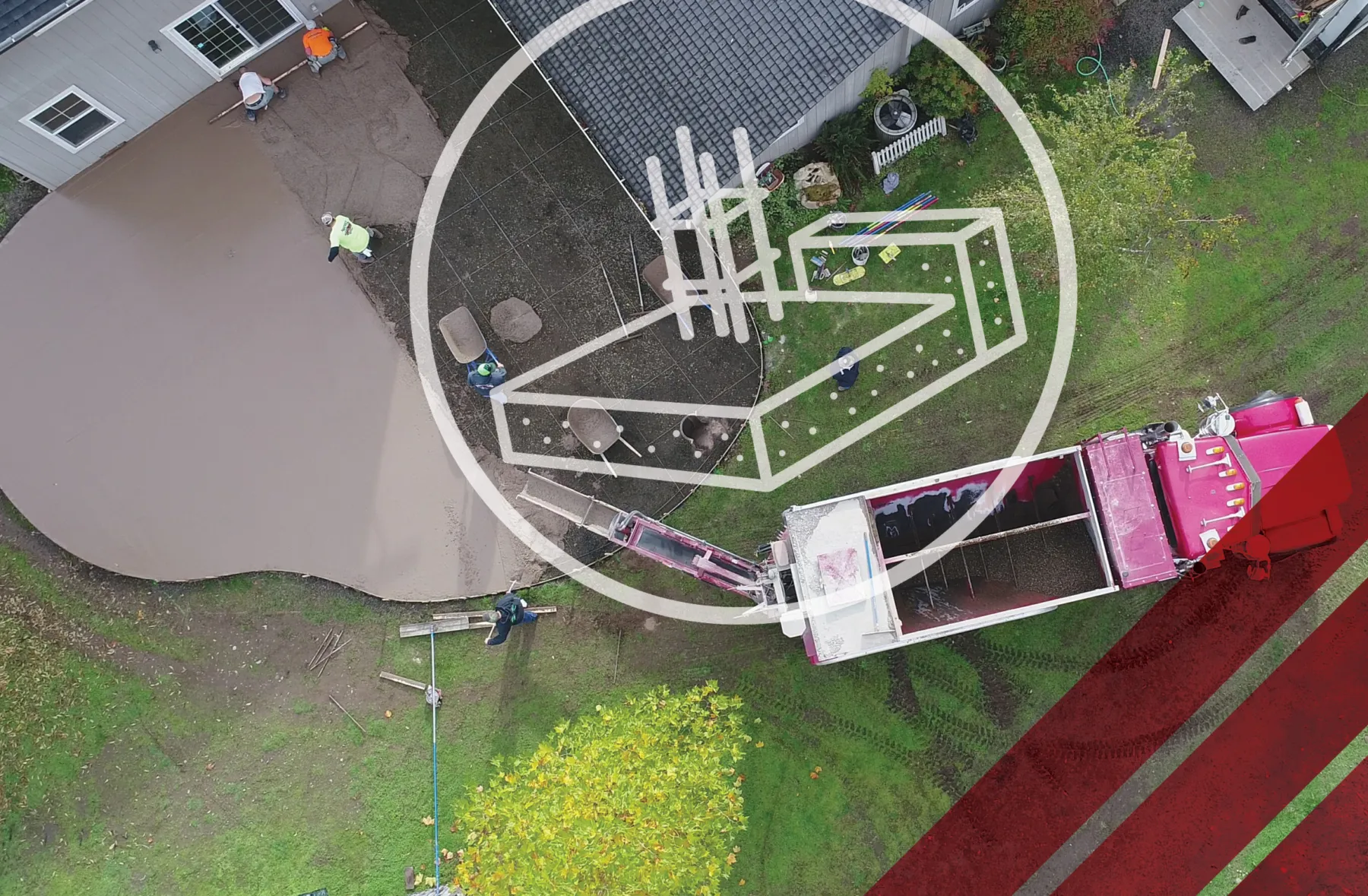
Volumetric concrete mixers are well suited to residential and small commercial foundation, footing, and slab work because pours are often small, scattered across the job site, and demand precise mix specifications. Foundation walls, spread footings, slab-on-grade pours, garage and basement slabs, driveways, sidewalks, and patios all benefit from on-site mixing that produces fresh concrete in the exact amount needed. Volumetric mixers eliminate the returned-load waste that ready-mix delivery creates on small pours, accommodate mix design changes between pours, and let contractors serve job sites that ready-mix trucks struggle to reach economically.
Why Foundation and Slab Work Fits Volumetric
Foundation and slab work has logistics that match volumetric mixing well. The pours are often small relative to what ready-mix trucks deliver, scattered across job sites, sensitive to mix specification, and tied to inspection and scheduling dependencies that disrupt fixed-route delivery.
Pour sizes match production capacity
A typical residential foundation pour might be 5 to 15 cubic yards. A spread footing might be 2 to 4 yards. A residential driveway might be 6 to 10 yards. These are pour sizes where ready-mix trucks routinely arrive with excess capacity. Volumetric mixers produce the exact amount needed for each pour, with no returned-load waste and no disposal cost.
Mix design varies by application
A foundation wall pour uses different concrete than a slab-on-grade. A garage slab in a freeze-thaw climate uses different concrete than a basement slab in a dry climate. A driveway exposed to de-icing salts needs durability features that a sidewalk does not. Volumetric mixers allow each pour to use its appropriate mix design without the logistical headache of scheduling separate ready-mix deliveries.
Inspection and schedule dependencies
Foundation pours often depend on inspections (footing inspection, reinforcement inspection, formwork inspection) that may not happen on schedule. Ready-mix delivery has to be coordinated against the inspection timing, and a delayed inspection can mean returned-load concrete and a wasted trip. Volumetric mixers eliminate this risk because the concrete is not produced until the inspection clears and the pour is ready.
Access constraints on residential sites
Residential job sites often have narrow access, soft ground, overhead utility lines, and tight setbacks that make ready-mix truck access difficult or impossible. Trailer-mounted or compact truck-mounted volumetric mixers handle these constraints better than full-size ready-mix trucks. For contractors working in established neighborhoods or on infill sites, the access flexibility is itself a competitive advantage.
Common Foundation, Footing, and Slab Applications
The general category of “foundations, footings, and slabs” covers several distinct work types, each with specific concrete and placement requirements. Understanding the differences helps with both project planning and equipment selection.
Spread footings and foundation walls
Spread footings distribute building loads to the soil below the structure. They are typically poured first, allowed to cure, and then become the base for foundation walls or columns above. Foundation walls form the perimeter of basements, crawl spaces, or stem walls under slab-on-grade structures. Both applications use structural concrete designed for compressive strength (typically 3,000 to 4,000 psi) with appropriate exposure class for the local soil and water conditions.
Slab-on-grade (residential and light commercial)
Slab-on-grade is the standard floor system for many residential and light commercial buildings. The slab is poured directly on prepared subgrade, typically with vapor barrier, base course, and rebar or fiber reinforcement. Mix designs balance compressive strength with finish ability and durability. Air entrainment is standard in freeze-thaw climates.
Garage and basement slabs
Garage slabs face different exposures than basement slabs. Garage floors deal with chloride exposure from de-icing salts on vehicles, freeze-thaw cycling in unheated garages, and point loading from vehicle tires. Basement slabs deal with moisture intrusion from below, often with vapor mitigation requirements. Mix designs differ accordingly: garage concrete often uses lower water-cement ratios and air entrainment; basement concrete often emphasizes lower permeability.
Driveways, sidewalks, and exterior flatwork
Exterior flatwork (driveways, sidewalks, walkways, patios) faces all the durability challenges of outdoor concrete: freeze-thaw, de-icing chemicals, UV exposure, and surface wear. Air entrainment per ACI 318 exposure class requirements is essential in cold climates. Surface finishing (broomed, stamped, exposed aggregate) affects how the concrete is placed and worked.
Specialty foundations (brief)
Deep foundations (drilled piers, helical piles with concrete caps), mat foundations for buildings on poor soil, post-tensioned slabs for larger commercial work, and other specialty applications exist. These typically involve larger pours, structural engineering decisions, and sometimes contractor specialization that goes beyond general residential and light commercial work. They are mentioned here for completeness; the rest of this piece focuses on the common applications most volumetric owner-operators serve.
Mix Design Considerations
Foundation and slab work uses several different mix designs depending on the structural role,
exposure environment, and finishing requirements. The mix design choices affect both the concrete performance and how the volumetric mixer is operated.
Compressive strength specifications
Residential foundations typically require 3,000 psi at 28 days, though some jurisdictions or specific designs require 3,500 to 4,000 psi. Light commercial may require 4,000 to 5,000 psi. The compressive strength specification drives the cement content, water-cement ratio, and sometimes the inclusion of supplementary cementitious materials. ACI 318 provides the durability and strength framework, and local building codes layer specific requirements on top.
Exposure class and air entrainment
Concrete exposed to freeze-thaw cycling, de-icing chemicals, or wet conditions needs air entrainment to provide freeze-thaw resistance. ACI 318 exposure classes (F0 through F3 for freezing, S0 through S3 for sulfate, W0 through W2 for water exposure, C0 through C2 for chloride exposure) define the air content and water-cement ratio requirements. Volumetric mixers can produce air-entrained concrete by metering the air-entraining admixture during mixing.
Workability and slump control
Foundation pours typically use higher slump concrete (4 to 6 inches) for placement around rebar and into formwork. Slab work typically uses lower slump (3 to 4 inches) for better finishing characteristics. Water-reducing admixtures help achieve workability without exceeding the water cement ratio limit set by the exposure class. The mixer’s admixture metering capability matters for hitting both targets simultaneously.
Fiber reinforcement (when specified)
Some slab work uses fiber reinforcement (synthetic or steel fibers) to control shrinkage cracking and add tensile strength. Fiber-reinforced concrete can be produced on volumetric mixers when the unit is configured to add fibers during mixing. Fiber dosage and timing matter for proper distribution in the concrete.
Project Planning for Foundation and Slab Work
Foundation and slab pours often look simple from the outside but involve coordination across
inspections, formwork, reinforcement placement, and finishing. Building these into the project plan avoids the late-stage scrambles that cost time and money.
Inspection sequence and timing
Most jurisdictions require inspections before the pour can proceed: footing excavation and rebar placement, foundation reinforcement, slab vapor barrier and reinforcement, and other intermediate inspections depending on the local code. The pour cannot proceed until the inspection clears. Volumetric mixing aligns with this because the concrete is produced after the inspection signoff, not before.
Weather and temperature considerations
Foundation pours happen year-round in many climates. Cold-weather concreting per ACI 306 requires temperature control, heated water, and curing protection below certain temperature thresholds. Hot-weather concreting per ACI 305 requires evaporation control and possibly chilled water or ice. Volumetric mixers allow real-time adjustment for temperature conditions in ways that fixed batch-plant deliveries cannot.
Crew coordination and finishing
Slab work especially depends on tight coordination between concrete production and the finishing crew. The mix has to arrive at the right rate for the finishers to keep up, and the workability has to hold long enough for proper screeding, floating, and final finishing. Volumetric mixing supports this because the production rate matches the placement rate, and the mix design can be adjusted in real time if conditions change.
Curing planning
Concrete curing affects final strength, durability, and surface quality. Curing methods include wet
burlap, plastic sheeting, curing compounds, and water curing. Curing duration depends on temperature and the specified strength gain. For foundations and slabs, proper curing in the first 7 days establishes the long-term performance. Skipping curing is the most common reason foundation and slab concrete underperforms its design strength.
Equipment Considerations for Residential and Light Commercial Work
Foundation and slab work has equipment requirements that differ from large infrastructure projects. Buyers and project planners selecting volumetric mixers for this work should weigh these factors.
Compact size for residential access. Tight job sites, narrow driveways, and overhead utility lines make compact mixers (often trailer-mounted) better suited than larger units. Match the equipment to the typical job site profile.
Mix flexibility across daily applications. A contractor running residential work may pour a footing, then a foundation wall, then a slab in the same day. The mixer needs to change between mix designs quickly without lengthy reset times.
Capacity matched to pour profile. For 5-to-15 yard typical pours, mid-sized mixers fit better than the largest commercial units. Excess capacity sitting idle costs money in fuel, financing, and depreciation every day.
Operator-friendly controls. Owner-operators and small crews benefit from mixers with straightforward controls and good operator training resources. Equipment that requires extensive specialized training adds friction to crew management.
Dealer service in the region. Residential contractors usually work within a defined geographic area. Equipment from manufacturers with strong dealer service in that region handles maintenance and repairs with less downtime than equipment from distant support networks.
Can volumetric concrete mixers be used for foundations?
Yes. Volumetric mixers are well suited to residential and small commercial foundations because
pours are typically small, mix designs vary between footings and walls, and job sites often have
access constraints that ready-mix delivery struggles with. Volumetric mixers eliminate returned-load
waste, accommodate inspection-driven schedule changes, and serve sites that ready-mix trucks
cannot easily reach.
What concrete strength is needed for residential foundations?
Most residential foundations require 3,000 psi at 28 days, though some designs or local codes
require 3,500 to 4,000 psi. Light commercial may require 4,000 to 5,000 psi. The specific requirement
comes from ACI 318 durability standards, the structural engineer’s design, and local building code.
Verify the specification before each pour.
Is volumetric concrete good for driveways and sidewalks?
Yes. Driveways, sidewalks, and other exterior flatwork are well-served by volumetric mixers
because the pours are usually small (often 5 to 10 yards), the mix often needs air entrainment for
freeze-thaw resistance, and contractors can match production to the work rate. The waste savings on
small flatwork pours often justify volumetric over ready-mix for these jobs.
Can I do garage and basement slabs with a volumetric mixer?
Yes. Garage slabs need different concrete than basement slabs (chloride and freeze-thaw
resistance vs lower permeability for moisture control), and volumetric mixers handle this well by
allowing each pour to use its appropriate mix design. The on-site mixing also matches the typical 8 to
15 yard pour size of residential garage and basement work.
What size mixer fits residential foundation work?
Compact and mid-range volumetric mixers fit residential foundation work best. Trailer-mounted
units excel on tight residential sites. Truck-mounted compact mixers work well for contractors with
steady residential and light commercial demand. The largest commercial mixers are usually overkill for
residential work and harder to position on typical job sites.
Next Steps
- See the equipment lineup: Cemen Tech’s volumetric mixer lineup includes compact and mid-range
units sized for residential and light commercial foundation work. - Read about paving operations: The McQuay Paving case study covers a contractor running
large-scale residential paving with volumetric mixers. - Read about fleet operations: The Bauman Landscape case study covers building a volumetric mixer
fleet for public works and parks projects. - Talk to a representative: For specific foundation and slab project questions, contact a Cemen Tech
rep for a no-pressure conversation.
Volumetric Mixers for Tunnel and Underground Construction
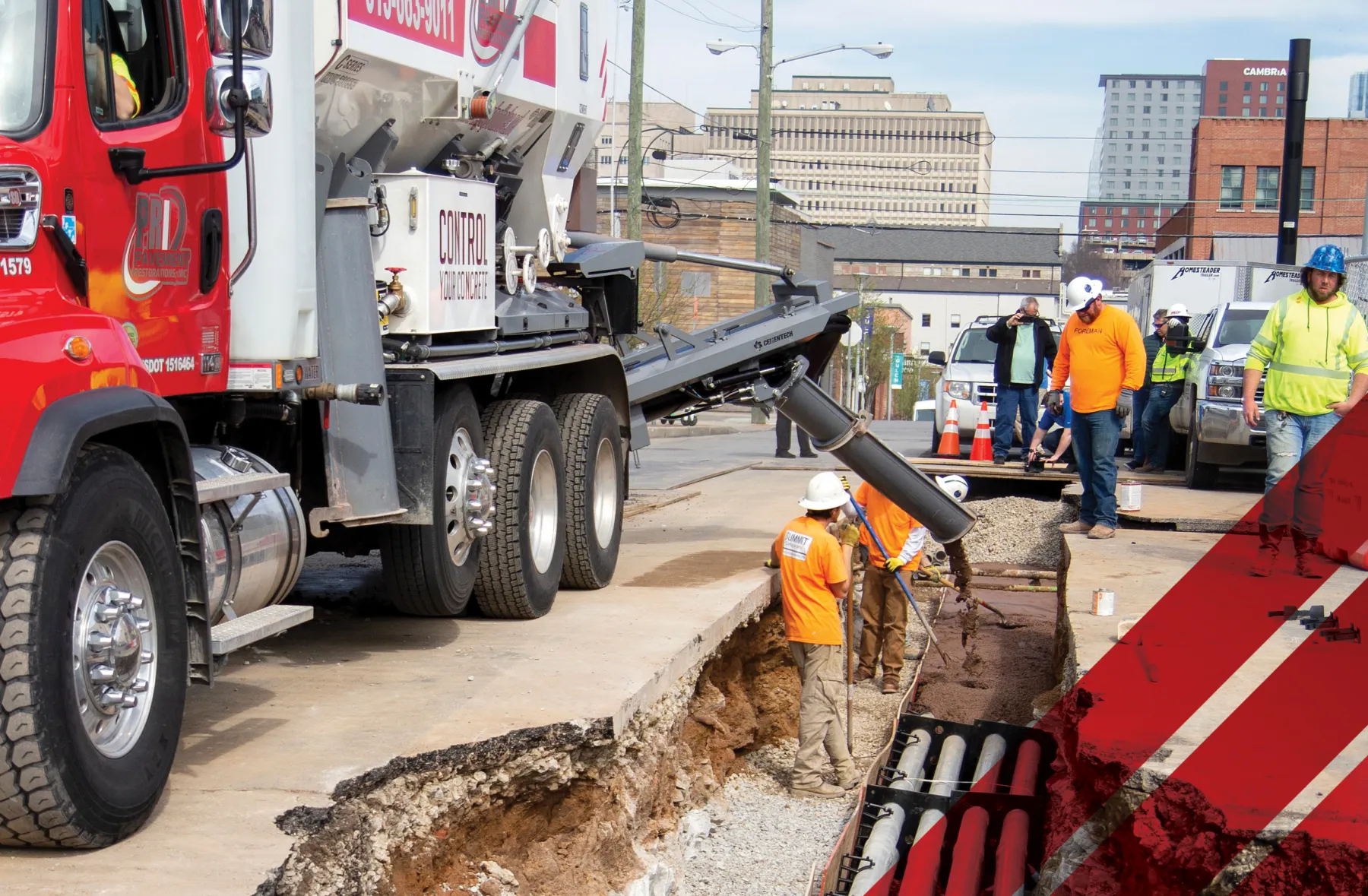
Volumetric concrete mixers are well suited to tunnel and underground construction because they produce concrete on-site under conditions where ready-mix delivery is difficult or impossible. Tunnel work involves restricted access, continuous pour requirements, ventilation constraints, and the need to coordinate concrete production with excavation, support installation, and other ongoing operations in a confined space. Volumetric mixers eliminate delivery timing risk, allow on-site mix adjustments for specific tunnel applications, and reduce the waste and disposal challenges that returned-load concrete creates in underground environments where every cubic yard of excavated and
produced material has to be carefully managed.
Why Tunnel and Underground Work Demands Different Concrete
Logistics
Above-ground concrete projects have flexibility that underground projects do not. Ready-mix trucks can come and go, returned loads can be redirected, and the work site can accommodate fleet operations. Tunnel and underground construction operates under constraints that change the math on concrete logistics entirely.
Access constraints
Tunnel work happens at the end of a long, restricted access path. Materials come in through a limited number of access points (portals, shafts, or vertical access from surface). Ready-mix delivery to deep tunnel locations is often impractical because the truck cannot reach the work face or because the time from batch plant to placement exceeds the concrete’s workability window. A volumetric mixer that can be positioned at the access point or moved along the tunnel produces fresh concrete exactly where it is needed.
Continuous pour requirements
Many tunnel concrete operations (invert slabs, tunnel lining sections, support structures) require continuous pours that cannot tolerate interruptions. A pause for the next ready-mix truck to arrive can create a cold joint, compromise the concrete’s monolithic integrity, and create a weak point in a structure that may have to last for decades. Volumetric mixers produce concrete continuously as long as materials are loaded, eliminating the delivery-driven interruptions that fixed-batch logistics impose.
Ventilation and environmental conditions
Tunnel environments have specific ventilation requirements driven by OSHA standards for underground construction and by the operating limits of equipment, workers, and concrete itself. Diesel-powered ready-mix trucks add to ventilation load every time they enter the tunnel. Volumetric mixers stationed at the portal or strategically positioned reduce the number of vehicle movements into and out of the working zone, which has real implications for ventilation system load and crew safety.
Materials management in confined spaces
Excavated material removal and concrete delivery share the same access infrastructure in most tunnel projects. Every cubic yard of returned-load concrete from a ready-mix truck has to be hauled back out the access path, often along with excavated muck. Volumetric mixers that produce only what is needed avoid this entirely. There is no returned-load disposal problem because there is no returned load.
Where Volumetric Concrete Fits in Tunnel Construction
Tunnel construction involves multiple concrete applications, and not every one is volumetric territory. Understanding where volumetric concrete fits, and where other equipment is the right tool, helps with project planning and equipment selection.
Tunnel invert and floor slabs
The invert slab (the floor of the tunnel) is often a primary volumetric application. The pour can be substantial, the placement requires steady supply, and the mix specification may need adjustment based on substrate conditions found during construction. A volumetric mixer positioned for invert pours allows continuous production matched to the placement rate.
Tunnel lining sections
Cast-in-place tunnel lining (where used instead of segmental precast lining) is another volumetric application. Lining pours require careful control of the mix to achieve specified strength and durability, and the placement rate often dictates the production rate. Volumetric mixers handle this work well because the mix can be adjusted during the pour and production runs as long as needed.
Cross passages, niches, and support structures
Tunnels include many smaller concrete elements: cross passages between adjacent tunnels, electrical and mechanical niches in the lining, support pads for equipment, and miscellaneous structural elements. These smaller pours are particularly well suited to volumetric mixers because the production volume matches the placement need precisely. No returned-load waste from oversized ready-mix deliveries.
Mix Design Considerations for Underground Concrete
Underground concrete operates in environments that affect the mix design choices. Temperature, humidity, ground conditions, and the specific structural role all influence what the concrete needs to do and how it should be mixed.
Temperature and curing
Tunnel environments often have stable temperatures that differ significantly from surface conditions. Deep tunnels can be warm year-round; shallow or recently excavated sections can be cool and damp. ACI 306 (cold-weather concreting) and ACI 305 (hot-weather concreting) provide guidance, but tunnel conditions often fall in a middle zone that affects curing rate and final strength development. The mix design should account for actual placement conditions, not surface assumptions.
Groundwater and substrate moisture
Many tunnels carry water inflows that affect concrete placement. Mix designs may need to incorporate additional admixtures for placement against wet substrates, or shotcrete may be used to control inflow before final concrete placement. Volumetric mixers allow real-time adjustment of admixture dosing as conditions change during the pour.
Strength specifications and exposure class
Tunnel structural concrete typically follows ACI 318 strength and durability requirements, with the exposure class determined by the specific tunnel environment (chloride exposure from de-icing in road tunnels, sulfate exposure in some geologic conditions, freeze-thaw cycling in shallow tunnels in cold climates). The mix design has to match the specified exposure class, and the volumetric mixer needs to be calibrated to produce that mix accurately.
Aggregate and admixture considerations
Tunnel concrete often uses specific aggregates and admixture combinations selected for the underground environment: low-alkali cements where ASR-susceptible aggregates are present, supplementary cementitious materials for sulfate resistance or chloride permeability reduction, water-reducing admixtures for pumpability over distance. Volumetric mixers can accommodate these specifications when the unit’s metering systems are configured for the materials involved.
Project Planning for Underground Concrete Work
Tunnel and underground concrete projects involve planning steps that surface concrete projects do not require. Building these into the project from the start avoids the late-stage scrambles that drive cost overruns.
Access and positioning planning
Where will the volumetric mixer be positioned? How will it be moved as the work progresses? How will raw materials (cement, aggregate, water) be delivered to the mixer location? These logistical questions have answers that affect equipment selection, crew planning, and the project schedule. Larger tunnel projects sometimes use multiple mixers positioned at different points along the work face.
Ventilation and air quality coordination
The tunnel ventilation plan has to accommodate the mixer operations. Diesel-powered equipment in the tunnel adds to the ventilation load, and concrete operations themselves can release water vapor, dust, and admixture vapors that affect air quality. Project planning should coordinate concrete operations with overall tunnel ventilation capacity.
Documentation and inspection access
Federal tunnel projects (and many state DOT tunnel projects) require detailed concrete placement documentation that can be inspected during and after the work. Modern volumetric mixers generate batching records and digital tickets that satisfy these requirements, but the inspection workflow has to accommodate the tunnel environment. Plan how inspectors will access the placement records and the concrete itself for testing.
Coordination with excavation and support work
Concrete placement in tunnels happens around active excavation, ground support installation, and other operations. The concrete pour schedule has to integrate with the rest of the tunnel construction sequence. Volumetric mixing helps here because the production rate can match the placement rate, which often depends on the rate of the surrounding work rather than on a fixed concrete delivery schedule.
Equipment Considerations for Tunnel Work
Tunnel applications place specific demands on volumetric mixers. Buyers and project planners selecting equipment for this work should evaluate units against these criteria.
Mobility within constrained spaces. The mixer needs to fit through the access infrastructure and operate in the available work zones. Compact and trailer-mounted units often fit tunnel applications better than the largest commercial units. Match the equipment to the access constraints.
Reliable performance under sustained operation. Tunnel pours often run long. The mixer needs to operate reliably for extended periods without the kind of downtime that would stall the work face. Well-maintained units with strong parts availability matter more here than in less demanding applications.
Mix flexibility for specialty designs. Tunnel concrete often uses specialty mixes (low-alkali, SCM-blended, admixture-heavy). The mixer needs to accommodate the specified materials and produce them accurately. Confirm the unit’s metering systems can handle the specific materials in the project specification.
Documentation systems. For DOT, federal, or large infrastructure tunnel projects, the mixer’s documentation capabilities (batching records, digital tickets, calibration history) need to satisfy the project’s documentation requirements.
Service and support reach. A tunnel project mid-pour cannot easily wait for a service visit. Equipment from manufacturers with strong dealer service networks in the project region is the safer choice, even if other equipment options exist at lower upfront cost.
Can volumetric concrete mixers be used in tunnel construction?
Yes. Volumetric mixers are well suited to tunnel work because they produce concrete on-site
under access constraints that make ready-mix delivery impractical. They support continuous pours,
allow real-time mix adjustments, eliminate returned-load waste, and reduce vehicle traffic in the tunnel
environment. Common applications include invert slabs, lining sections, and smaller structural pours.
What is the difference between volumetric concrete and shotcrete in tunnel work?
Volumetric concrete is placed by traditional methods (pumping, chuting, or bucketing) for structural
elements like invert slabs and lining sections. Shotcrete is pneumatically applied for ground support,
rock stabilization, and initial tunnel lining. Both have roles in tunnel construction; they are not
interchangeable. The choice depends on the specific application within the project.
What ACI standards apply to tunnel concrete?
ACI 318 covers structural concrete design and durability requirements, with the exposure class
selected for the specific tunnel environment. ACI 305 (hot-weather concreting) and ACI 306
(cold-weather concreting) provide placement guidance. ACI 506 covers shotcrete placement
separately. The specific standards depend on the application and the project specification.
How do volumetric mixers handle tunnel ventilation constraints?
Volumetric mixers stationed at portals or positioned strategically within the tunnel reduce the
number of diesel-powered vehicle movements into the working zone, which helps ventilation load. The
mixer itself uses less fuel per cubic yard than the equivalent ready-mix delivery cycle, further reducing
ventilation system demand. OSHA underground construction standards (29 CFR 1926 Subpart S)
govern the overall ventilation requirements.
What size mixer is best for tunnel work?
Tunnel work generally favors compact and mid-range mixers that can navigate access constraints
and operate within work zone dimensions. The largest commercial mixers are often impractical in
tunnel environments. The right size depends on the specific tunnel dimensions, the access
infrastructure, and the production rate required. Trailer-mounted units sometimes work well for tunnel
positioning flexibility.
Next Steps
- Explore applications: Cemen Tech’s volumetric mixer applications page covers the range of project
types these mixers serve. -
See the equipment lineup: Cemen Tech’s equipment lineup includes units sized and configured for
infrastructure work, including tunnel applications. - For gunite and shotcrete work: See the G30X gunite mixer for dedicated gunite applications.
-
Talk to a representative: For specific tunnel project questions or equipment selection guidance,
contact a Cemen Tech rep for a no-pressure conversation.
Precast Concrete Production with Volumetric Mixers
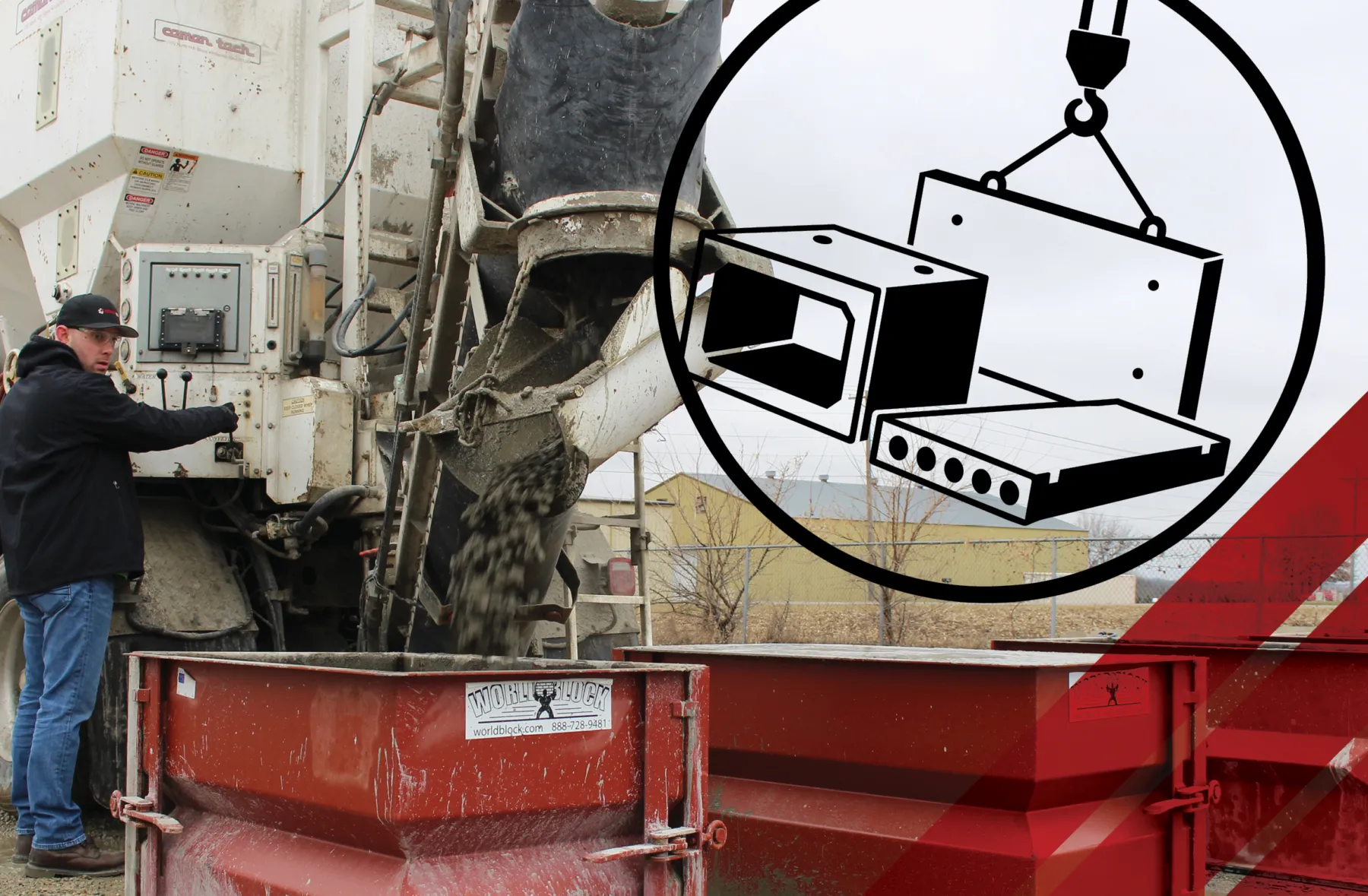
Volumetric mixers fit precast concrete production because they produce concrete in exactly the amount needed for each cast, allow real-time mix design adjustments between casts, and integrate cleanly with the casting schedule that precast plants run. Stationary volumetric mixers serve fixed-plant precast operations where the mixer stays in place and materials are delivered to it. Mobile volumetric mixers serve precast contractors who cast on-site or who need flexible production capacity beyond their fixed plant. Both approaches eliminate the returned-load waste that fixed-batch ready-mix delivery creates when cast schedules shift.
Why Volumetric Mixers Fit Precast Production
Precast concrete production has specific rhythms that traditional ready-mix delivery does not match well. Production happens in casting cycles, mix designs vary between products, and the production schedule shifts based on cast curing times, demolding schedules, and shipping requirements. Volumetric mixers fit these rhythms because they produce on demand to exact specification.
Cast-to-cast mix variation
A precast plant might produce structural beams, architectural panels, and underground utility vaults in the same day, each requiring different concrete mix designs. A traditional batch-plant operation has to either run separate batches for each product (with the cleanup and changeover time that requires) or compromise on a single mix design that works adequately for everything. Volumetric mixers change mix designs on the fly with no batch-plant changeover.
Production matched to casting capacity
Precast production rate is governed by the forms, the curing schedule, and the demolding cycle. The concrete supply has to match the rate at which casts are ready to be filled. Producing too much creates waste; producing too little stalls the casting crew. Volumetric mixers produce concrete continuously as casts come available, with production rate adjustable to match the casting rate.
Schedule shifts and casting delays
Precast schedules shift constantly. A cast may be delayed by inspection, formwork issues, reinforcement problems, or material delivery timing. With ready-mix delivery, schedule shifts create returned-load disposal problems and wasted truck time. With volumetric mixing, schedule shifts are absorbed naturally because concrete is not produced until the cast is ready.
Quality control documentation
Precast plants often supply structural products that require detailed quality documentation: batch records, strength test results, dimensional verification. Volumetric mixers generate batching records and digital tickets for every pour, which integrate with the plant’s quality control system. ACI 318 and PCI design standards both depend on documented mix and placement, which volumetric mixers support natively.
Stationary Mixers for Fixed-Plant Precast Operations
Established precast producers running fixed plant operations typically use stationary volumetric mixers as part of the plant infrastructure. The mixer stays in one location and materials are delivered to it from on-site silos and aggregate bins.
How stationary volumetric differs from traditional batch plants
A traditional batch plant produces concrete in discrete batches sized to the equipment capacity. The plant has to be cleaned out between mix designs, which limits the practical mix variation in a production day. A stationary volumetric mixer produces continuously, with materials metered into the mix in real time. The result is greater mix flexibility, less changeover downtime, and production rates matched to casting needs rather than batch sizes.
Sizing stationary equipment for plant capacity
Stationary volumetric mixers are sized to the plant’s typical production rate. Smaller precast operations producing limited daily volume may need a compact stationary unit. Larger plants producing high daily volume need larger capacity. The right size depends on the typical cast volume, the casting cycle time, and the diversity of mix designs in production.
Integration with plant infrastructure
Stationary mixers integrate with the plant’s materials handling: cement and aggregate silos, water systems, admixture dosing, and the digital quality control infrastructure. A well-designed precast plant treats the mixer as a core piece of plant equipment, not an add-on. The materials handling capacity has to match the mixer’s production capacity for the integration to work efficiently.
Cemen Tech’s SCD stationary mixer lineup Concrete
Cemen Tech’s SCD-series stationary mixers cover precast plant operations from small compact installations to large high-volume plants. The lineup includes the SCD2-50 and SCD5-50 for smaller operations, the SCD6-100 and SCD8-150 for mid-range plants, and the SCD10-200 for the largest production capacity. Sizing depends on the daily production volume and the typical mix variation a plant runs.
Mobile Volumetric Mixers for Precast Operations
Not every precast operation runs from a fixed plant. Some precast work happens on-site (cast-in-place adjacent operations, site-built precast for specific projects), and some precast contractors use mobile equipment to supplement fixed-plant capacity during peak production.
On-site precast for project-specific work
Some construction projects involve precast elements cast on-site rather than transported from a fixed plant. Large structural elements that exceed transport limits, project-specific architectural pieces, or remote work locations may all favor on-site casting. Mobile volumetric mixers handle this work because the mixer comes to the job site rather than the cast traveling to a plant.
Supplementing fixed-plant capacity
During peak production, a fixed-plant precast operation may need supplemental concrete supply beyond what the plant’s stationary mixer can produce. A mobile volumetric mixer brought in for peak periods adds capacity without permanent plant investment. This is also useful when the fixed mixer is down for maintenance and the casting schedule cannot accommodate a full shutdown.
Specialty applications and small-batch production
Some precast products are produced in such small quantities that running the full fixed plant is uneconomical. Small specialty casts, mock-up production, or research and development work may all favor a mobile mixer that can be dedicated to the small-batch work without taking the main plant offline.
Mix Design Considerations for Precast
Precast concrete typically uses higher-performance mix designs than general construction concrete. The structural performance requirements, the demolding schedule, and the aesthetic and dimensional requirements all drive mix design choices.
High early strength for demolding
Precast production cycles depend on the cast reaching demolding strength quickly so the form can be cleaned and reused for the next cast. Mix designs often emphasize early strength gain through Type III cement, higher cement content, accelerators, or steam curing. The mixer has to handle the high-cement-content mixes without segregation or workability issues.
Self-consolidating concrete (SCC) for complex shapes
Precast products with complex shapes, dense reinforcement, or surface detailing often use self-consolidating concrete that flows into the form under its own weight. SCC mix designs are specifically engineered for flowability without segregation. ACI 237 covers SCC specifications. Volumetric mixers can produce SCC when the admixture systems are configured for the specific requirements.
Durability and exposure considerations
Precast products are often used in aggressive exposure environments: bridges, marine structures, parking decks, utility vaults in chloride-rich soils. Mix designs incorporate supplementary cementitious materials (fly ash, slag cement, silica fume) and air entrainment to address durability per ACI 318 exposure class requirements. The plant has to be able to produce the required mix consistently for every cast that will see the exposure environment.
Aesthetic and architectural finishes
Architectural precast products have surface appearance requirements that drive mix design choices: specific aggregates for exposed-aggregate finishes, pigments for integral color, specific cement types for surface uniformity. The mixer has to handle these specialty materials accurately. Variability in the mix shows up as variability in the finished surface, which is unacceptable for architectural work.
Equipment Considerations for Precast Work
Precast production places specific demands on volumetric equipment, whether stationary or mobile. The right equipment selection depends on the production scale, the mix variation, and the operational integration with the rest of the plant.
Production rate matched to casting capacity. The mixer’s production rate should match the plant’s casting capacity at peak production, with margin for occasional surges. Undersized mixers stall the casting crew; oversized mixers represent wasted capital.
Mix flexibility for diverse product lines. Plants producing diverse precast products (structural and architectural, multiple cement types, varied aggregate sizes) need equipment that can handle the variation. Confirm the mixer’s metering systems accommodate the full range of materials in the plant’s production.
Materials handling integration. The mixer integrates with cement silos, aggregate bins, water systems, and admixture dosing. The integration should be designed at the plant level, not retrofitted as an afterthought. Strong materials handling makes the mixer’s on-demand production a real advantage; weak materials handling undermines it.
Documentation and quality control integration. For structural precast supplied to commercial and infrastructure projects, the documentation requirements are significant. The mixer’s batching records and digital tickets should integrate with the plant’s overall quality control system, not exist as a separate paper trail.
Service support and downtime tolerance. A precast plant operating at full production has limited tolerance for mixer downtime. Equipment from manufacturers with strong service support, quick parts availability, and proven uptime track records is the safer choice for production-critical operations.
Can volumetric mixers be used for precast production?
Yes. Volumetric mixers fit precast production because they produce concrete on demand in the
exact amount needed for each cast, allow mix design adjustments between casts, and match
production to the casting schedule. Stationary volumetric mixers serve fixed-plant operations; mobile
mixers serve on-site casting and supplemental production. Both approaches eliminate returned-load
waste.
What is the difference between a stationary mixer and a mobile volumetric mixer for precast?
Stationary mixers stay in one location and are integrated into the plant’s materials handling
infrastructure. Mobile mixers travel to job sites or move between locations. For fixed-plant precast,
stationary equipment matches the production model. For on-site casting, project-specific work, or
supplemental capacity, mobile equipment provides flexibility.
What size stationary mixer does a precast plant need?
Sizing depends on daily production volume, casting cycle time, and the diversity of mix designs in
production. Compact stationary mixers fit smaller operations with limited daily volume. Larger units
serve high-volume plants. The right size also depends on the materials handling capacity feeding the
mixer; an oversized mixer constrained by inadequate materials supply is not a productivity gain.
Can volumetric mixers produce self-consolidating concrete (SCC)?
Yes, when the mixer’s admixture metering systems are configured for SCC mix designs. ACI 237
covers SCC specifications. Volumetric production of SCC requires careful admixture dosing because
SCC mix designs are sensitive to dosage variation. For precast plants producing significant SCC
volume, this is worth confirming with the equipment specifications.
What documentation do precast plants need from a volumetric mixer?
Modern volumetric mixers generate batching records and digital tickets for every pour, including
the mix design, materials used, batch quantity, and time stamp. For structural precast subject to ACI
318 and PCI design standards, this documentation supports the quality records required by the
standards. The mixer’s documentation should integrate with the plant’s overall quality control system.
Next Steps
- Explore stationary mixer options: Cemen Tech’s SCD-series stationary mixers cover precast
operations from compact installations to large high-volume plants. -
Explore mobile mixer options: For on-site precast or supplemental capacity, see the full equipment
lineup including truck-mounted and trailer-mounted volumetric mixers. - Talk to a representative: For specific precast plant equipment selection or operational questions,
contact a Cemen Tech rep for a no-pressure conversation.
Training Your Crew on a Volumetric Concrete Mixer
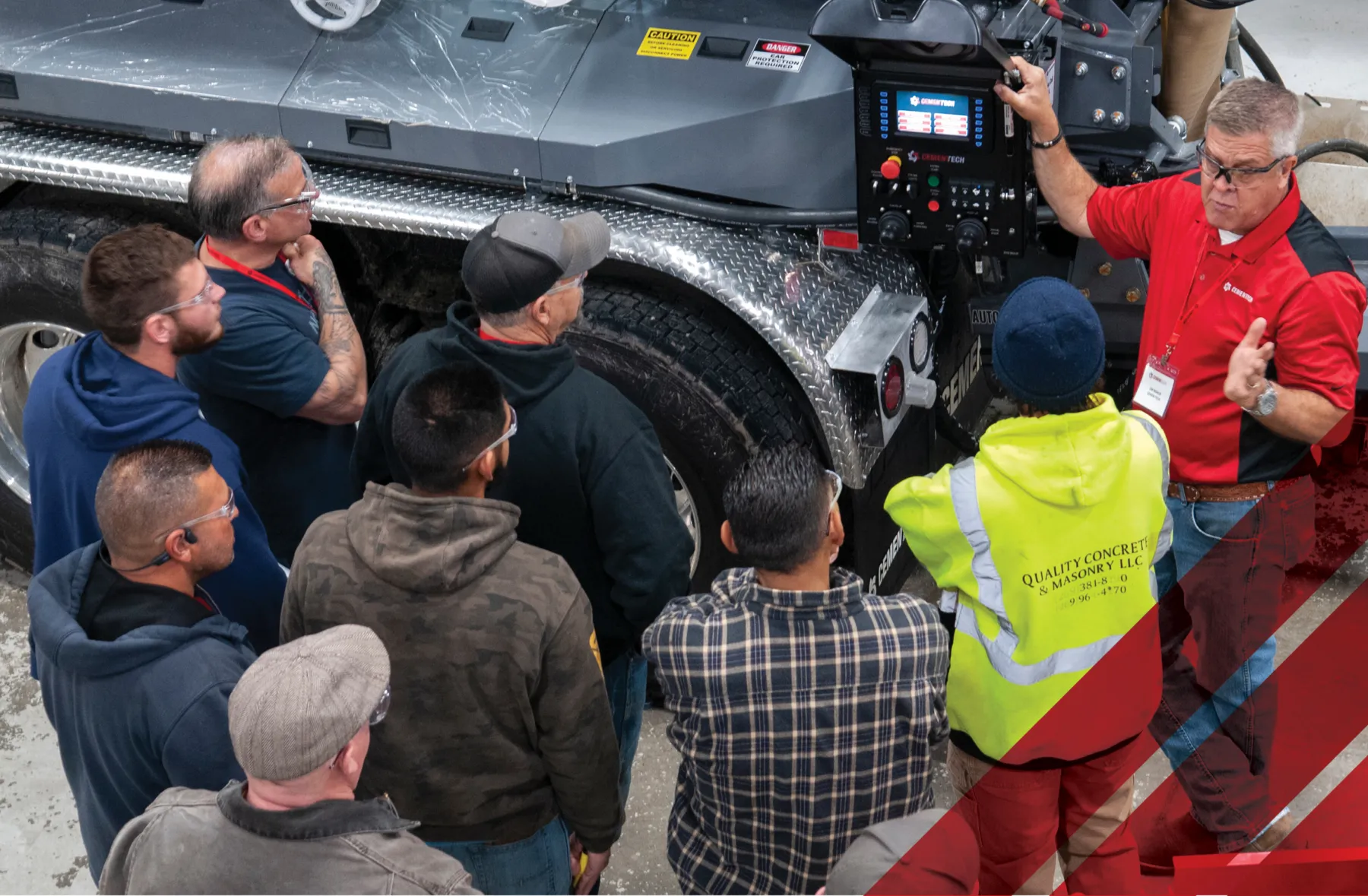
Training a new volumetric mixer operator typically takes 4 to 12 weeks of combined manufacturer training and supervised on-the-job experience before the operator can run independently. Manufacturer training (usually 1 to 2 weeks) covers the equipment fundamentals: controls, mix design entry, safety procedures, basic calibration, and routine maintenance. On-the-job mentoring with an experienced operator covers the operational judgment that only develops through actual production work: reading job site conditions, troubleshooting in real time, managing materials, and handling the customer-facing aspects of the job. The two components together produce competent operators; either alone produces incomplete operators.
Why Volumetric Mixer Operators Need Training
A volumetric concrete mixer is more complex than the ready-mix trucks most concrete operators are familiar with. The operator does not just transport the concrete; they actually produce it on-site, adjusting the mix in real time, meeting specifications, and handling the materials and equipment that make on-demand production possible. Putting an untrained operator behind the controls is one of the most expensive mistakes a contractor can make.
Concrete quality depends on the operator
A trained operator produces concrete that consistently meets the specified mix design, exposure class, and project requirements. An untrained operator can produce concrete that looks fine but tests low for strength, fails to bond properly, or otherwise underperforms the specification. The mistakes can be invisible until the concrete is in place and the problem has multiplied.
Safety depends on the operator
Volumetric mixers involve hydraulic systems under high pressure, electrical systems, mechanical components in motion, and the production of materials that can cause burns, eye injuries, or respiratory problems. Trained operators follow safety procedures that protect them, their crew, and the public around the work site. Untrained operators often cause the accidents that drive up insurance premiums and create liability exposure.
Equipment longevity depends on the operator
Trained operators treat the equipment correctly: proper warmup and cool-down, appropriate operating speeds, scheduled maintenance discipline, and recognition of developing problems before they become failures. Untrained operators wear out equipment faster, miss developing problems, and convert preventable maintenance into expensive repairs. Over a 15 to 20 year equipment life, the cumulative cost difference is substantial.
Customer relationships depend on the operator
The operator is often the customer-facing representative of the business. They arrive on the job site, interact with the customer’s crew, handle inevitable questions and minor issues, and represent the contractor’s brand. A professional, knowledgeable operator builds customer relationships that drive repeat business. A struggling or unprofessional operator drives customers away.
The Two Components of Effective Operator Training
Effective volumetric mixer operator development combines manufacturer technical training with on-the-job operational experience. Neither component alone produces competent operators; the combination is what works.
Component 1: Manufacturer technical training
Manufacturer training (typically 1 to 2 weeks for new operators) covers the equipment-specific knowledge that does not transfer from other concrete experience: how the controls work, how to enter and run mix designs, how the metering systems function, basic troubleshooting, safety procedures specific to the equipment, and routine maintenance the operator handles in the field.
Cemen Tech’s volumetric mixer training delivers this technical foundation for Cemen Tech equipment. The training is structured, time-bounded, and produces operators who understand the specific equipment they will run. It is the appropriate starting point for any new operator coming to Cemen Tech equipment.
Component 2: On-the-job mentoring
On-the-job mentoring (typically 4 to 8 additional weeks of supervised production work) covers the operational judgment that only develops through actual experience: reading job site conditions, adjusting to material variations, recognizing developing problems, managing the production rhythm to match the placement crew, handling customer questions and minor disputes, and the dozens of small decisions that experienced operators make automatically.
Effective on-the-job mentoring requires a qualified mentor (an experienced operator who can teach as well as do), supervised practice on real jobs, gradually increasing responsibility, and structured feedback. Just having a new operator ride along is not mentoring; it is unsupervised observation that may or may not produce useful learning.
Why both components matter
Operators who get manufacturer training without on-the-job mentoring know the equipment but lack operational judgment. They make textbook decisions that work in training but fail in real conditions. Operators who get on-the-job experience without manufacturer training develop habits that may work but include gaps in their understanding of why those habits work. They are less able to adapt when conditions change. The combination is what produces operators who can both execute and adapt.
A Realistic Operator Development Timeline
Realistic timelines help owner-operators plan for the actual work of bringing on a new operator. Compressed timelines produce undertrained operators; overlong timelines waste payroll. The right timeline depends on the trainee’s prior experience.
Weeks 1-2: Manufacturer technical training
The trainee attends manufacturer training, learns the equipment fundamentals, practices on training units, and returns ready to start supervised production work. The trainee has the technical foundation but no operational experience yet.
Weeks 3-6: Heavily supervised production
The trainee runs production work with an experienced operator alongside them at all times. The trainee does the work; the mentor provides immediate guidance, catches problems before they become mistakes, and gradually expands the trainee’s responsibilities. Customer-facing aspects of the job stay with the mentor in this phase.
Weeks 7-10: Lightly supervised production
The trainee runs production work independently for most of the day, with the mentor available by phone and on-site for specific situations. Customer-facing aspects of the job start transferring to the trainee under the mentor’s observation. Mistakes happen at this stage; the mentor reviews them with the trainee rather than just fixing them.
Weeks 11-12: Independent operation with monitoring
The trainee operates independently. The mentor reviews work performance, customer feedback, and any incidents. The trainee handles the full operator role including customer interaction, troubleshooting, and end-of-day reporting. After successful independent operation for several weeks, the trainee transitions to fully autonomous status.
Accelerated timelines for experienced concrete operators
A trainee with prior concrete equipment experience (ready-mix truck operator, batch plant operator, finisher with strong knowledge of concrete behavior) may compress this timeline meaningfully. Someone with zero concrete experience may need longer than 12 weeks. Match the timeline to the actual learning curve, not to a generic schedule.
What to Teach Beyond the Equipment
Equipment training is necessary but not sufficient. The full operator role includes responsibilities that go beyond the mixer itself. Effective training covers these dimensions explicitly rather than leaving them to chance.
Reading job site conditions. Site access, ground conditions, weather effects on the work, traffic management, and dozens of other site factors affect how the work goes. Operators need to assess these quickly and adjust their approach accordingly.
Understanding mix design and concrete behavior. Operators do not need to be concrete engineers, but they need enough understanding of how the mix design works to recognize when conditions require adjustment and to communicate intelligently with the customer’s placement crew.
Materials management. Cement supply, aggregate quality, water quality, and admixture handling all affect the concrete the operator produces. Trained operators monitor materials and recognize when something is off-spec before it shows up in the concrete.
Customer interaction. Concrete contractors are often working under stress, on tight schedules, with their own customers waiting. The operator who can stay calm, communicate clearly, and solve problems collaboratively builds relationships that drive repeat business.
Documentation discipline. For DOT work and major commercial projects, the operator is responsible for documentation that supports project acceptance. Skipping or sloppy documentation can produce major problems downstream. Training has to cover the why of documentation, not just the what.
Common Training Mistakes
Several recurring mistakes show up in volumetric operator training programs. Knowing them in advance helps you avoid them.
Compressing the timeline to save payroll
The most common mistake is releasing trainees to independent work too soon. Saved payroll in the training period gets erased many times over by the mistakes the undertrained operator makes once independent. A trainee who needs an extra month of supervised work and gets it produces better outcomes than a trainee who is pushed to independence too early.
Skipping manufacturer training
Some owner-operators decide they will train new operators themselves rather than sending them to manufacturer training. This usually does not work because the owner is busy running their own work and cannot dedicate the focused training time the trainee needs. Manufacturer training is a small investment that produces better operators than improvised in-house training.
Choosing a mentor based on availability rather than skill
The best operators are not always the best mentors. Mentoring requires patience, the ability to explain why things work, and the willingness to let the trainee make mistakes and learn from them. If your best operator is impatient or cannot articulate why they do what they do, they may not be the right mentor. Choose mentors based on teaching ability, not just operational skill.
Failing to give the trainee real responsibility
A trainee who only observes never develops independent judgment. Effective training requires the trainee to make decisions, including some that will turn out to be wrong. The mentor’s job is to catch the wrong decisions before they cause serious problems while letting the trainee experience the consequences enough to learn. Pure observation without responsibility produces operators who freeze when they have to act independently.
Building an Ongoing Development Culture
Initial training produces a competent operator. Ongoing development produces an excellent one. Operations that treat training as a one-time event get operators who plateau at competent. Operations that build ongoing development into the work get operators who keep improving for years.
Regular skills updates. Equipment evolves, mix designs change, project requirements shift. Operators benefit from periodic refreshers that update their knowledge to current practice. Many manufacturers offer continuing education and update training for existing operators.
After-action reviews. After significant jobs (especially difficult ones), discuss what worked, what did not, and what the team learned. The conversation matters more than the outcome of any individual job; it is how the operator develops judgment over time.
Cross-training across the operation. Operators who understand the rest of the business (sales, dispatch, materials supply, accounting) make better decisions in the field. Cross-training takes time but produces operators who can solve problems collaboratively rather than just executing instructions.
Recognition and advancement. Good operators are valuable. Operations that recognize their value, pay competitively, and offer advancement paths retain operators longer. Operator turnover is expensive in training cost, productivity loss, and customer relationship disruption.
How long does it take to train a volumetric concrete mixer operator?
Typical training timelines run 4 to 12 weeks combining manufacturer technical training (1 to 2
weeks) with supervised on-the-job experience (4 to 8 additional weeks). Trainees with prior concrete
equipment experience may compress this timeline. Trainees new to concrete may need longer. Match
the timeline to the trainee’s actual learning curve, not to a generic schedule.
Do I need to send my operator to manufacturer training?
Manufacturer training is the most efficient way to teach the equipment-specific knowledge that
does not transfer from other concrete experience: controls, mix design entry, metering systems, safety
procedures, and routine maintenance. Most owner-operators find manufacturer training produces
better outcomes than improvised in-house training. Cemen Tech offers volumetric mixer training
through its service support program.
Can I train a new operator myself?
Possibly, but most owner-operators find it does not work well. Owners are typically too busy
running their own work to provide the focused training time a new operator needs. Manufacturer
training combined with on-the-job mentoring usually produces better operators in less time than full
in-house training, and at lower total cost when you account for the owner’s opportunity cost.
What should I look for in a good volumetric mixer operator trainee?
Strong candidates have prior concrete or construction experience, mechanical aptitude, attention
to detail, comfort with customer interaction, and the temperament to handle pressure on tight
schedules. Pure mechanical ability without people skills produces operators who struggle with
customer-facing aspects. People skills without mechanical aptitude produces operators who damage
equipment. Look for balance.
How do I keep good operators?
Operators stay when they are paid competitively, recognized for their work, offered advancement
paths, and treated as professionals. Operations that treat operators as interchangeable see high
turnover and the associated training costs. Operations that invest in operator development through
continuing education, after-action reviews, and cross-training retain operators longer and get better
performance.
Next Steps
- For manufacturer training on Cemen Tech equipment: Volumetric mixer training provides the technical foundation new operators need before starting on-the-job work.
- For ongoing support: Technical support via video call connects operators with Cemen Tech expertise for questions that come up during the work.
- For ongoing maintenance training: Operators benefit from understanding the maintenance schedule well enough to perform daily and weekly maintenance correctly.
- Talk to a representative: For specific training questions or to schedule training for your operators, contact a Cemen Tech rep for a no-pressure conversation.
Volumetric Concrete for Highway and Road Repair: A Practical Guide

Volumetric concrete mixers are widely used in highway and road repair because they produce fresh concrete on-site under the tight closure windows, scattered work sites, and varied pour sizes that pavement repair demands. Highway repair work involves full-depth pavement repair, partial-depth patching, joint and crack repair, concrete overlays, and dowel bar retrofit operations. Each of these has specific concrete specifications, traffic restoration timelines, and DOT documentation requirements. Volumetric mixers fit this work because they produce only what is needed, allow real-time mix adjustment for varying repair conditions, and meet the ASTM C685 calibration standards required for state and federal road work.
Why Volumetric Mixers Fit Highway Repair Work
Highway and road repair has logistics that differ from new road construction. Crews move along long stretches of roadway making small, scattered repairs. Closure windows are short, traffic management is constant, and the production rate must match the work rate of repair crews ahead of the pour. Volumetric mixers fit this rhythm because they produce only what is needed and travel with the crew rather than depending on fixed-route ready-mix delivery.
Early strength gain for traffic restoration
Most repair specifications require minimum compressive strength before traffic restoration. Common thresholds include 3,000 psi for general traffic and higher figures for heavy vehicle or interstate work. Mix designs for repair often use Type III high-early-strength portland cement, accelerators, or specialty rapid-setting cements like calcium sulfoaluminate (CSA) to achieve strength fast.
Scattered, variable-size pours
A highway repair crew may pour a 1-yard patch, then a 3-yard joint repair, then an 8-yard full-depth section, then a 2-yard partial-depth patch, all in the same shift. Ready-mix delivery struggles with this profile because every truck delivers a fixed batch and unused concrete goes to waste. A volumetric mixer produces the exact amount needed for each repair, with no waste between pours.
Mobile crew operations
Highway repair crews work along the road, not at a fixed location. The mixer travels with the crew, repositioning between pours and producing concrete at the work face. Ready-mix delivery has to follow the crew along the road, which is impractical for small, scattered pours and uneconomical for the delivery operator.
Tight closure windows for traffic restoration
Highway closure windows are often measured in hours, sometimes overnight, occasionally even shorter. The concrete has to be placed, finished, and cured enough to support traffic restoration within the window. Delays in delivery can cascade into missed closure windows, regulatory penalties, and angry motorists. Volumetric mixers eliminate delivery timing risk by producing concrete on-site as the work proceeds.
DOT compliance and documentation
State DOTs and federally funded highway projects require equipment certified per ASTM C685 / C685M with calibration documentation supporting acceptance. Modern volumetric mixers generate batching records and digital tickets that satisfy DOT documentation requirements. For high-volume repair contracts, the documentation discipline is as important as the concrete itself.
Common Highway Repair Applications
Highway and road repair encompasses several distinct work types. Each has specific concrete requirements, placement methods, and DOT specifications. Knowing the differences matters for both project planning and equipment selection.
Full-depth pavement repair (FDR)
Full-depth pavement repair removes deteriorated concrete down to the base course and replaces it with new concrete bonded to the surrounding pavement. FDR is the most demanding pavement repair from a concrete perspective: the section has to integrate with the existing pavement, achieve specified strength quickly, and restore the structural capacity of the original road. AASHTO guidelines and state DOT specifications govern the materials and methods.
Partial-depth pavement repair
Partial-depth repair addresses surface deterioration without removing the full pavement thickness. The repair area is milled or saw-cut to a specified depth, the substrate is cleaned and prepared, and the area is filled with repair concrete. Mix designs for partial-depth work often emphasize bond to the substrate, rapid strength gain for traffic restoration, and durability against freeze-thaw and de-icing salts.
Joint repair and crack sealing with concrete
Pavement joints and cracks deteriorate over time due to traffic loading, moisture intrusion, and freeze-thaw cycling. Joint repair work uses specialized concrete or polymer-modified materials to restore the joint or crack to functional condition. The pours are small, scattered, and time-sensitive. Volumetric mixers handle this well because the production matches the small-pour profile.
Concrete overlays
Concrete overlays apply a new concrete surface over an existing pavement (which may be concrete or asphalt). The overlay adds structural capacity, improves ride quality, and extends pavement life. Bonded concrete overlays on asphalt (BCOA) and unbonded concrete overlays both require careful surface preparation, bond evaluation, and concrete that meets specific strength and durability criteria.
Dowel bar retrofit (DBR)
Dowel bar retrofit installs load-transfer dowel bars across existing pavement joints to restore proper load transfer between slabs. The work involves saw-cutting slots, installing the dowels, and backfilling with a specialty repair concrete that has to achieve specified strength quickly to allow traffic restoration. DBR is precise work, with each slot a small pour requiring exact mix control.
Mix Design Considerations for Pavement Repair
Pavement repair concrete operates under different constraints than new pavement construction. The repair has to integrate with existing material, achieve strength quickly enough for traffic restoration, and resist the specific failure modes that caused the original distress.
Durability against freeze-thaw and de-icing salts
Repair concrete on highways faces the same harsh exposure as the surrounding pavement: freeze-thaw cycling, de-icing chemical exposure, heavy traffic loading, and water intrusion. Air entrainment per AASHTO T 121 / ASTM C231 is standard for freeze-thaw resistance. Supplementary cementitious materials (fly ash, slag cement, silica fume) reduce permeability to chlorides and improve long-term durability.
Bond to existing pavement
Repair concrete has to bond to the surrounding pavement to achieve the intended structural performance. Surface preparation (milling, hydrodemolition, shot-blasting), bonding agents (when specified), and the placement method all affect bond. The mix design has to be compatible with the bonding strategy specified by the project engineer.
Workability for varied placement methods
Pavement repair concrete may be placed by direct chute, pump, screed, hand-finishing, or specialized placement equipment depending on the repair type. The mix design has to be workable enough for the placement method while still achieving the specified strength and durability. Water-reducing admixtures and proper slump control are critical.
Project Planning for Highway Repair Work
Highway repair projects involve planning that goes beyond the concrete itself. Traffic management, crew sequencing, materials logistics, and documentation discipline all affect project success.
Traffic management and closure windows
The traffic management plan determines what work can be done when. Lane closures, time-of-day restrictions, and detour requirements all affect the work schedule. Repair crews working under tight windows need concrete production that matches the closure window exactly. Pouring too much creates waste; pouring too little forces an extra closure to complete the work.
Crew sequencing
Highway repair involves multiple operations: surface preparation, formwork or saw-cutting, rebar or dowel placement, concrete placement, finishing, and curing. The mixer has to produce concrete in sync with the crew’s pace. Too fast and the concrete sits before placement; too slow and the crew waits. Experienced operators size and configure mixers to match the typical crew throughput.
Materials staging and reloading
A volumetric mixer running highway repair work needs steady access to cement, aggregate, water, and admixtures. Materials staging along the work corridor, mobile water trucks, and reload coordination all affect production. Larger repair projects sometimes use multiple mixers in rotation so one can reload while another runs the work face.
Documentation discipline
DOT and federally funded repair contracts require detailed documentation of every pour: location, mix design, batch records, calibration verification, and testing results. The documentation discipline has to be built into the work flow, not handled as an afterthought. Missing documentation can result in rejected work or payment disputes.
Equipment Considerations for Road Repair Work
Highway repair work places specific demands on the volumetric mixer. Buyers and project planners selecting equipment for this work should evaluate units against these criteria.
Mobility along work corridors. The mixer needs to travel along the road with the crew, repositioning frequently between pours. Truck-mounted units that can move quickly between repair locations fit better than larger or less mobile equipment.
Quick-change mix flexibility. A crew may pour a partial-depth patch followed by a joint repair followed by a dowel bar slot, with different mix specifications for each. The mixer needs to handle quick mix changes without lengthy reset times.
Capacity matched to typical repair sizes. Highway repair pours are usually small (often under 5 yards each). Compact and mid-range mixers fit this profile better than the largest commercial units. Excess capacity sitting idle costs money every day.
Documentation and ticketing for DOT acceptance. Calibration certificates, batching records, and digital tickets matter for DOT-funded work. Confirm the mixer’s documentation capabilities satisfy the specific project requirements.
Service and parts reach. Highway repair contracts often run for an extended period across a wide geography. Equipment from manufacturers with strong dealer networks along the work corridor handles service issues with less downtime than equipment from smaller support networks.
Real-World Highway Repair with Volumetric Mixers
Volumetric mixers have established track records on highway and pavement work across the U.S. Contractors operating these mixers for repair work consistently report better waste reduction, more predictable closure-window performance, and the ability to take on smaller-volume repair contracts that ready-mix delivery cannot serve economically.
Large-scale paving operations: McQuay Paving uses volumetric mixers to streamline large-scale residential paving projects, where the same logistics advantages (scattered pours, variable sizes, tight schedules) that apply to highway repair also apply to subdivision and commercial paving work. The McQuay Paving case study covers the specific operational benefits they captured.
Can volumetric concrete mixers be used for highway repair?
Yes. Volumetric mixers are widely used in highway and road repair because they produce
concrete on-site as small, scattered repairs require. They eliminate returned-load waste, match mobile
crew operations, and meet ASTM C685 calibration standards required for DOT and federally funded
road work. Common applications include full-depth repair, partial-depth patching, joint repair, overlays,
and dowel bar retrofit.
What concrete is used for highway pavement repair?
Highway repair concrete typically uses Type III high-early-strength portland cement or specialty
rapid-setting cements like calcium sulfoaluminate for fast strength gain. Mix designs include air
entrainment for freeze-thaw resistance and supplementary cementitious materials for durability. The
specific mix depends on the repair type, traffic restoration window, and the project’s DOT
specifications.
How quickly can repaired pavement be opened to traffic?
Traffic restoration depends on the concrete reaching minimum compressive strength specified in
the contract, often 3,000 psi for general traffic. Standard repair concrete typically requires 24 to 72
hours. Rapid-setting mixes designed for short closure windows can reach traffic-restoration strength in
as little as 2 to 6 hours, at higher material cost.
What is dowel bar retrofit (DBR)?
Dowel bar retrofit installs load-transfer dowel bars across existing pavement joints to restore
proper load transfer between slabs. The work saw-cuts slots, installs the dowels, and backfills with
specialty repair concrete that achieves specified strength quickly. DBR extends pavement life by
restoring structural performance without full reconstruction. The pours are small and precise.
Do highway repair contracts require DOT-certified equipment?
Most state DOT and federally funded highway projects require equipment calibrated per ASTM
C685 with documentation supporting DOT acceptance. The specific requirements vary by state and
project type. Federal Highway Administration (FHWA) funded work often layers federal documentation
requirements on top of state specs. Confirm equipment certification before mobilizing.
Next Steps
- Learn about DOT certification: Cemen Tech’s DOT certification information covers the certification process and documentation for state and federal bridge work.
- See the equipment lineup: Cemen Tech’s volumetric mixer lineup includes units sized and configured for DOT and infrastructure work.
- Talk to a representative: For specific calibration questions or service scheduling, contact a Cemen Tech rep for a no-pressure conversation.