
 English
 Español
 Français
 Deutsch
 Polski
 Nederlands
Training Your Crew on a Volumetric Concrete Mixer
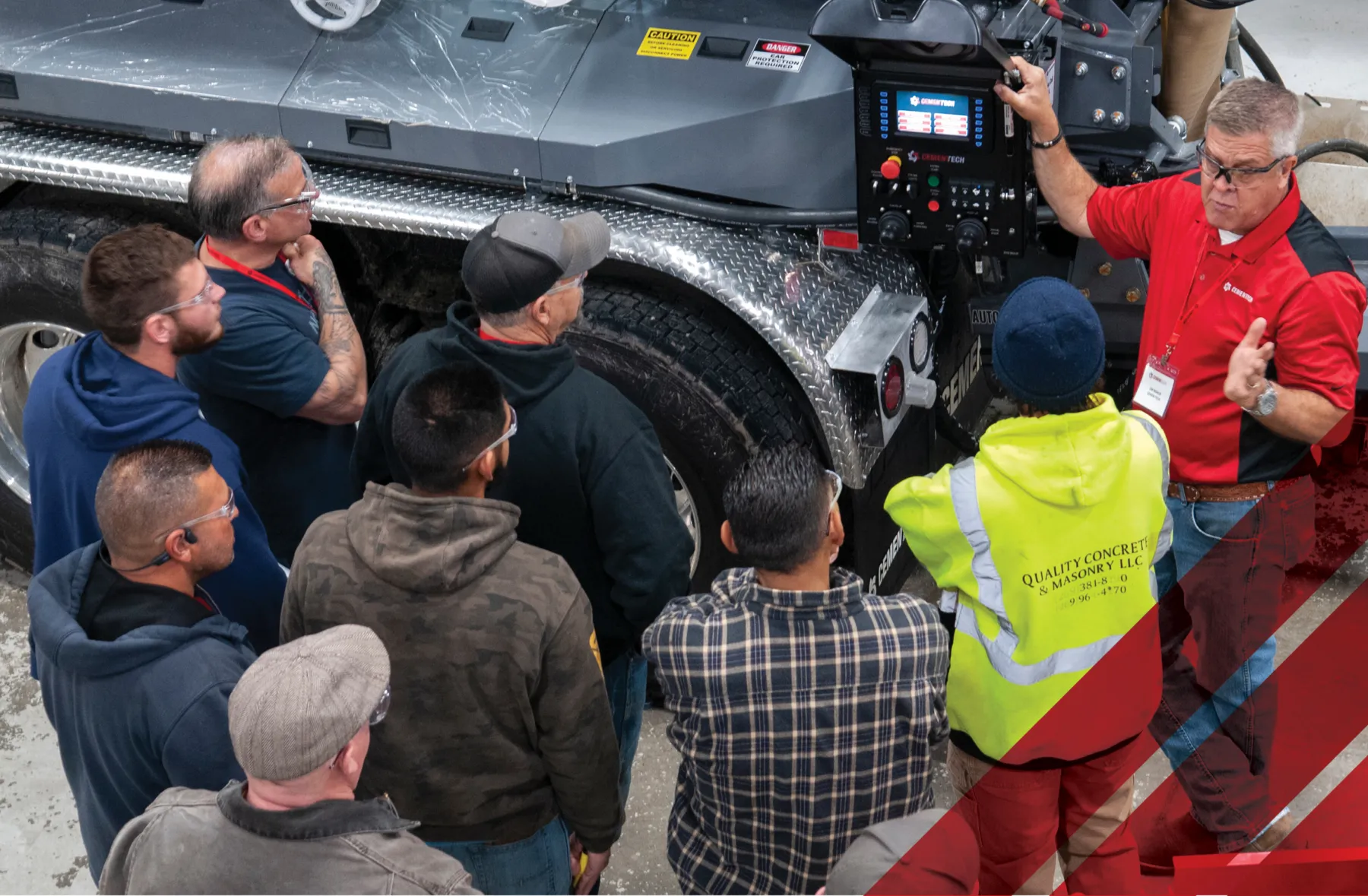
Training a new volumetric mixer operator typically takes 4 to 12 weeks of combined manufacturer training and supervised on-the-job experience before the operator can run independently. Manufacturer training (usually 1 to 2 weeks) covers the equipment fundamentals: controls, mix design entry, safety procedures, basic calibration, and routine maintenance. On-the-job mentoring with an experienced operator covers the operational judgment that only develops through actual production work: reading job site conditions, troubleshooting in real time, managing materials, and handling the customer-facing aspects of the job. The two components together produce competent operators; either alone produces incomplete operators.
Why Volumetric Mixer Operators Need Training
A volumetric concrete mixer is more complex than the ready-mix trucks most concrete operators are familiar with. The operator does not just transport the concrete; they actually produce it on-site, adjusting the mix in real time, meeting specifications, and handling the materials and equipment that make on-demand production possible. Putting an untrained operator behind the controls is one of the most expensive mistakes a contractor can make.
Concrete quality depends on the operator
A trained operator produces concrete that consistently meets the specified mix design, exposure class, and project requirements. An untrained operator can produce concrete that looks fine but tests low for strength, fails to bond properly, or otherwise underperforms the specification. The mistakes can be invisible until the concrete is in place and the problem has multiplied.
Safety depends on the operator
Volumetric mixers involve hydraulic systems under high pressure, electrical systems, mechanical components in motion, and the production of materials that can cause burns, eye injuries, or respiratory problems. Trained operators follow safety procedures that protect them, their crew, and the public around the work site. Untrained operators often cause the accidents that drive up insurance premiums and create liability exposure.
Equipment longevity depends on the operator
Trained operators treat the equipment correctly: proper warmup and cool-down, appropriate operating speeds, scheduled maintenance discipline, and recognition of developing problems before they become failures. Untrained operators wear out equipment faster, miss developing problems, and convert preventable maintenance into expensive repairs. Over a 15 to 20 year equipment life, the cumulative cost difference is substantial.
Customer relationships depend on the operator
The operator is often the customer-facing representative of the business. They arrive on the job site, interact with the customer’s crew, handle inevitable questions and minor issues, and represent the contractor’s brand. A professional, knowledgeable operator builds customer relationships that drive repeat business. A struggling or unprofessional operator drives customers away.
The Two Components of Effective Operator Training
Effective volumetric mixer operator development combines manufacturer technical training with on-the-job operational experience. Neither component alone produces competent operators; the combination is what works.
Component 1: Manufacturer technical training
Manufacturer training (typically 1 to 2 weeks for new operators) covers the equipment-specific knowledge that does not transfer from other concrete experience: how the controls work, how to enter and run mix designs, how the metering systems function, basic troubleshooting, safety procedures specific to the equipment, and routine maintenance the operator handles in the field.
Cemen Tech’s volumetric mixer training delivers this technical foundation for Cemen Tech equipment. The training is structured, time-bounded, and produces operators who understand the specific equipment they will run. It is the appropriate starting point for any new operator coming to Cemen Tech equipment.
Component 2: On-the-job mentoring
On-the-job mentoring (typically 4 to 8 additional weeks of supervised production work) covers the operational judgment that only develops through actual experience: reading job site conditions, adjusting to material variations, recognizing developing problems, managing the production rhythm to match the placement crew, handling customer questions and minor disputes, and the dozens of small decisions that experienced operators make automatically.
Effective on-the-job mentoring requires a qualified mentor (an experienced operator who can teach as well as do), supervised practice on real jobs, gradually increasing responsibility, and structured feedback. Just having a new operator ride along is not mentoring; it is unsupervised observation that may or may not produce useful learning.
Why both components matter
Operators who get manufacturer training without on-the-job mentoring know the equipment but lack operational judgment. They make textbook decisions that work in training but fail in real conditions. Operators who get on-the-job experience without manufacturer training develop habits that may work but include gaps in their understanding of why those habits work. They are less able to adapt when conditions change. The combination is what produces operators who can both execute and adapt.
A Realistic Operator Development Timeline
Realistic timelines help owner-operators plan for the actual work of bringing on a new operator. Compressed timelines produce undertrained operators; overlong timelines waste payroll. The right timeline depends on the trainee’s prior experience.
Weeks 1-2: Manufacturer technical training
The trainee attends manufacturer training, learns the equipment fundamentals, practices on training units, and returns ready to start supervised production work. The trainee has the technical foundation but no operational experience yet.
Weeks 3-6: Heavily supervised production
The trainee runs production work with an experienced operator alongside them at all times. The trainee does the work; the mentor provides immediate guidance, catches problems before they become mistakes, and gradually expands the trainee’s responsibilities. Customer-facing aspects of the job stay with the mentor in this phase.
Weeks 7-10: Lightly supervised production
The trainee runs production work independently for most of the day, with the mentor available by phone and on-site for specific situations. Customer-facing aspects of the job start transferring to the trainee under the mentor’s observation. Mistakes happen at this stage; the mentor reviews them with the trainee rather than just fixing them.
Weeks 11-12: Independent operation with monitoring
The trainee operates independently. The mentor reviews work performance, customer feedback, and any incidents. The trainee handles the full operator role including customer interaction, troubleshooting, and end-of-day reporting. After successful independent operation for several weeks, the trainee transitions to fully autonomous status.
Accelerated timelines for experienced concrete operators
A trainee with prior concrete equipment experience (ready-mix truck operator, batch plant operator, finisher with strong knowledge of concrete behavior) may compress this timeline meaningfully. Someone with zero concrete experience may need longer than 12 weeks. Match the timeline to the actual learning curve, not to a generic schedule.
What to Teach Beyond the Equipment
Equipment training is necessary but not sufficient. The full operator role includes responsibilities that go beyond the mixer itself. Effective training covers these dimensions explicitly rather than leaving them to chance.
Reading job site conditions. Site access, ground conditions, weather effects on the work, traffic management, and dozens of other site factors affect how the work goes. Operators need to assess these quickly and adjust their approach accordingly.
Understanding mix design and concrete behavior. Operators do not need to be concrete engineers, but they need enough understanding of how the mix design works to recognize when conditions require adjustment and to communicate intelligently with the customer’s placement crew.
Materials management. Cement supply, aggregate quality, water quality, and admixture handling all affect the concrete the operator produces. Trained operators monitor materials and recognize when something is off-spec before it shows up in the concrete.
Customer interaction. Concrete contractors are often working under stress, on tight schedules, with their own customers waiting. The operator who can stay calm, communicate clearly, and solve problems collaboratively builds relationships that drive repeat business.
Documentation discipline. For DOT work and major commercial projects, the operator is responsible for documentation that supports project acceptance. Skipping or sloppy documentation can produce major problems downstream. Training has to cover the why of documentation, not just the what.
Common Training Mistakes
Several recurring mistakes show up in volumetric operator training programs. Knowing them in advance helps you avoid them.
Compressing the timeline to save payroll
The most common mistake is releasing trainees to independent work too soon. Saved payroll in the training period gets erased many times over by the mistakes the undertrained operator makes once independent. A trainee who needs an extra month of supervised work and gets it produces better outcomes than a trainee who is pushed to independence too early.
Skipping manufacturer training
Some owner-operators decide they will train new operators themselves rather than sending them to manufacturer training. This usually does not work because the owner is busy running their own work and cannot dedicate the focused training time the trainee needs. Manufacturer training is a small investment that produces better operators than improvised in-house training.
Choosing a mentor based on availability rather than skill
The best operators are not always the best mentors. Mentoring requires patience, the ability to explain why things work, and the willingness to let the trainee make mistakes and learn from them. If your best operator is impatient or cannot articulate why they do what they do, they may not be the right mentor. Choose mentors based on teaching ability, not just operational skill.
Failing to give the trainee real responsibility
A trainee who only observes never develops independent judgment. Effective training requires the trainee to make decisions, including some that will turn out to be wrong. The mentor’s job is to catch the wrong decisions before they cause serious problems while letting the trainee experience the consequences enough to learn. Pure observation without responsibility produces operators who freeze when they have to act independently.
Building an Ongoing Development Culture
Initial training produces a competent operator. Ongoing development produces an excellent one. Operations that treat training as a one-time event get operators who plateau at competent. Operations that build ongoing development into the work get operators who keep improving for years.
Regular skills updates. Equipment evolves, mix designs change, project requirements shift. Operators benefit from periodic refreshers that update their knowledge to current practice. Many manufacturers offer continuing education and update training for existing operators.
After-action reviews. After significant jobs (especially difficult ones), discuss what worked, what did not, and what the team learned. The conversation matters more than the outcome of any individual job; it is how the operator develops judgment over time.
Cross-training across the operation. Operators who understand the rest of the business (sales, dispatch, materials supply, accounting) make better decisions in the field. Cross-training takes time but produces operators who can solve problems collaboratively rather than just executing instructions.
Recognition and advancement. Good operators are valuable. Operations that recognize their value, pay competitively, and offer advancement paths retain operators longer. Operator turnover is expensive in training cost, productivity loss, and customer relationship disruption.

How long does it take to train a volumetric concrete mixer operator?
Typical training timelines run 4 to 12 weeks combining manufacturer technical training (1 to 2
weeks) with supervised on-the-job experience (4 to 8 additional weeks). Trainees with prior concrete
equipment experience may compress this timeline. Trainees new to concrete may need longer. Match
the timeline to the trainee’s actual learning curve, not to a generic schedule.
Do I need to send my operator to manufacturer training?
Manufacturer training is the most efficient way to teach the equipment-specific knowledge that
does not transfer from other concrete experience: controls, mix design entry, metering systems, safety
procedures, and routine maintenance. Most owner-operators find manufacturer training produces
better outcomes than improvised in-house training. Cemen Tech offers volumetric mixer training
through its service support program.
Can I train a new operator myself?
Possibly, but most owner-operators find it does not work well. Owners are typically too busy
running their own work to provide the focused training time a new operator needs. Manufacturer
training combined with on-the-job mentoring usually produces better operators in less time than full
in-house training, and at lower total cost when you account for the owner’s opportunity cost.
What should I look for in a good volumetric mixer operator trainee?
Strong candidates have prior concrete or construction experience, mechanical aptitude, attention
to detail, comfort with customer interaction, and the temperament to handle pressure on tight
schedules. Pure mechanical ability without people skills produces operators who struggle with
customer-facing aspects. People skills without mechanical aptitude produces operators who damage
equipment. Look for balance.
How do I keep good operators?
Operators stay when they are paid competitively, recognized for their work, offered advancement
paths, and treated as professionals. Operations that treat operators as interchangeable see high
turnover and the associated training costs. Operations that invest in operator development through
continuing education, after-action reviews, and cross-training retain operators longer and get better
performance.
Next Steps
- For manufacturer training on Cemen Tech equipment: Volumetric mixer training provides the technical foundation new operators need before starting on-the-job work.
- For ongoing support: Technical support via video call connects operators with Cemen Tech expertise for questions that come up during the work.
- For ongoing maintenance training: Operators benefit from understanding the maintenance schedule well enough to perform daily and weekly maintenance correctly.
- Talk to a representative: For specific training questions or to schedule training for your operators, contact a Cemen Tech rep for a no-pressure conversation.