
 English
 Español
 Français
 Deutsch
 Polski
 Nederlands
Volumetric Mixers for Tunnel and Underground Construction
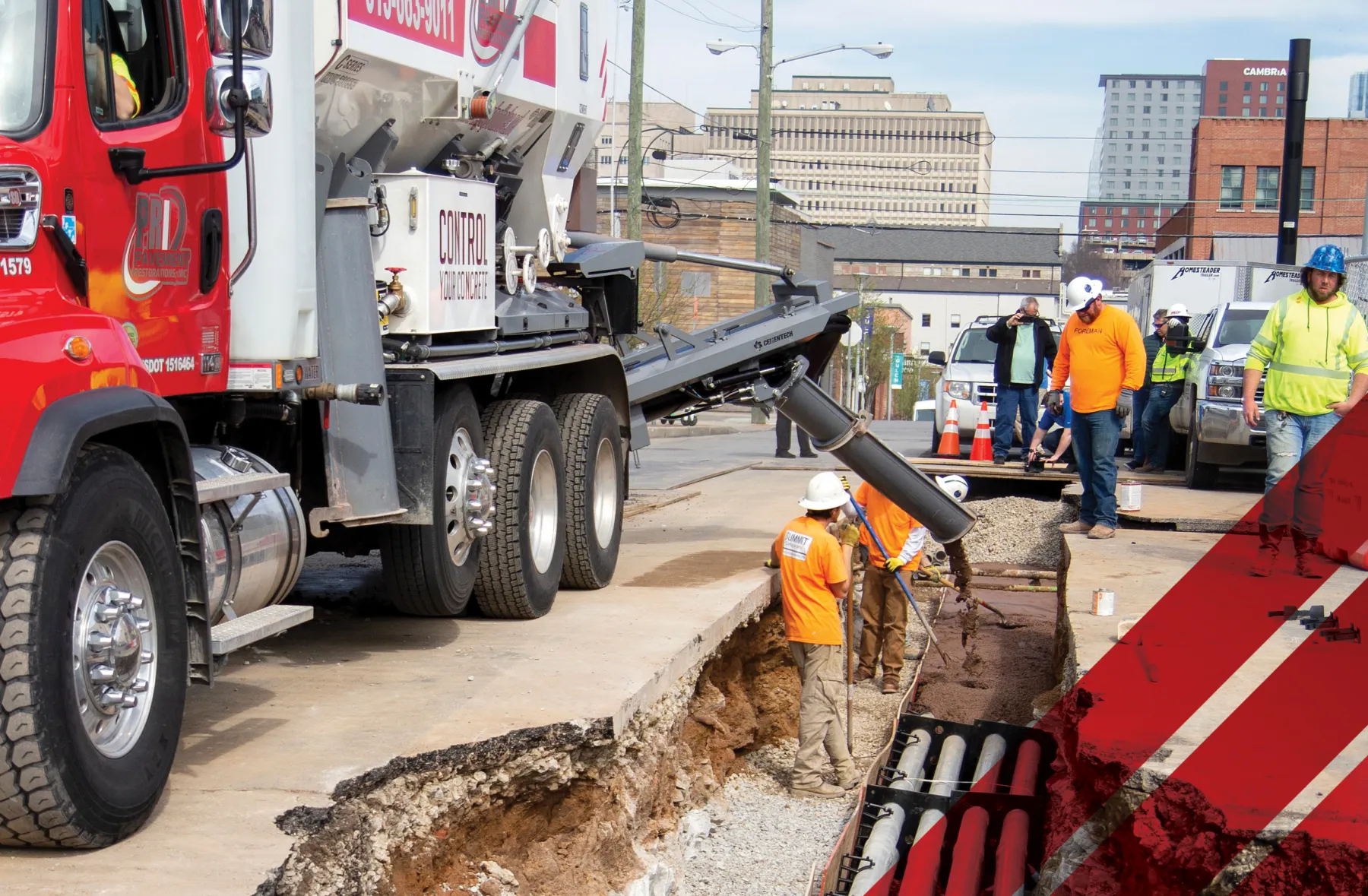
Volumetric concrete mixers are well suited to tunnel and underground construction because they produce concrete on-site under conditions where ready-mix delivery is difficult or impossible. Tunnel work involves restricted access, continuous pour requirements, ventilation constraints, and the need to coordinate concrete production with excavation, support installation, and other ongoing operations in a confined space. Volumetric mixers eliminate delivery timing risk, allow on-site mix adjustments for specific tunnel applications, and reduce the waste and disposal challenges that returned-load concrete creates in underground environments where every cubic yard of excavated and
produced material has to be carefully managed.
Why Tunnel and Underground Work Demands Different Concrete
Logistics
Above-ground concrete projects have flexibility that underground projects do not. Ready-mix trucks can come and go, returned loads can be redirected, and the work site can accommodate fleet operations. Tunnel and underground construction operates under constraints that change the math on concrete logistics entirely.
Access constraints
Tunnel work happens at the end of a long, restricted access path. Materials come in through a limited number of access points (portals, shafts, or vertical access from surface). Ready-mix delivery to deep tunnel locations is often impractical because the truck cannot reach the work face or because the time from batch plant to placement exceeds the concrete’s workability window. A volumetric mixer that can be positioned at the access point or moved along the tunnel produces fresh concrete exactly where it is needed.
Continuous pour requirements
Many tunnel concrete operations (invert slabs, tunnel lining sections, support structures) require continuous pours that cannot tolerate interruptions. A pause for the next ready-mix truck to arrive can create a cold joint, compromise the concrete’s monolithic integrity, and create a weak point in a structure that may have to last for decades. Volumetric mixers produce concrete continuously as long as materials are loaded, eliminating the delivery-driven interruptions that fixed-batch logistics impose.
Ventilation and environmental conditions
Tunnel environments have specific ventilation requirements driven by OSHA standards for underground construction and by the operating limits of equipment, workers, and concrete itself. Diesel-powered ready-mix trucks add to ventilation load every time they enter the tunnel. Volumetric mixers stationed at the portal or strategically positioned reduce the number of vehicle movements into and out of the working zone, which has real implications for ventilation system load and crew safety.
Materials management in confined spaces
Excavated material removal and concrete delivery share the same access infrastructure in most tunnel projects. Every cubic yard of returned-load concrete from a ready-mix truck has to be hauled back out the access path, often along with excavated muck. Volumetric mixers that produce only what is needed avoid this entirely. There is no returned-load disposal problem because there is no returned load.
Where Volumetric Concrete Fits in Tunnel Construction
Tunnel construction involves multiple concrete applications, and not every one is volumetric territory. Understanding where volumetric concrete fits, and where other equipment is the right tool, helps with project planning and equipment selection.
Tunnel invert and floor slabs
The invert slab (the floor of the tunnel) is often a primary volumetric application. The pour can be substantial, the placement requires steady supply, and the mix specification may need adjustment based on substrate conditions found during construction. A volumetric mixer positioned for invert pours allows continuous production matched to the placement rate.
Tunnel lining sections
Cast-in-place tunnel lining (where used instead of segmental precast lining) is another volumetric application. Lining pours require careful control of the mix to achieve specified strength and durability, and the placement rate often dictates the production rate. Volumetric mixers handle this work well because the mix can be adjusted during the pour and production runs as long as needed.
Cross passages, niches, and support structures
Tunnels include many smaller concrete elements: cross passages between adjacent tunnels, electrical and mechanical niches in the lining, support pads for equipment, and miscellaneous structural elements. These smaller pours are particularly well suited to volumetric mixers because the production volume matches the placement need precisely. No returned-load waste from oversized ready-mix deliveries.
Mix Design Considerations for Underground Concrete
Underground concrete operates in environments that affect the mix design choices. Temperature, humidity, ground conditions, and the specific structural role all influence what the concrete needs to do and how it should be mixed.
Temperature and curing
Tunnel environments often have stable temperatures that differ significantly from surface conditions. Deep tunnels can be warm year-round; shallow or recently excavated sections can be cool and damp. ACI 306 (cold-weather concreting) and ACI 305 (hot-weather concreting) provide guidance, but tunnel conditions often fall in a middle zone that affects curing rate and final strength development. The mix design should account for actual placement conditions, not surface assumptions.
Groundwater and substrate moisture
Many tunnels carry water inflows that affect concrete placement. Mix designs may need to incorporate additional admixtures for placement against wet substrates, or shotcrete may be used to control inflow before final concrete placement. Volumetric mixers allow real-time adjustment of admixture dosing as conditions change during the pour.
Strength specifications and exposure class
Tunnel structural concrete typically follows ACI 318 strength and durability requirements, with the exposure class determined by the specific tunnel environment (chloride exposure from de-icing in road tunnels, sulfate exposure in some geologic conditions, freeze-thaw cycling in shallow tunnels in cold climates). The mix design has to match the specified exposure class, and the volumetric mixer needs to be calibrated to produce that mix accurately.
Aggregate and admixture considerations
Tunnel concrete often uses specific aggregates and admixture combinations selected for the underground environment: low-alkali cements where ASR-susceptible aggregates are present, supplementary cementitious materials for sulfate resistance or chloride permeability reduction, water-reducing admixtures for pumpability over distance. Volumetric mixers can accommodate these specifications when the unit’s metering systems are configured for the materials involved.
Project Planning for Underground Concrete Work
Tunnel and underground concrete projects involve planning steps that surface concrete projects do not require. Building these into the project from the start avoids the late-stage scrambles that drive cost overruns.
Access and positioning planning
Where will the volumetric mixer be positioned? How will it be moved as the work progresses? How will raw materials (cement, aggregate, water) be delivered to the mixer location? These logistical questions have answers that affect equipment selection, crew planning, and the project schedule. Larger tunnel projects sometimes use multiple mixers positioned at different points along the work face.
Ventilation and air quality coordination
The tunnel ventilation plan has to accommodate the mixer operations. Diesel-powered equipment in the tunnel adds to the ventilation load, and concrete operations themselves can release water vapor, dust, and admixture vapors that affect air quality. Project planning should coordinate concrete operations with overall tunnel ventilation capacity.
Documentation and inspection access
Federal tunnel projects (and many state DOT tunnel projects) require detailed concrete placement documentation that can be inspected during and after the work. Modern volumetric mixers generate batching records and digital tickets that satisfy these requirements, but the inspection workflow has to accommodate the tunnel environment. Plan how inspectors will access the placement records and the concrete itself for testing.
Coordination with excavation and support work
Concrete placement in tunnels happens around active excavation, ground support installation, and other operations. The concrete pour schedule has to integrate with the rest of the tunnel construction sequence. Volumetric mixing helps here because the production rate can match the placement rate, which often depends on the rate of the surrounding work rather than on a fixed concrete delivery schedule.
Equipment Considerations for Tunnel Work
Tunnel applications place specific demands on volumetric mixers. Buyers and project planners selecting equipment for this work should evaluate units against these criteria.
Mobility within constrained spaces. The mixer needs to fit through the access infrastructure and operate in the available work zones. Compact and trailer-mounted units often fit tunnel applications better than the largest commercial units. Match the equipment to the access constraints.
Reliable performance under sustained operation. Tunnel pours often run long. The mixer needs to operate reliably for extended periods without the kind of downtime that would stall the work face. Well-maintained units with strong parts availability matter more here than in less demanding applications.
Mix flexibility for specialty designs. Tunnel concrete often uses specialty mixes (low-alkali, SCM-blended, admixture-heavy). The mixer needs to accommodate the specified materials and produce them accurately. Confirm the unit’s metering systems can handle the specific materials in the project specification.
Documentation systems. For DOT, federal, or large infrastructure tunnel projects, the mixer’s documentation capabilities (batching records, digital tickets, calibration history) need to satisfy the project’s documentation requirements.
Service and support reach. A tunnel project mid-pour cannot easily wait for a service visit. Equipment from manufacturers with strong dealer service networks in the project region is the safer choice, even if other equipment options exist at lower upfront cost.

Can volumetric concrete mixers be used in tunnel construction?
Yes. Volumetric mixers are well suited to tunnel work because they produce concrete on-site
under access constraints that make ready-mix delivery impractical. They support continuous pours,
allow real-time mix adjustments, eliminate returned-load waste, and reduce vehicle traffic in the tunnel
environment. Common applications include invert slabs, lining sections, and smaller structural pours.
What is the difference between volumetric concrete and shotcrete in tunnel work?
Volumetric concrete is placed by traditional methods (pumping, chuting, or bucketing) for structural
elements like invert slabs and lining sections. Shotcrete is pneumatically applied for ground support,
rock stabilization, and initial tunnel lining. Both have roles in tunnel construction; they are not
interchangeable. The choice depends on the specific application within the project.
What ACI standards apply to tunnel concrete?
ACI 318 covers structural concrete design and durability requirements, with the exposure class
selected for the specific tunnel environment. ACI 305 (hot-weather concreting) and ACI 306
(cold-weather concreting) provide placement guidance. ACI 506 covers shotcrete placement
separately. The specific standards depend on the application and the project specification.
How do volumetric mixers handle tunnel ventilation constraints?
Volumetric mixers stationed at portals or positioned strategically within the tunnel reduce the
number of diesel-powered vehicle movements into the working zone, which helps ventilation load. The
mixer itself uses less fuel per cubic yard than the equivalent ready-mix delivery cycle, further reducing
ventilation system demand. OSHA underground construction standards (29 CFR 1926 Subpart S)
govern the overall ventilation requirements.
What size mixer is best for tunnel work?
Tunnel work generally favors compact and mid-range mixers that can navigate access constraints
and operate within work zone dimensions. The largest commercial mixers are often impractical in
tunnel environments. The right size depends on the specific tunnel dimensions, the access
infrastructure, and the production rate required. Trailer-mounted units sometimes work well for tunnel
positioning flexibility.
Next Steps
- Explore applications: Cemen Tech’s volumetric mixer applications page covers the range of project
types these mixers serve. -
See the equipment lineup: Cemen Tech’s equipment lineup includes units sized and configured for
infrastructure work, including tunnel applications. - For gunite and shotcrete work: See the G30X gunite mixer for dedicated gunite applications.
-
Talk to a representative: For specific tunnel project questions or equipment selection guidance,
contact a Cemen Tech rep for a no-pressure conversation.